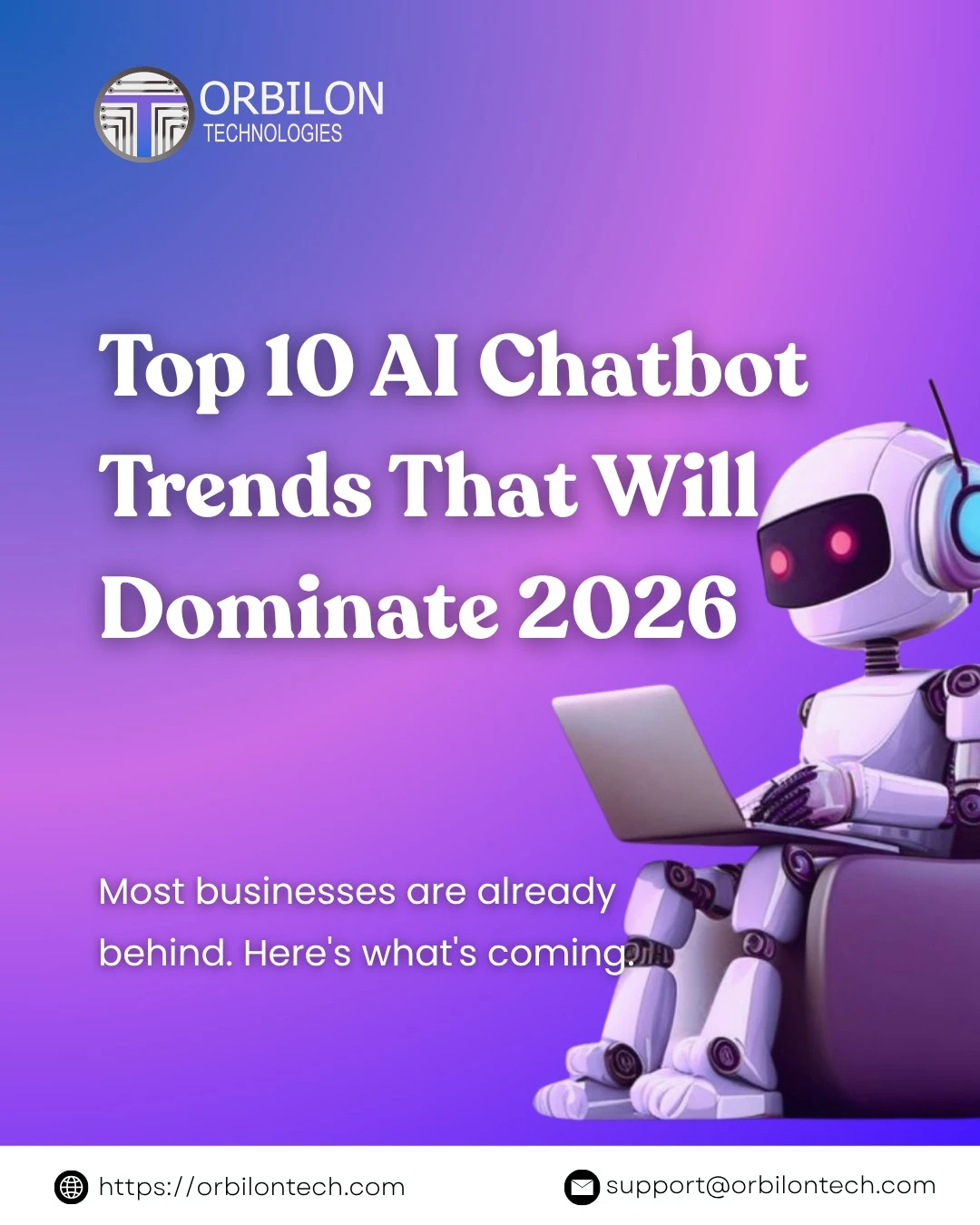
Top 10 AI Chatbot Trends That Will Dominate 2026
Introduction
About 987 million people are using AI chatbots around the world. The worldwide market for these chatbots has exceeded $11 billion. Companies that have implemented chatbots are reporting a return of $8 for every $1 they spent on chatbot implementation. Furthermore, 91% of enterprises with more than 50 employees have introduced chatbots at least at one point in their customer journey. If you still consider chatbots as just a “nice-to-have” in 2026, then you are not early but rather late.
The AI chatbot trends 2026 will bring changes that are not just small improvements. There will be big changes in the way chatbots think, act, and provide value. For example, an agentic execution that can replace whole workflows, voice-first interactions, multimodal intelligence, etc., the chatbot you installed in 2023 has already become old-fashioned.
So, here are the 10 new AI chatbot trends that are already changing the landscape – and how each one impacts your business.
The Market Snapshot: AI Chatbot Trends 2026 by the Numbers
| Metric | 2026 Data |
|---|---|
| Global AI chatbot market | $11 billion+ |
| Generative AI chatbot segment | $12.98–$13.19 billion |
| Conversational AI market | $17.97 billion |
| Growth rate (CAGR) | 23.3–28.5% |
| Global chatbot users | 987 million |
| Enterprise adoption (50+ employees) | 91% |
| Fortune 500 using LLMs | 92% |
| SMBs planning adoption by the end of 2026 | 64% |
| Enterprise apps embedding AI agents | 40% (Gartner) |
| Average ROI per $1 invested | $8 return |
| Customer service cost reduction | 30–60% |
| Contact center savings projected | $80 billion (Gartner) |
1. From Chatbots to Agentic AI: The Biggest Shift
What’s very likely, and the principal reason for the AI chatbot trend in 2026, is that the capacity of chatbots is being extended from just responding to queries to agentic AI systems.
Chatbots that are very traditional stay on call and reply. Agentic chatbots not only plan, decide, execute, and adapt, but also can autonomously work through multi-step workflows across different systems. Rather than just replying to “What’s my order status?” by retrieving a tracking number, an agentic chatbot can realize that a shipment is delayed, inform the customer, give a discount or reship offer, make the adjustment in the ERP, and update the CRM – all without any human intervention.
Gartner says that by the end of 2026, 40% of enterprise applications will have task-specific AI agents embedded in them, compared to less than 5% in 2025. Databricks reveals that the use of multi-agent systems grew by 327% within only 4 months. This is not an update of a feature – it is the emergence of a new category.
What it could mean for you: If you have a chatbot that only responds to inquiries, you are operating on 2023 technology. The benchmark for 2026 will be chatbots that are capable of completing tasks from start to finish.
2. Voice-First Conversational AI Goes Mainstream
Text chatbots are table stakes. The explosive growth in voice AI in 2026 is pushing chatbots into phone-first, voice-first experiences. The number of voice assistant users in the US alone is projected to reach 157.1 million by 2026.
AI voice agents now handle natural phone conversations with sub-500ms response times, interrupt detection, and emotion recognition. Platforms like Vapi, ElevenLabs, and RingCentral AIR enable businesses to deploy AI phone agents that answer calls, qualify leads, and book appointments — sounding indistinguishable from human receptionists.
RingCentral’s AI Receptionist now serves over 8,300 businesses, growing 44% quarter-over-quarter. The cost? As low as $0.20 per call versus $7–12 for a human agent.
What it means for you: Your chatbot strategy needs a voice channel. Customers increasingly expect to call a number and have an intelligent conversation — not press buttons on an IVR menu.
3. Multimodal Chatbots: Beyond Text and Voice
A primary powerful trend in AI chatbots in 2026 will be that they are multimodal, i.e., capable of understanding and producing text, images, video, audio, and code at the same time.
Gartner forecasts that 40% of generative AI products will be multimodal by 2027. However, the transition is quite advanced already. This will allow, for instance, a customer to take a photo of a broken item, send it to a chatbot, and get a visual repair manual or a replacement offer in the blink of an eye. A patient can show a skin problem through a live camera, and the doctor will do the preliminary check. A customer logs in to send verbal instructions to a bot for making the slide presentation output.
OpenAI’s Operator, Claude’s computer use capabilities, and Google Gemini’s inherent multimodality are paving the way for image understanding, video analysis, and multimodal reasoning to become standard chatbot features as opposed to being premium add-ons.
What is it going to mean for you? Developing conversational AI able to see, listen, read, and not just reply to texts. Sectors such as healthcare, retail, real estate, and insurance will be able to reap huge benefits from the visually-driven AI interactions.
4. Hyper-Personalization Through Real-Time Data
Generic chatbot responses are becoming obsolete. The 2026 standard involves hyper-personalization chatbots accessing customer history, purchase patterns, browsing behavior, and CRM data in real time to deliver contextually relevant interactions.
Nowadays, chatbots connected via MCP (Model Context Protocol) and API integrations can pull data from Salesforce, HubSpot, Shopify, and internal databases, even during the conversation, instantly adapting the responses to the individual customer’s context. The effect on conversion is very great.
Businesses that provide personalized chatbot experiences have reported a 20-35% increase in conversion rates and a lot higher customer satisfaction scores. When a chatbot is aware of your name, purchase history, and preferences, it ceases being just a bot and starts being like a knowledgeable concierge.
What it means for you: Integrate your chatbot with your CRM and customer data platform. Personalization is not just a nice-to-have anymore; customers expect it.
5. RAG-Powered Accuracy: The End of Hallucinations
One of the greatest obstacles to enterprises adopting chatbots has been instances of hallucinations where AI gives wrong answers with confidence.
Retrieval-Augmented Generation (RAG) is bringing large-scale solutions to this issue. With RAG-based chatbots, the relevant information is first sought in your knowledge base, documentation, and databases, and only then does the generation of a response take place.
The proposed efficiency: 95 to 98% accurate answers with near-zero hallucination rates, according to the benchmarks of enterprise deployments. Such a model is a stark contrast to a base LLM that merely generates answers from the training data. For sectors where accuracy is a must and deviations from the truth can lead to dire consequences, such as healthcare, legal finance, insurance, government, RAG changes, and chatbots, from a mere risky experiment to a fully-fledged production system that can be entrusted with the responsibility. Each response can be traced, cited, and validated.
What it implies for you: If you are choosing to deploy chatbots in regulated industries or high-stakes environments, then a RAG setup is your only way. It is like the difference between a chatbot that the compliance team gives a green light to and one that they ban.
6. Chatbots as Revenue Drivers, Not Just Cost Centers
The story is changing. Updates on AI chatbot trends 2026 indicate that more and more companies consider chatbots as a means of generating revenue rather than just a way to reduce overhead.
Actually, according to the figures, companies experience an average 340% ROI in their first year from chatbot technology usage. 8 out of 10 sales and marketing departments have included chatbots in their workflow. Conversion rates through AI-based chatbots in e-commerce are said to grow by 20 to 35% due to features like instant product suggestion, recovery of a customer who abandons their shopping cart, and customers’ proactive engagement.
Besides the per-interaction cost going down from about $6.00 (human agent) to $0.50 (AI chatbot), the main thing is still revenue capture. Chatbots running round the clock, at the time/highest energy/engagement moment) website visitors and qualifying leads in real-time are generating revenue that human teams would miss entirely during off-hours.
What it means for you: Ditch the old goal of ticket deflection through chatbots. Instead, focus on the measurement by leads, deals, and revenue, etc. After-hours effects are also very important.
7. Autonomous Customer Service: The 80% Automation Threshold
AI chatbots in 2026 have evolved to independently deal with up to 80% of customer inquiries, made up of simple and very usual requests, without a human being involved. The other 20% is dealt with by live agents who get fully briefed with the customer’s history at the time of interaction, making the human part of the interaction much quicker and of better quality.
Great systems manage to get 92% customer satisfaction rate and still very rarely involve humans. NIB Health Insurance, for example, has. Besides that, they have documented 60 percent cost reductions and 22 million dollars in savings through smart chatbot deployment.
The main factor is smooth escalation. When the AI gets the message that the user is confused, irritated, or that the issue is complex to it, then it passes the conversation to an agent – providing the entire chat history, customer profile, and AI-suggested solution along with it. The customer does not have to explain their case again.
Here is what that implies for you: Remember to prepare the switch. A good sharing between AI and humans is 80/20, which is where the majority of 2026 successful deployments end up. Complete automation without a human available for the case is a failure. On the other hand, human-only support without AI is expensive.
8. Industry-Specific Chatbots: Vertical AI Takes Over
The generic, one-size-fits-all chatbots are gradually being replaced by the industry-specific AI that, in a way, “speaks” the language of different sectors.
- For instance, the healthcare sector: Chatbots capable of going through multimodal analysis and diagnosing with 79.6% accuracy, as well as being HIPAA-compliant with patient intake, scheduling appointments, and managing prescriptions- the healthcare chatbot market alone is expected to reach $543.65 million in 2026.
- E-Commerce & Retail: The biggest adopters with 21.2% market share. Chatbots are used for product discovery, cart recovery, order tracking, returns, and personalized recommendations. AI shopping assistants are used instead of just support bots.
- Financial Services: Second-highest adoption. Chatbots are capable of processing loan applications, explaining financial products, confirming identity, and handling transaction disputes with compliance frameworks requiring audit trails.
- Legal: AI chatbots prepare initial legal intake documents, summarize case law, review contracts, and qualify potential clients, thereby lowering law firm intake expenses by over 60%.
What it means for you: Either pick or develop a chatbot that suits the specific workflows, terminology, and compliance requirements of your industry. Generic solutions perform very poorly compared to domain-specific ones.
9. Ethical AI and Regulatory Compliance Become Non-Negotiable
With the EU AI Act fully implemented and similar legislation surfacing worldwide, the patterns of AI chatbot trends towards 2026 indicate that ethics and compliance will shift from being “nice-to-have” to essential parts of the infrastructure.
Currently, 69% of CX executives have a plan for the ethical use of AI. More and more enterprise chatbot launches are calling for transparency disclosures (informing customers that the person they are interacting with is a machine), creating an audit trail for every AI decision, bias checking, data privacy controls, and human oversight mechanisms.
According to Gartner, by 2026, 70% of organizations will have an AI governance framework in place. Chatbots without governance are not only risky, but in regulated industries, they might be considered illegal under new AI laws.
What this means for you: Make chatbot governance a part of their DNA from the first day. Being transparent, auditable, and under human control are not just embellishments but fundamental architectural requirements.
10. The Platform War: ChatGPT's Grip Slips as Competition Explodes
The last major trend contributing to the rise of AI chatbots in 2026 is the competitive reshuffling. While ChatGPT was dominating the market with 87% share, it has now decreased to 64-68% as competitors have made significant progress and are becoming a threat. The market share of Google Gemini has rocketed to 18.2%. Furthermore, Claude Perplexity and certain vertical chatbots are in areas that generic solutions cannot satisfy.
From a business perspective, you will have more options, get better deals, and will be able to choose models designed for specific uses rather than default to one provider. The most intelligent uses of AI in 2026 will be combining multiple models: Claude for a deep understanding of documents, GPT for the generation of creative content, Gemini for tasks involving multiple modes, and fine-tuned open-source models for industry-specific requirements.
What it implies for you: Avoid tying yourself down to one single AI supplier. Code your chatbot design with the consideration of model flexibility – thereby allowing you to replace the models as the market changes in the competition.
How to Act on These AI Chatbot Trends 2026?
If your business is one of those without an AI chatbot, then you are probably already among a very small minority – in fact, 91% of companies with 50+ staff have one. Besides, if you put one into service last year or this year, chances are it is not really up to date. So here is what you should do –
If you have not started yet: Get your chatbot installed on your company’s website and phone system within a month. Initially, focus on customer service and lead qualification – these are the areas where the ROI has been very frequently demonstrated and is almost immediate. The tools have become so user-friendly even for small and medium-sized enterprises, and 64% of the small businesses intend to have one by 2026.
If you already have a very basic chatbot: Make it agentic. Do that by linking it up with your CRM, calendar, and payment systems so it will be able to act – not just answer. Besides, incorporate RAG (Retrieval-Augmented Generation) for better accuracy. Give it voice capability in order to cover the phone calls.
If you happen to run enterprise AI, Work on the governance aspect, multimodal capabilities, and multi-agent orchestration. All AI chatbot trends point towards 2026, where the systems will go hand in hand rather than isolated bots deployed in silos.
Conclusion: Most Businesses Are Already Behind
The AI chatbot trends 2026 have brought aren’t future predictions — they’re current deployments. 987 million users. $11 billion market. $8 return per $1 invested. 91% enterprise adoption. These are today’s numbers.
The businesses that act on these trends — deploying agentic chatbots, adding voice, going multimodal, personalizing with real-time data, governing with compliance-first architecture — will operate faster, cheaper, and closer to their customers than competitors still running 2023-era FAQ bots.
The chatbot era isn’t coming. It’s here. And it’s moving without you.
About Orbilon Technologies
Orbilon Technologies is a leading AI development company focused on creating intelligent chatbots and conversational AI systems. Our range of offerings includes tailor-made agentic chatbots, voice AI agents, RAG-based knowledge bots, and top-notch enterprise AI solutions. With our decade-long experience complemented by an impressive average rating of 4.96 on Clutch, GoodFirms, and Google, we have been successful in helping businesses leverage AI chatbots to drive revenue, reduce costs, and deliver outstanding customer experiences.
If you are planning to build an AI chatbot that genuinely contributes to your business, get in touch with our conversational AI team and have a free consultation.
- Website:orbilontech.com
- Email: support@orbilontech.com
Want to Hire Us?
Are you ready to turn your ideas into a reality? Hire Orbilon Technologies today and start working right away with qualified resources. We will take care of everything from design, development, security, quality assurance, and deployment. We are just a click away.