
AI Agents Are Replacing SaaS Tools. Here's What That Means for Your Stack?
Introduction
In February 2026, approximately $285 billion in market value vanished from software stocks in a single trading session. ServiceNow dropped 7%. Salesforce fell 7%. Intuit plummeted 11%. Thomson Reuters collapsed nearly 16%. LegalZoom sank almost 20%.
The catalyst wasn’t a recession or a regulatory crackdown. It was AI agents replacing SaaS tools— and investors recognizing that the per-seat subscription model powering a $300 billion industry for two decades is breaking.
Companies are moving from “one tool per task” to “one agent per outcome.” Instead of buying separate subscriptions for project management, CRM, email marketing, customer support, and analytics, businesses are building multi-step AI agents that handle entire workflows across systems autonomously. The SaaS model is being disrupted, fast.
This isn’t a prediction. It’s happening right now. Here’s what it means for your tech stack, your budget, and how you build software going forward.
The SaaSpocalypse: What Actually Happened
The term “SaaSpocalypse” emerged in early 2026 after Anthropic released enterprise plugins for Claude Cowork on January 30 — tools that let non-developers automate entire business workflows previously requiring 5-10 separate SaaS subscriptions. Within 48 hours, investors repriced the entire software sector.
The trigger wasn’t theoretical AI potential. It was a specific realization: when one employee equipped with AI agents can accomplish the work of five, the per-seat pricing model collapses. Companies don’t need 50 Jira seats when an AI agent handles task tracking. They don’t need 20 Mailchimp seats when an AI agent writes, personalizes, sends, and optimizes email campaigns autonomously.
Publicis Sapient is already reducing traditional SaaS licenses by approximately 50% — including major platforms like Adobe — substituting them with generative AI tools. A Databricks 2026 survey found multi-agent system usage spiked by 327% over just four months. And Gartner predicts that 35% of point-product SaaS tools will be replaced by AI agents by 2030.
The evidence of AI agents replacing SaaS tools isn’t in analyst reports anymore. It’s in quarterly earnings calls where software companies explain why growth is slowing.
Why the Per-Seat Model Is Breaking?
The SaaS business model was built on a simple equation: more employees using software = more revenue. Per-seat pricing worked beautifully when every new hire needed their own login, dashboard, and license.
AI agents invert this equation entirely:
| Traditional SaaS Model | AI Agent Model |
|---|---|
| Pay per seat (more users = more cost) | Pay per outcome (more results = more value) |
| One tool per function (CRM, email, PM, support) | One agent orchestrates across all systems |
| User navigates the software | Agent navigates the systems for you |
| Humans trigger every action | The agent acts autonomously toward goals |
| Value = access to features | Value = tasks completed |
| Scales by adding headcount | Scales by adding agents |
When AI makes one person as productive as five, the company doesn’t need five seats. Revenue per customer drops. Growth stalls. Valuations compress. This is exactly what happened in Q4 2025 and Q1 2026 earnings for multiple SaaS companies — not because AI failed, but because it succeeded too well at making their customers more efficient.
Which SaaS Categories Are Most Vulnerable?
Not all software indeed faces the same amount of risk. What really sets them apart is whether a product’s main role is something that has to be exact and perfect every single time—we call that a “deterministic” task—or if it involves making judgments, estimates, or creating content, making it “probabilistic.” When AI programs start looking to replace the SaaS tools we use, they usually go after these probabilistic kinds of work first.
i. High Risk — AI Agents Already Replacing These
- Project management tools like Asana, Monday, and Jira for basic tracking – AI agents are capable of creating tasks, assigning work, tracking progress, and sending updates, even without a dedicated PM tool. It is worth mentioning that Atlassian’s share price dropped 35% due to the SaaSpocalypse.
- Email marketing platforms (Mailchimp, ActiveCampaign) – AI agents can write campaigns, segment audiences, schedule sending, carry out A/B testing, and optimize – in fact, the workflow of email marketing is almost fully automatable.
- Basic CRM data entry – AI agents can make calls, update records, score leads, and manage pipeline data without the need for humans to manually enter information. These become the most time-consuming aspects of CRM, and agents can handle them naturally.
- Customer support triage – AI agents review, route, and solve level-1 support tickets. A core workflow for Intercom is very likely a candidate for agent automation.
- Content creation – AI generates product descriptions, social media posts, advertisements, draft blogs, and video scripts. The “content-creating SaaS” category is under pressure from commoditization.
ii. Lower Risk — SaaS Products That Survive
- Systems of record (core ERP, HRIS, and accounting systems). These are the ones that call for absolute accuracy of results. For example, it’s a big mistake if payroll is incorrect even only 4 times out of 10. So the AI agents are usually designing orchestration layers atop such systems rather than totally replacing them.
- Compliance and regulatory platforms, for things like audit trails, legal documents, and regulatory reporting, require a high level of accuracy with a certain guarantee. Probabilistic AI models alone cannot deliver that kind of accuracy nowadays.
- Deep data moat products, SaaS tools carrying multiple years of proprietary customer data, network effects, and deeply embedded integrations (Salesforce CRM data, Stripe payment infrastructure) have their own strong advantages that agents may not be able to easily replicate.
The New Architecture: Agent-First Stacks
The shift from AI agents replacing SaaS tools to AI agents becoming the stack follows a clear architectural pattern. Bain & Company describes it as a three-layer model:
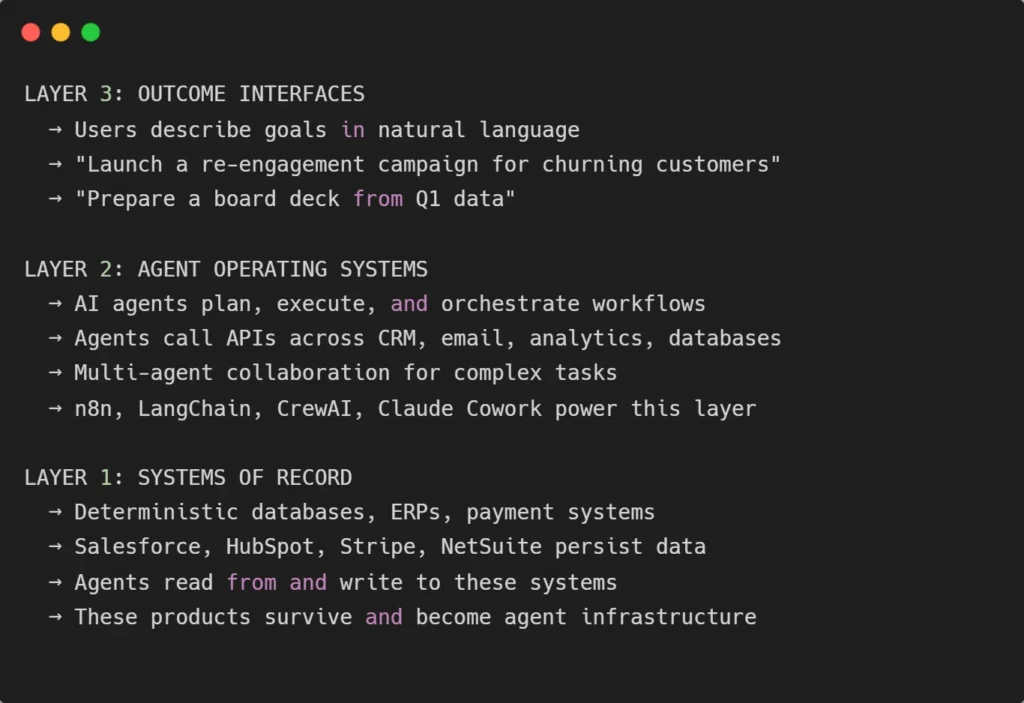
In this model, the middle layer — the agent operating system — replaces dozens of point-solution SaaS tools. Instead of paying for Mailchimp (email), Intercom (support), Asana (PM), Jasper (content), and Mixpanel (analytics) separately, a single agent layer orchestrates all these functions by connecting directly to your systems of record via APIs.
What This Means for Your Stack Right Now
1. Audit Your SaaS Spend Against Agent Alternatives
Go through all the SaaS subscriptions your company is paying for. For each one, ask yourself: could an AI program do this job instead, maybe by connecting to our current data through an API? If the answer is yes, then you might have found something you can merge or replace. This ‘SaaSpocalypse’ period has opened up a unique opportunity to renegotiate deals with those SaaS vendors. They’re definitely feeling the pressure from AI alternatives now.
2. Build Agent Workflows for High-Volume Tasks First
Begin by looking at the SaaS tools you use a lot, especially for tasks that are the same over and over again. Things like putting together and sending email campaigns, sorting out support tickets, entering data into your CRM, making reports, or even creating content are good places to start, as they can save you a lot. You could use tools like n8n or other similar workflow platforms to create AI agents that can take over these jobs you currently pay subscriptions for.
3. Keep Your Systems of Record
Don’t try to replace your CRM, ERP, or accounting system with AI agents. These deterministic systems are where agents write their outputs. Instead, treat them as infrastructure that your agents orchestrate on top of. Salesforce with Agentforce, HubSpot with AI tools, and similar platforms are evolving to become agent platforms rather than traditional SaaS dashboards.
4. Invest in Agent Infrastructure
The companies gaining the most from this shift are building internal agent capabilities: prompt libraries, MCP server connections, workflow templates, and governance frameworks. Deloitte predicts that up to half of organizations will put more than 50% of their digital transformation budgets toward AI automation in 2026. The organizations investing now will have a compounding advantage.
5. Rethink Pricing If You Sell SaaS
If your business is a SaaS company, it’s pretty clear that simply charging per user won’t last much longer. Gartner thinks that by 2030, at least 40% of what big companies spend on SaaS will be based on how much they use, or how many AI agents they run, or what results they get, rather than just how many seats they have. It’s smart to start trying out mixed pricing models now – before your customers find an AI agent that does the same thing for a lot less than your subscription.
The Bigger Picture: Disruption, Not Destruction
The AI agents replacing SaaS tools narrative isn’t a story of destruction. It’s a story of selective unbundling. Gartner’s prediction that 35% of point-product SaaS tools get replaced means 65% survive — though likely in an evolved form.
The pattern is clear: SaaS tools that are essentially “wrappers around workflows” — where the core value is automating a sequence of steps a human used to do manually — are the most vulnerable. SaaS tools that serve as systems of record, hold irreplaceable data, or provide deterministic infrastructure become more valuable as the orchestration layer that agents depend on.
Even Salesforce CEO Marc Benioff dismissed the SaaSpocalypse panic on an earnings call, noting the industry has survived similar disruption fears before. But he also invested heavily in Agentforce — acknowledging that the future of CRM isn’t dashboards humans navigate, but agents that act on data autonomously.
Conclusion: One Tool Per Task Is Over. One Agent Per Outcome Is Here.
The SaaS model isn’t dying — it’s forking. One path leads to agent-native platforms that deliver outcomes, not features. The other leads to legacy tools that charge per seat for software that AI can now operate better than humans.
AI agents replacing SaaS tools isn’t a 2030 prediction. It’s a 2026 reality backed by $285 billion in market corrections, 327% growth in multi-agent deployments, and enterprises actively cutting SaaS licenses in half. The companies that move now — auditing their stack, building agent workflows, and investing in orchestration infrastructure — will operate leaner, faster, and cheaper than competitors still paying for a tool per task.
The question isn’t whether your SaaS stack will be disrupted. It’s whether you’ll be the one disrupting it — or the one paying for subscriptions while your competitors talk to agents.
About Orbilon Technologies
Orbilon Technologies is an AI development agency that builds multi-step AI agents that replace entire software workflows — from customer support and marketing automation to CRM orchestration and internal operations. With years of engineering experience and a 4.96 average rating across Clutch, GoodFirms, and Google, we help companies design agent-first architectures that eliminate SaaS bloat and deliver real outcomes.
Ready to replace SaaS subscriptions with AI agents? Get a free consultation from our AI agent engineering team.
- Website:orbilontech.com
- Email: support@orbilontech.com
Want to Hire Us?
Are you ready to turn your ideas into a reality? Hire Orbilon Technologies today and start working right away with qualified resources. We will take care of everything from design, development, security, quality assurance, and deployment. We are just a click away.