Google Antigravity vs Claude Code vs Codex: Which Wins in 2026?
Introduction
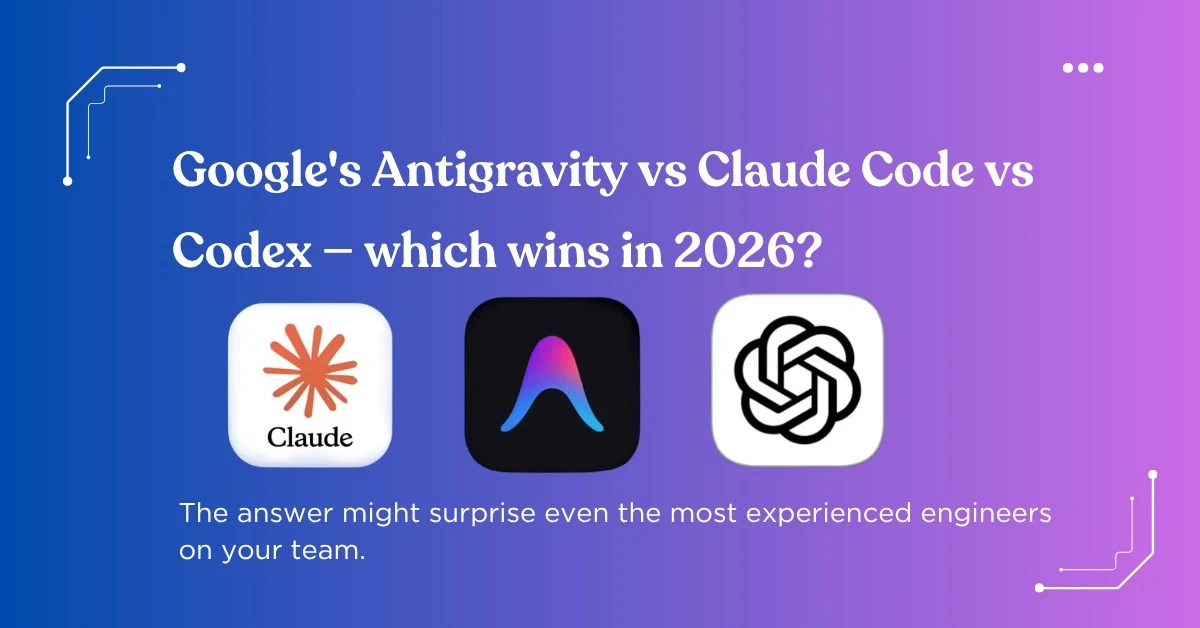
The answer might surprise even the most experienced engineers on your team.
For most of 2025, the AI coding agent conversation had a clear hierarchy. Claude Code was a thoughtful architect. Codex was the fast executor. And Google’s Gemini CLI was the budget option nobody took too seriously. Then Google I/O 2026 happened on May 19, and Google did not iterate on Gemini CLI. It replaced the entire product category with Antigravity 2.0, a full multi-agent platform running on Gemini 3.5 Flash that generates code at roughly 289 tokens per second, about 4x faster than Claude Opus 4.8 or GPT-5.5.
Suddenly, the Google Antigravity vs Claude Code vs Codex question is not a foregone conclusion. Each tool now leads in a category that genuinely matters: Antigravity on raw speed and multi-agent orchestration, Claude Code on code quality and reliability, and Codex on codebase-wide understanding and aggressive problem-solving. Pick wrong, and your team either ships slower than it should or ships fast code that breaks in production.
This is the honest, hands-on comparison. Real benchmarks, real pricing, real developer feedback, and a clear verdict on which agent fits which kind of team. No marketing spin, just the data your engineers actually need.
The 30-Second Verdict
If you only read one section, read this.
- Choose Google Antigravity if speed and parallel multi-agent workflows matter most, you want a desktop-plus-CLI-plus-SDK platform, and cost efficiency is a priority. It is the fastest and cheapest of the three.
- Choose Claude Code if code quality and reliability are non-negotiable, you work on complex tasks where subtle bugs are expensive, and you value an agent that flags its own uncertainty. It produces the highest-quality code on hard problems.
- Choose Codex if you need an agent that understands your entire codebase, catches cross-file dependencies, and aggressively solves problems beyond the literal prompt. It thinks like a lead developer under a deadline.
Now, the details that justify those verdicts.
Meet the Three Contenders
Before the head-to-head, here is what each tool actually is in mid-2026.
- Google Antigravity 2.0: Relaunched at Google I/O on May 19, 2026, as a complete agent-first platform. It bundles a redesigned desktop app, a new Antigravity CLI (built in Go, replacing Gemini CLI for consumers), and a public SDK. It runs on Gemini 3.5 Flash by default, dispatches dynamic subagents in parallel, supports scheduled background tasks, and leads the MCP Atlas tool-use benchmark at 83.6%. This is the same Gemini 3.5 Flash engine we covered in our Claude Opus 4.8 vs GPT-5.5 vs Gemini comparison.
- Claude Code (Anthropic): Anthropic’s terminal-native coding agent, now powered by Claude Opus 4.8 (released May 28) with the new Dynamic Workflows feature. Known for producing the highest-quality code on complex tasks, exceptional reliability, and being the most honest about flagging its own uncertainty. It is the tool we explored in depth in our breakdown of Claude Code as a co-engineer.
- OpenAI Codex: OpenAI’s coding agent, powered by its latest GPT-5.5-Codex model on a custom chip designed for agentic work. Known for reading entire codebases rather than single files, catching cross-file dependencies, and aggressively going beyond the prompt to solve problems. It feels like a lead developer racing against a deadline.
1. Speed Comparison: Antigravity's Big Advantage
Speed is where the Google Antigravity vs Claude Code vs Codex comparison gets dramatic. Here is the raw difference.
Output Speed (tokens per second):
| Tool | Speed | Note |
|---|---|---|
| Google Antigravity | ~289 tok/s | Gemini 3.5 Flash, ~4x faster |
| Claude Code | ~67 tok/s | Opus 4.8 standard |
| Codex | Fast | Custom agentic chip |
In plain language for mobile readers:
Google Antigravity generates around 289 tokens per second on Gemini 3.5 Flash, roughly 4x faster than the other two. For developers watching an agent work in real time, this difference is felt instantly.
Claude Code runs around 67 tokens per second on standard Opus 4.8. Slower, but the output quality on complex tasks often justifies the wait.
Codex is noticeably fast thanks to OpenAI’s custom chip built for agentic workloads, sitting between the two on raw speed but excelling at codebase-wide reasoning.
For rapid prototyping, high-volume agentic loops, and parallel subagent workflows, Antigravity’s speed is a genuine competitive edge. For deep, careful work, raw speed matters less than getting it right the first time.
2. Context Window: How Much Each Agent Can Hold?
Context window determines how much code an agent can reason across at once. This matters enormously for large codebases.
- Google Antigravity: 1 million token context window. Can hold massive codebases in a single session.
- Claude Code: 1 million token context window on Opus 4.8. Matches Antigravity, enabling codebase-wide reasoning without chunking.
- Codex: Reads the whole codebase and understands connections. One developer noted that when asked to fix a single function, Codex flagged “this is used in 4 other places, I will update all of them.”
Both Antigravity and Claude Code offer 1M token windows, a major advantage over older 200K-token tools. Codex differentiates less on raw window size and more on how intelligently it traces dependencies across files.
3. Code Quality: Where Claude Code Leads?
Speed means nothing if the code breaks. Here is where quality separates the three.
Independent hands-on testing in 2026 consistently finds that Claude Code produces higher-quality code on complex tasks. It is more likely to flag uncertainties, less likely to overengineer, and the new Opus 4.8 model is roughly 4x less likely than its predecessor to let flaws pass unflagged.
The character of each agent, based on real developer testing:
- Claude Code thinks like an architect. It teaches you how to prevent problems. It explains its reasoning, flags edge cases, and writes maintainable code. On a security test, it was the only agent to realize a particular bug was so useless it should simply be deleted rather than fixed.
- Codex ships like an engineer on deadline. Fast, aggressive, and defensive. On the same security test, it went beyond the prompt to add input validation, preventing oversized text from crashing the database, a pro-level move Claude missed. It protects you from problems you did not anticipate.
- Antigravity prioritizes speed and orchestration. Strong on multi-step tool use (83.6% MCP Atlas) and parallel agent dispatch, but as a Flash-tier model, it may not match Claude Code’s depth on the hardest reasoning tasks.
The honest takeaway from testing: no single agent leads across all tasks. Claude Code teaches you to prevent problems. Codex protects you from the ones you missed. Antigravity gets you there fastest.
4. Pricing: The Cost Breakdown
For teams equipping multiple developers, pricing matters as much as capability. Here is where the three land in mid-2026.
Pricing Overview:
| Tool | Entry Price | Best For |
|---|---|---|
| Google Antigravity | Free tier available | Cost-conscious teams, high volume |
| Claude Code | $20/mo (Pro), $100-200 (Max) | Quality-focused engineering |
| Codex | Via ChatGPT plans | OpenAI ecosystem teams |
In simple terms:
Google Antigravity offers a free tier, making it the most accessible entry point. Combined with Gemini 3.5 Flash’s low token costs ($1.50/$9 per million), it is the cheapest option for high-volume work. Note: early reports mention occasional safety incidents and quota changes, so test before depending on it for critical work.
Claude Code runs on Anthropic’s Pro ($20/month), Max ($100-200/month), Team, and Enterprise plans. More expensive, but the Max plan unlocks the 1M context window and Dynamic Workflows for codebase-scale tasks.
Codex is bundled into OpenAI’s ChatGPT plans, making it convenient for teams already in the OpenAI ecosystem.
For teams building cost-efficient AI development stacks, the architecture decisions matter as much as the tool choice, which is exactly why an API-first development approach pays off when integrating any of these agents.
Which Agent for Which Team?
This is where the Google Antigravity vs Claude Code vs Codex decision gets practical.
- Choose Google Antigravity if: You run high-volume agentic workflows where speed compounds. You want a complete platform (desktop, CLI, SDK) rather than just a terminal tool. You prioritize cost efficiency and can tolerate a newer, still-maturing product. You need parallel multi-agent dispatch for complex orchestration.
- Choose Claude Code if: Code quality and reliability are non-negotiable for your team. You work on complex, high-stakes tasks where subtle bugs are expensive to catch later. You value an agent that flags its own uncertainty rather than confidently shipping flawed code. You want codebase-scale migrations via Dynamic Workflows.
- Choose Codex if: You need an agent that understands your entire codebase and traces cross-file dependencies automatically. You want aggressive problem-solving that goes beyond the literal prompt. You are already deep in the OpenAI ecosystem. You value an agent who catches problems you did not think to ask about.
The Smart Strategy: Most Teams Use Two
Here is what experienced engineering teams actually do in 2026: they do not pick just one. They match the agent to the task.
A common production setup:
- Rapid prototyping and high-volume work go to Google Antigravity for its speed and cost.
- Complex features and critical code go to Claude Code for its quality and reliability.
- Codebase audits and dependency-heavy refactors go to Codex for its whole-codebase understanding.
This multi-tool approach mirrors the broader pattern we documented in our analysis of AI agents replacing SaaS tools. Developers are assembling AI stacks where each tool handles what it does best, rather than forcing one tool to do everything.
The combined cost is manageable, and the productivity gain from using the right tool for each job is significantly larger than standardizing on a single agent.
Honest Limitations of Each
No tool is perfect. Here are the real tradeoffs.
- Google Antigravity Limitations: As a newer relaunch, it has reported occasional safety incidents and quota changes. As a Flash-tier model, it may not match Claude Code’s depth on the hardest reasoning tasks. Developers advise not depending on it for critical production work just yet.
- Claude Code Limitations: The slowest of the three on raw speed (67 vs 289 tok/s for Antigravity). More expensive than the free Antigravity tier. Can be verbose, which fills context faster on long agentic runs.
- Codex Limitations: Its aggressive “ship fast” approach sometimes adds unrequested changes. Tied to the OpenAI ecosystem. The confident execution style means it occasionally completes tasks in ways that need review.
The disciplined approach is the same one that separates teams capturing AI value from those covered in our analysis of why AI projects fail: test each agent on your actual codebase, measure real results, and adapt based on outcomes rather than benchmark claims.
The Bigger Picture: What This Race Signals?
Step back, and the Google Antigravity vs Claude Code vs Codex race tells you where AI coding is heading in 2026.
- First, the category moved from “autocomplete” to “autonomous agents” completely. All three tools now plan, execute, and verify multi-step work across your entire toolchain via MCP. The era of single-file suggestions is over.
- Second, speed became a real differentiator. Google’s bet with Antigravity is that a 4x faster generation, plus parallel subagents, changes how developers work. Whether that bet pays off depends on whether teams value speed over the depth that Claude Code and Codex offer.
- Third, specialization is winning. Antigravity for speed and orchestration. Claude Code for quality and reliability. Codex for codebase understanding. No single tool dominates, which means the smartest teams build flexible workflows rather than betting everything on one agent.
For most engineering teams, the winning move in 2026 is not choosing the one perfect agent. It is understanding which agent fits which task and building a workflow that uses each for its strength.
Conclusion: No Single Winner, Only Best Fits
The Google Antigravity vs Claude Code vs Codex comparison does not crown one champion because each tool is optimized for something different. Google built the fastest, most cost-efficient agent-first platform. Anthropic built the most reliable, highest-quality coding agent. OpenAI built the most aggressive, codebase-aware problem solver.
The answer that might surprise your most experienced engineers: the best choice is often not one tool, but the right tool for each job. Antigravity when speed matters. Claude Code when quality matters. Codex when codebase understanding matters. The teams winning in 2026 are the ones smart enough to use each agent for what it does best, then test relentlessly on their own real-world code.
Whichever you pick, one rule has not changed in 2026: the AI does not replace engineering judgment. It amplifies it. Test all three on your actual workflows, measure the results, and build something flexible enough to adopt whatever ships next, because in this space, something faster or smarter is always just weeks away.
More About Orbilon Technologies
Orbilon Technologies is an AI development partner that helps engineering teams choose, integrate, and maximize AI coding agents, including Google Antigravity, Claude Code, and Codex. We design and deploy agentic development workflows, multi-agent orchestration, MCP integrations, and full enterprise AI architectures across Google Vertex AI, AWS Bedrock, and Microsoft Foundry.
Our team holds a 4.96 average rating across Clutch, GoodFirms, and Google from clients across the US, Europe, and the Middle East, including SaaS startups, financial services firms, healthcare platforms, and enterprise operations teams.
Want help building an AI-first development workflow? Get a free consultation. We will review your team’s needs and recommend the right agent stack for how you actually work.
- Email: support@orbilontech.com
Want to Hire Us?
Ready to bring your vision to life? Team up with Orbilon Technologies and tap into a crew of highly qualified experts, right away. We cover everything, from the first sketches and solid development to security checks, quality assurance, and final launch, so you don’t get dragged through the messy middle. Our whole workflow is handled end-to-end; you just stay focused on growth. Your success is, honestly, a click away.