Hyperautomation in 2026: 4 Critical Facts Every Business Leader Must Know
Introduction
There’s a quiet shift happening in enterprises right now — and most leadership teams don’t have the numbers to see it clearly.
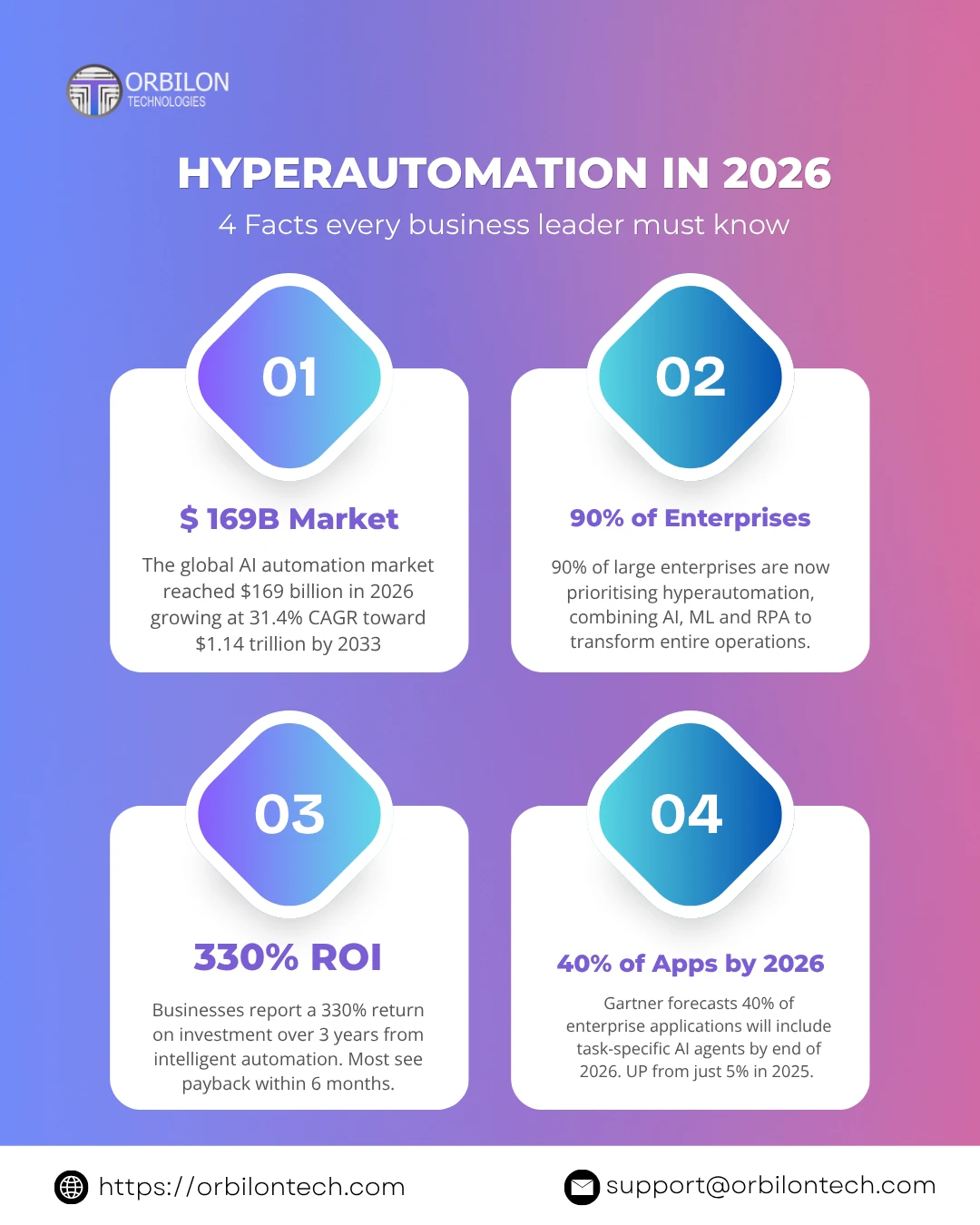
Hyperautomation in 2026 has crossed from “interesting concept” to operational reality for the world’s largest companies. The global market just hit $169 billion. 90% of large enterprises are prioritizing it as a core strategic initiative. Companies executing well are reporting 330% ROI over three years with payback in just six months. And by the end of 2026, Gartner projects 40% of enterprise applications will include task-specific AI agents — up from less than 5% in 2025.
This isn’t another technology hype cycle. Hyperautomation in 2026 is what happens when AI, machine learning, and RPA stop being separate tools and start working together as one coordinated system. The companies winning aren’t the ones buying the most software. They’re the ones combining these technologies into stacks that handle entire business processes end-to-end — invoice processing, customer onboarding, supply chain coordination, support triage — with minimal human handoff.
Below are the four facts every business leader needs to understand about hyperautomation in 2026 — what each number actually means, where it came from, and what it tells you about your next move.
The Market Numbers: Voice AI in 2026 Is Exploding
Before the facts, a quick definition that matters. Hyperautomation isn’t just “advanced automation” or “AI plus robots.” It’s a specific operational discipline.
Gartner defines hyperautomation as the combined use of multiple technologies and tools — including AI, machine learning, event-driven software architecture, robotic process automation (RPA), process mining, and intelligent document processing — to identify, vet, and automate as many business processes as possible.
In practical terms, a working hyperautomation stack in 2026 has four coordinated layers:
| Layer | What It Does | Example Tools |
|---|---|---|
| RPA | Handles structured, repeatable tasks (invoice entry, system updates, data movement) | UiPath, Automation Anywhere, Microsoft Power Automate |
| AI / ML | Processes judgment-heavy inputs (document classification, anomaly detection, response drafting) | Claude, GPT, custom ML models |
| Workflow Orchestration | Coordinates handoffs between layers and across systems | n8n, Zapier, Make, custom platforms |
| Governance | Tracks exceptions, audit trails, escalation paths, and compliance | Custom governance layers, observability tools |
Most companies already have the first two layers. The third and fourth layers — orchestration and governance — are what separate a collection of tools from an actual hyperautomation system. This is exactly the gap we’ve documented in our analysis of why AI projects fail — companies buy the AI but skip the system design that makes it work.
Now the four facts.
Fact #1: The $169 Billion Market Has Become Mainstream Infrastructure
The worldwide market for AI automation, which will be the main driver behind hyperautomation in 2026, is expected to reach $169 billion this year and is set to grow at a CAGR of 31.4% to $1.14 trillion by 2033 (data from Grand View Research)
However, the market for hyperautomation enablement software in general, which comprises all the layers of orchestration, AI RPA, process mining, and governance together, is even bigger. Earlier forecasts by Gartner had this market reaching close to $1 trillion by 2026 across all enabling categories.
So, what does this translate to in real terms:
- RPA on its own has grown to $35.27 billion in 2026 and is expected to reach $247 billion by 2035 (Precedence Research).
- The agentic AI industry alone reached $10.91 billion in 2026 and grew at a CAGR of 46.3%.
- Generative AI even contributed another $67 billion in 2026.
- Enterprise-wide AI spending has exceeded $301 billion around the world (IDC).
These figures make an unmistakable point: hyperautomation in 2026 is firmly established as more than a trial phase. It’s even bigger than the combined global music and video game industries and is set to overtake cloud computing within five years.
For the business leaders, this means that their rivals are not even considering investing in or not investing in hyperautomation anymore. They are already contemplating how rapidly they want to expand their existing deployments.
Fact #2: 90% of Large Enterprises Are Already Prioritizing Hyperautomation
According to Gartner’s research, hyperautomation continues to be a staple discipline for 90% of large enterprises. The pattern accelerated significantly after generative AI became mainstream in late 2022, and the demand has only grown since.
But here’s the more interesting number underneath that 90% — fewer than 20% of organizations have actually mastered the measurement of their hyperautomation initiatives. Most companies are doing hyperautomation. Far fewer are doing it well enough to know whether it’s working.
This gap creates a specific opportunity in 2026. The companies that win aren’t necessarily the ones with the largest budgets or the most tools. They’re the ones who treat hyperautomation as a measured, governed system from day one.
The discipline that matters:
- 88% of enterprises use AI automation in at least one function — but only 33% have scaled it across the organization.
- 51% of enterprises already have AI agents running in production.
- 97% of executives report deploying AI agents in the past year.
- 80%+ of Fortune 500 companies now run AI agents in production.
This is also why we’re seeing the broader pattern of AI agents replacing entire SaaS tools across the enterprise stack. When 90% of large enterprises commit to hyperautomation as a strategic priority, the software ecosystem reshapes around them.
Fact #3: 330% ROI With 6-Month Payback Is Real — But Only for Companies That Execute Well
The financial case for hyperautomation in 2026 is no longer theoretical. Forrester’s Total Economic Impact studies of structured AI platform deployments show:
- 333% average ROI with a 6-month payback period
- 5.8x average ROI on AI investment within 14 months of production deployment (McKinsey Global AI Survey)
- 84% of organizations investing in AI report positive ROI
- 35% average reduction in operational costs from AI automation
- Up to 40% cost reduction across various sectors (McKinsey)
- 42% faster process execution for organizations with coherent hyperautomation stacks
- 25% productivity gains documented in mid-market deployments
The cost economics by category are compelling:
| Cost Comparison | Human-Led | Hyperautomation |
|---|---|---|
| Customer service interaction | $6–$8 | $0.50–$0.70 (90%+ savings) |
| Invoice processing time | 14 days average | Under 24 hours |
| Sales rep weekly capacity | Manual workflow | Hundreds of saved hours per year per rep |
| RPA project payback | N/A | Typically under 12 months |
| Intelligent automation 3-year cost reduction | Baseline | ~40% reduction |
But here’s the honest gap. While 84% of organizations report positive ROI, only 29% see significant ROI from generative AI specifically, and only 39% report measurable EBIT impact from broader AI initiatives. 42% of companies abandoned most AI initiatives last year, up from 17% the year before.
The pattern is consistent across every study: hyperautomation works. Organizations struggle. The ones winning treat it as a workflow redesign, not technology procurement. Companies extending these wins typically combine governance-first deployment with proven AI tools to automate sales pipelines, chatbot trends that match 2026 standards, and clean API-first architectures that make multi-system orchestration practical.
Fact #4: 40% of Enterprise Apps Will Embed AI Agents by End of 2026
This is the projection from Gartner that should reshape every product roadmap and IT plan for the year. By the end of 2026, 40% of enterprise applications will include task-specific AI agents — up from less than 5% in 2025.
That’s an 8x increase in 12 months. No technology category in enterprise history has scaled embedded adoption that fast.
Where this is happening fastest:
| Department | AI Agent Adoption |
|---|---|
| Customer service | 56% of departments using AI in production today, projected to handle 50% of all interactions by 2027 |
| IT operations | 51% adoption — 31% fewer critical incidents reported, 28% faster resolution times |
| Marketing | 48% adoption — 37% productivity improvement vs. 12% from traditional automation |
| Software engineering | Explosive growth — 40-55% more code per week from AI-assisted developers |
| Finance (some processes) | Exceeding 90% automation — invoice matching, reconciliation, transaction processing |
The implications for hyperautomation in 2026:
- Embedded vs. bolted-on — AI agents are increasingly built into the applications you already use, not separate tools your team has to choose to open
- From assistive to autonomous — Agents now plan, decide, and execute multi-step processes without waiting for prompts
- Cross-system coordination — Modern agents work across multiple business systems via APIs and protocols like MCP
- Production over pilots — 48% of enterprises are running agentic systems in production, not just experimenting
For organizations evaluating which AI models to standardize on, this shift makes the Claude Opus 4.7 vs GPT-5 decision directly relevant — the model you choose for embedded agents shapes everything downstream.
What These Hyperautomation Facts Mean for Your Business?
Numbers without action are just trivia. Here’s how to turn those four facts into decisions:
- If you’re a small-to-mid business, you don’t need a massive $20 million system to get real benefits. Smaller businesses can now use hyperautomation easily because the tools for managing it and AI have become much cheaper in 2025-2026. Instead of trying to do everything at once, pick 2 or 3 processes you know well to start with. Getting these first few main tasks set up usually takes about 8 to 14 weeks. You’ll often see the quickest returns by automating things like customer service, handling invoices, and new employee onboarding.
- If you’re a large enterprise: For big companies, the real challenge isn’t whether to use hyperautomation, but how quickly you can get it working fully after a test run. More than 80% of Fortune 500 companies are already using AI tools in their daily work. The companies getting the best results tend to do four things: they link AI directly to making money, they set up rules before expanding, their business teams manage the AI tasks, and they see it as changing how the whole organization works, not just a tech project.
- If you’re an engineering leader: To make hyperautomation work well, you need systems that can grow with your needs. Things like n8n, Zapier, and your own custom tools for managing these processes are now essential. Also, you need to think about rules and oversight from the very beginning. For example, the EU AI Act has rules about being open, being able to check things, and sorting risks for most tasks that involve employees, customers, or other companies.
- If you’re a CFO: As a CFO, you should ask for clear numbers showing the return on investment for every hyperautomation project. The companies that actually see good returns keep an eye on things like how much time is saved per person each week, how many errors there were before and after, how much money came in because of AI, and the cost for each transaction. If you don’t have these numbers, projects can just wander off course. But if you do, then people can be held responsible.
The Quiet Fragmentation Problem Most Companies Don't See
Here’s the issue most leadership teams miss: hyperautomation in 2026 isn’t usually broken because tools are bad. It’s broken because tools don’t talk to each other.
A typical mid-market company has accumulated:
- A CRM with built-in AI features.
- An email automation platform with separate AI suggestions.
- A customer support tool with its own AI chatbot.
- A separate document AI for invoice processing.
- An HR platform with AI-driven candidate screening.
Each tool works fine in isolation. None of them coordinates. Data doesn’t flow between them. Manual handoffs sit between automated steps. Recurring exceptions go uncaught. This quiet fragmentation is the real hyperautomation problem in 2026 — and it’s not solved by buying more tools.
The fix is treating hyperautomation as a system, not a collection of features. That means:
- A unified orchestration layer coordinating across your existing tools.
- A governance layer tracking exceptions and audit trails consistently.
- Standardized integration patterns through APIs or protocols like MCP.
- A single source of truth for data flowing through automated workflows.
Companies that build this system layer typically see compounding returns over time — not just one-time efficiency gains. Companies that skip it find themselves running 70+ “automation initiatives” with little measurable business impact.
Conclusion: Hyperautomation in 2026 Is About Systems, Not Software
The four facts about hyperautomation in 2026 — $169 billion market, 90% enterprise prioritization, 330% ROI for top performers, and 40% of apps embedding AI agents — describe a category that has fundamentally moved past the experimentation phase.
What separates winners from struggling adopters isn’t the tools they buy. It’s whether they treat hyperautomation as a coordinated system or as a stack of disconnected automation projects. The 30% getting measurable returns are running governed, integrated, end-to-end workflows. The 70% struggling are still running 50 isolated bots with no orchestration layer between them.
For business leaders making 2026 plans, the strategic question is straightforward: are you building a hyperautomation system, or accumulating hyperautomation tools? The companies asking the first question will be the ones reporting the headline ROI numbers a year from now. The companies asking the second will be the ones explaining to their boards why AI didn’t deliver.
About Orbilon Technologies
Orbilon Technologies is an AI development partner that turns hyperautomation strategy into measurable business outcomes. We design, build, and deploy production-ready hyperautomation systems — combining AI agents, RPA orchestration, workflow automation, and governance layers into coordinated stacks that actually deliver ROI.
Our team holds a 4.96 average rating across Clutch, GoodFirms, and Google from clients across the US, Europe, and the Middle East — including SaaS startups, financial services firms, healthcare platforms, and enterprise operations teams. We work across AWS Bedrock, Google Vertex AI, Microsoft Foundry, and self-hosted environments, depending on what fits your infrastructure.
Ready to build a hyperautomation system that actually works? Get a free consultation — we’ll review your highest-ROI automation opportunities and give you an honest implementation roadmap.
- Website:orbilontech.com
- Email: support@orbilontech.com
Want to Hire Us?
Are you ready to turn your ideas into a reality? Hire Orbilon Technologies today and start working right away with qualified resources. We will take care of everything from design, development, security, quality assurance, and deployment. We are just a click away.