
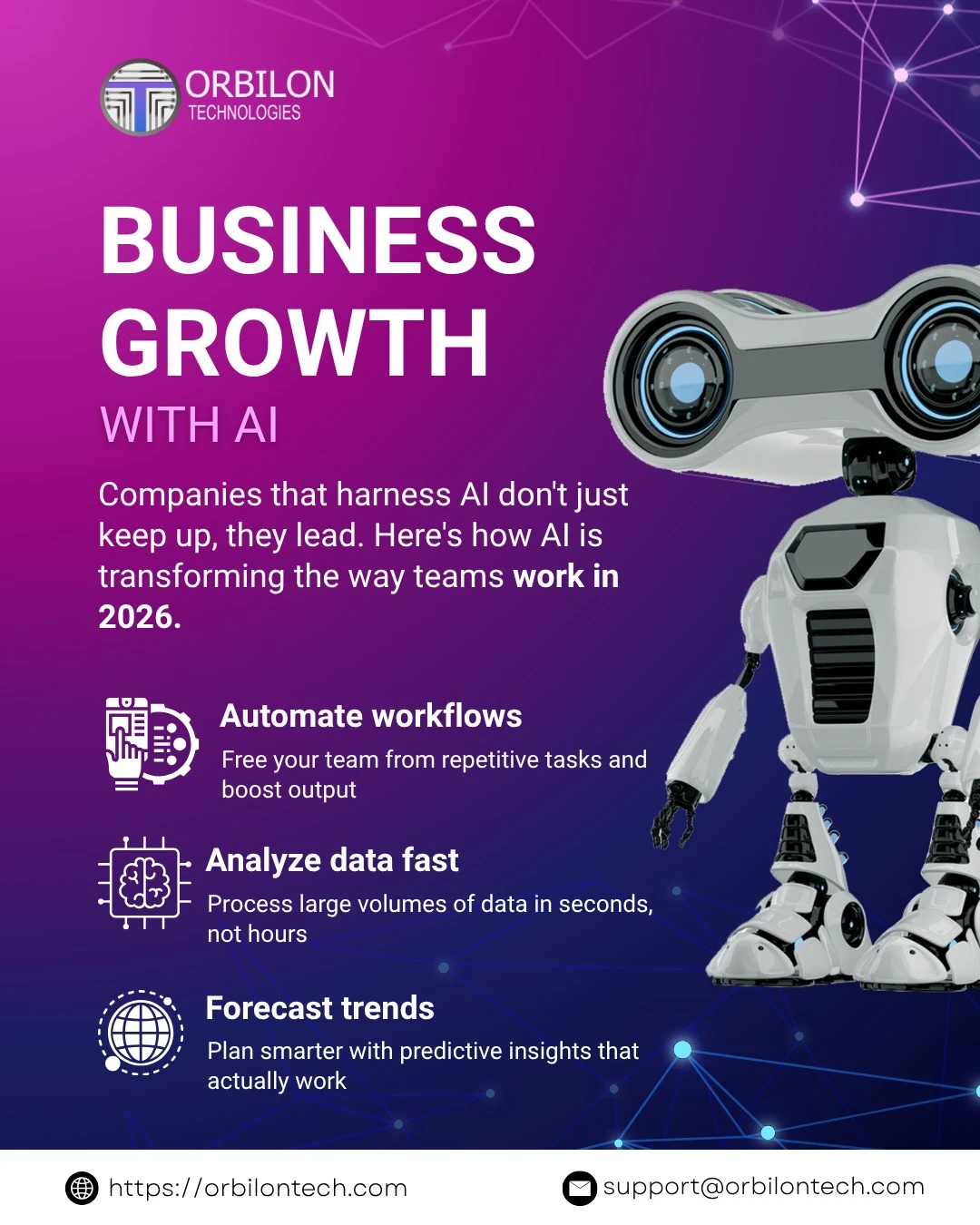
Business Growth With AI: 7 Smart Ways Leaders Are Winning in 2026
Introduction
Organizations that integrate AI deeply are not only adapting to changes but driving them. And the statistical evidence that demonstrates this in 2026 is hardly disguised anymore.
PwC’s 2026 AI Performance Study indicates that 74% of AI-generated economic value is being attained by only 20% of companies. Performance report by NVIDIA’s State of AI revealed that 88% of enterprises claim AI has directly enhanced their annual revenue, while 30% of these enterprises even recorded revenue uplift by more than 10%. According to McKinsey, generative AI alone can contribute about $4.4 trillion to the global economy on an annual basis. Moreover, industries with the highest AI exposure are already experiencing a triple boost in revenue growth per employee as compared to their low-exposure counterparts.
However, only 20% of enterprises are currently leveraging AI for revenue growth, despite 74% of them expressing their desire to do so. This discrepancy is where businesses using AI for growth in 2026 will form a competitive advantage, distinguishing leaders who are advancing from the majority who are still in the pilot phase.
Below are the winning strategies that the leaders are currently implementing: seven specific ways AI is enabling business growth presently, supported by corroborated data, authentic examples, and the tradeoffs that every leader should know prior to making a decision.
What "Business Growth With AI" Actually Means in 2026?
Before the seven ways, a definition that matters. Business growth with AI isn’t just buying ChatGPT licenses or running a chatbot pilot. It’s using AI to drive measurable outcomes across three categories:
| Growth Type | What AI Does | Example Outcome |
|---|---|---|
| Revenue growth | Identifies new opportunities, personalizes offers, expands into new markets | Sephora’s AI personalization driving repeat sales |
| Productivity growth | Frees teams from repetitive work, accelerates output per employee | Coding teams shipping 70% more pull requests |
| Margin growth | Cuts costs, reduces errors, automates expensive processes | 40% operational cost reductions documented |
The companies winning aren’t doing all three from day one. They’re picking one growth lever, executing well, then expanding. Below are the seven specific levers driving real business growth with AI in 2026.
1. Automate the Workflows That Drain Your Team's Best Hours
The first lever is the most obvious — and the most underused. The repetitive 20% of work that consumes 80% of your team’s energy is exactly where AI delivers the fastest ROI.
The data backs this up clearly. The 2026 Stanford Enterprise AI Playbook — based on 51 successful enterprise deployments — found that high-automation projects deliver 40% median productivity gains, while agentic implementations push that to 71%. NVIDIA’s research shows 87% of companies report AI helping reduce annual costs, with 25% seeing reductions of over 10%.
Where automation drives the strongest growth:
- Customer support — AI handles routine interactions at $0.50–$0.70 each versus $6–$8 for human agents (90%+ savings).
- Sales operations — AI captures CRM data, qualifies leads, drafts follow-ups — saving reps 5–10 hours per week.
- Finance & accounting — Invoice processing, reconciliation, and reporting workflows hit 90%+ automation in finance-forward enterprises.
- Marketing operations — Content production, audience segmentation, and campaign optimization run on AI workflows.
Companies seeing the biggest gains pair workflow automation with proper orchestration. We’ve covered the architectural pattern in depth in our analysis of hyperautomation in 2026 — the framework that turns isolated AI tools into coordinated growth systems.
2. Analyze Data Fast Enough to Actually Act on It
It’s tough for businesses to grow with AI if it takes weeks to get useful information when you actually need to act on it in hours. But modern AI is totally changing that.
- Things that used to take a data analyst three days – like gathering sales numbers, finding trends, suggesting what to do next, and making a report – now happen in minutes with AI. Instead of waiting months or weeks to go from asking a question to actually doing something, that time shrinks to days, or even instantly.
- Here are some actual examples of how data analysis is helping businesses grow, even looking ahead to 2026:
- For predicting what customers will want, retailers using AI are seeing their inventory costs drop by 30%, and their stock move 50% faster. For example, Lowe’s uses AI to figure out what people in different areas will buy, right down to specific items, and then adjusts what they have in stock on the fly.
- When it comes to figuring out which customers might leave, software companies using AI can spot those at-risk accounts before they cancel. They’ve reported cutting their monthly churn by 18%, which means they’re getting back money they would have lost.
- For setting prices, AI-powered systems can change prices instantly based on how much demand there is, what competitors are doing, and how much stock is left. This has boosted profit margins by 5–15%.
- And in marketing, AI can figure out exactly which ads or interactions first led to a sale. This lets marketing teams move their money from channels that aren’t working well to ones that bring in more business.
But this isn’t just about doing things faster. AI doesn’t just crunch numbers quicker; it can actually look at data that would be impossible for people to handle. Think about customer actions across millions of interactions, or supply chain information from thousands of different points, or up-to-the-minute market news. That’s why choosing something like Claude AI makes sense here, because how well it can think through really complicated data when it’s actually being used matters more than just benchmark scores. Especially for finance and analysis teams, having Claude right there in Excel means this kind of smart thinking can be used directly in the spreadsheets your team works with every day.
3. Forecast Trends With Predictive Insights That Actually Work
Forecasting has been the AI promise that has disappointed for years. Models trained on stale data made confident predictions that fell apart when reality shifted. But 2026 changed this with two specific advances:
Real-time data inputs. Modern AI forecasting pulls from live signals — search trends, social sentiment, weather data, supply chain disruptions — updating predictions continuously rather than monthly.
Explainable predictions. New AI systems show why they’re forecasting what they’re forecasting — letting business leaders sanity-check the logic before betting on it.
The growth applications are concrete:
| Forecasting Use Case: | Business Impact |
|---|---|
| Sales pipeline forecasting | 25–40% improvement in forecast accuracy vs. CRM-based prediction |
| Cash flow projection | Real-time visibility replaces monthly reports — earlier course-correction |
| Supply chain demand | 30% reduction in stockouts, 50% inventory turnover improvement |
| Customer lifetime value | Better LTV predictions = smarter acquisition spending |
| Talent attrition risk | Identify at-risk employees before they leave; targeted retention saves recruitment costs. |
Companies running AI-powered forecasting alongside AI tools to automate sales pipelines consistently report shorter sales cycles, larger deal sizes, and more accurate revenue projections to investors and boards.
4. Personalize Customer Experiences at Scale
As soon as AI scientifically made one-to-one customer experiences affordable, personalization ceased being just a luxury. The 2026 trend is the same throughout all sectors:
- Starbucks Deep Brews its own AI platform, which personally recommends to 35 million Starbucks rewards members the right drinks by taking into account their past purchases, time of day, and even local weather. Result: very noticeable same-store sales growth and digital loyalty program expansion.
- eCommerce personalization, those who utilize AI-driven product recommendation systems claim a 30% growth in average order value and a 2035% increase in conversion rates.
- Email & content personalization starting from the “Hi {first name}” level, marketing has finally reached the stage of sending each user contextually aware messages based on behavioral signals only.
PwC studies indicate that AI-skilled workers are paid 56% more than their non-AI counterparts; however, the real winners are companies utilizing AI for personalization, as they benefit from significantly increased customer lifetime value.
Besides, as better personalization leads to higher conversion rates, which in turn lead to more data and better-trained personalization models, the growth is exponential.
5. Build AI Agents That Work Autonomously, Not Just Reactively
This is where business growth with AI in 2026 separates from 2024 patterns. Agentic AI — systems that plan, decide, and execute multi-step tasks autonomously — is where the largest productivity gains are happening.
The Stanford Enterprise AI Playbook found agentic implementations deliver 71% median productivity gains versus 40% for traditional automation. NVIDIA’s data shows telecommunications (48%) and retail (47%) lead in agentic AI adoption, with software development as the broader leading use case.
What agentic AI actually does for growth:
- Research agents that prepare meeting briefings, analyze prospect companies, and synthesize industry intelligence.
- Sales agents who qualify leads, schedule meetings, and draft personalized outreach.
- Support agents that resolve 70–80% of routine tickets without human intervention.
- Operations agents that monitor system health, identify anomalies, and execute fixes.
- Coding agents that write, review, and deploy software autonomously.
For organizations evaluating which AI models to standardize on for agentic deployments, the Claude Opus 4.7 vs GPT-5 comparison covers the practical tradeoffs — different models excel at different agentic tasks, and intelligent routing typically beats single-model deployments
6. Empower Engineering Teams With AI-Assisted Development
Software is how modern businesses scale, and AI has fundamentally rewritten the cost equation for software development. Companies are shipping faster with smaller teams while maintaining or improving quality.
The numbers from real deployments tell the story:
- 70% increase in pull requests documented by engineering teams using AI coding assistants.
- 67% reduction in code review turnaround time — features moving to production significantly faster.
- 40–55% more code per developer per week based on GitHub Copilot research.
- 400+ microservices managed by lean engineering teams using AI assistance.
For technical organizations, this translates directly to growth. Faster product cycles mean faster customer feedback loops, which means faster product-market fit refinement. Smaller teams shipping more features means lower burn rates and longer runways. New hires onboard faster because AI tools navigate unfamiliar codebases on their behalf.
The competitive question isn’t whether to use AI coding tools — it’s which combination delivers the most value for your team’s workflow. Different tools excel at different parts of the development lifecycle, which is exactly the analysis we covered in our deep dive on the AI coding tools landscape for 2026.
7. Treat AI Adoption as a People Strategy, Not a Tech Strategy
This is the lever most companies skip — and it’s why most AI projects fail to drive business growth. Tools alone don’t deliver results. Organizational design that integrates AI into how teams actually work does.
The data is unambiguous on this point:
- Only 34% of companies are truly reimagining their business with AI (Deloitte 2026 State of AI in the Enterprise report).
- 74% of companies hope to grow revenue with AI; only 20% are actually doing it.
- 42% of companies abandoned most AI initiatives last year, up from 17%.
- Companies with senior leadership actively shaping AI governance achieve significantly greater business value than those delegating to technical teams alone.
The pattern matches what we documented in our analysis of why AI projects fail — the gap isn’t capability. It’s organizational readiness.
Companies winning AI-driven growth share four traits:
- Senior leadership ownership — McKinsey reports AI high performers are 3x more likely to have leaders demonstrating ownership of AI initiatives.
- Workflow redesign — they don’t bolt AI onto old processes; they rebuild processes assuming AI exists.
- Investment in change management — projects with dedicated change management deliver 58% success rates versus 16% without.
- Outcome metrics, not adoption metrics — they measure revenue, costs, customer satisfaction — not “how many people logged in.”
The Honest Reality: The 20/80 Gap Is Widening
The most important data point in PwC’s 2026 study isn’t a productivity number. It’s the gap between leaders and laggards.
74% of AI’s economic value is being captured by just 20% of companies. The other 80% are running pilots, accumulating tools, and generating a limited measurable impact. This isn’t a temporary phase that everyone will eventually catch up to — it’s a widening structural advantage.
The companies in the top 20% aren’t necessarily larger or better-funded. They share specific habits:
- They picked 2–3 high-value workflows to automate first, instead of trying to deploy AI everywhere.
- They built strong AI foundations — clean data, governance, change management — before scaling.
- They treated AI deployment as business reinvention, not IT modernization.
- They invested in their people’s AI skills through education and workflow redesign.
- They measured outcomes ruthlessly — revenue, costs, customer satisfaction — not vanity metrics.
What this means for your business: the window to join the 20% is narrowing every quarter. Companies still in pilot mode in late 2026 will face the same competitive position late internet adopters faced in 2003 — not a disadvantage, but an existential challenge.
How to Start: A 90-Day Business Growth With AI Roadmap?
Simply having data without taking any action is merely trivia. Below is the framework that works equally well for both SMBs and enterprises:
- Days 1-30 Audit & Prioritize. Identify your top 5 workflows that take up the most of your time. For each, determine whether it is repetitive (hence, RPA candidate), requires a lot of judgment (therefore, LLM candidate), or is mostly about coordinating (so, orchestration candidate). Select 2 with the highest impact and lowest complexity.
- Days 31-60 Build & Test. Implement AI for the selected workflows. Instead of starting from scratch, leverage existing platforms (Zapier, n8n, Claude, custom integrations). Involve initial users. Record pre-launch metrics.
- Days 61-90 Measure & Scale. Evaluate results against baseline. If findings are as expected (usually 3050% time savings, 2040% cost reduction), move on to nearby processes. Otherwise, determine the flaw and correct it before scaling.
Those companies that stick to this routine focus, measure, and expand based on results invariably do better than those who try “to go big” through company-wide AI rollouts. McKinsey’s State of AI reports that a 5.8x ROI in less than 14 months is possible. But only for companies that get the basics right.
Conclusion: Business Growth With AI Is About Choices, Not Tools
The headline numbers — $169 billion market, 88% revenue impact, 74% of value captured by 20% of companies — describe a category that has fundamentally moved past the experimentation phase. The question isn’t whether AI drives business growth. The data settles that.
The question is whether your company will be in the 20% capturing the value, or the 80% watching it. The seven levers above — automating workflows, analyzing data fast, forecasting trends, personalizing experiences, deploying agentic AI, accelerating engineering, and aligning people strategy — aren’t theoretical. They’re documented patterns from companies winning right now.
Pick one or two levers that match your highest-impact opportunities. Execute them well. Measure outcomes. Then expand. That’s the path real business growth with AI takes — not the path of buying every tool and hoping transformation happens. The 20% understood this. The 80% are still learning.
About Orbilon Technologies
Orbilon Technologies is an AI development partner that helps companies turn AI into measurable business growth. We design, build, and deploy production AI systems — including custom AI agents, voice AI pipelines, CRM and ERP integrations, document automation, and full enterprise AI architectures across AWS Bedrock, Google Vertex AI, and Microsoft Foundry.
Our team holds a 4.96 average rating across Clutch, GoodFirms, and Google from clients across the US, Europe, and the Middle East — including SaaS startups, financial services firms, healthcare platforms, and enterprise operations teams.
Ready to drive real business growth with AI? Get a free consultation — we’ll review your highest-ROI opportunities and give you an honest implementation roadmap.
- Website:orbilontech.com
- Email: support@orbilontech.com
Want to Hire Us?
Are you ready to turn your ideas into a reality? Hire Orbilon Technologies today and start working right away with qualified resources. We will take care of everything from design, development, security, quality assurance, and deployment. We are just a click away.