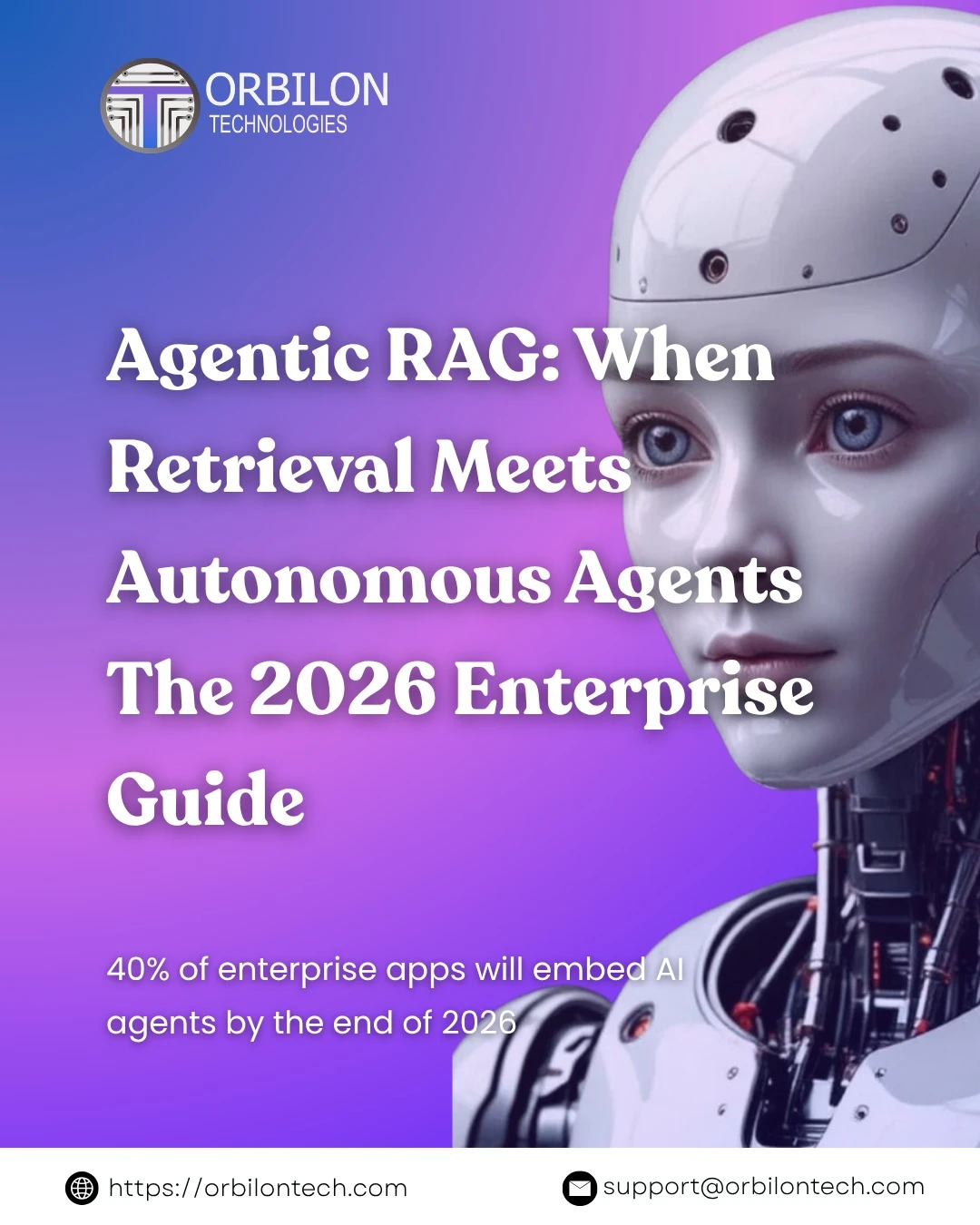
Agentic RAG: When Retrieval Meets Autonomous Agents — The 2026 Enterprise Guide
Introduction
Gartner predicts that 40% of enterprise applications will embed task-specific AI agents by the end of 2026 — up from less than 5% in 2025. That’s an eightfold jump in a single year. And the technology making most of these agents actually useful isn’t just large language models on their own. It’s agentic RAG — the convergence of retrieval-augmented generation with autonomous AI agents capable of planning, reasoning, and acting on enterprise data independently.
Traditional RAG-enabled LLMs look up information before answering. Agentic RAG gives them the ability to think about what to look up, decide how to use it, and take action — all without a human holding their hand through each step. For enterprises sitting on massive repositories of internal documents, policies, customer data, and operational knowledge, this is the difference between a glorified search bar and a genuine AI teammate.
This guide breaks down what agentic RAG actually is, how it differs from standard RAG, which industries are deploying it, and how to implement it in your organization.
What Is Agentic RAG? Why Does Agentic RAG Matter?
The regular way of doing RAG is pretty simple. A user asks a question. The system finds some documents that might help answer the question. It takes the information from those documents. Uses it to create a prompt for a big language model. Then the language model generates an answer. This works okay for questions that have straightforward answers that can be found in one document.
Companies do not have simple questions like that. They have questions like what the terms of the contract we signed with Client X are, and how those terms compare to what we do. They also want to know if the new proposal to renew the contract follows our rules. To answer a question like that, you need to look at a lot of sources. You need to compare the information you find and think about what it means. You also need to apply the rules of the company. You have to do all of this in order.
The regular way of doing RAG cannot do that. It just tries to find an answer. Hopes it is right.
Agentic RAG is different. It uses something called AI agents. These agents are like helpers that work inside the system. They use four ideas that were found in some research by Singh and others in 2025.
One of these ideas is called planning. The agent breaks down a question into smaller tasks. It does not try to answer everything at once. Instead, it makes a plan. First, it finds the contract. Then it finds the terms we usually use. Next, it finds the rules. Then it compares everything.
Another idea is called reflection. After the agent finds some information, it checks to see if it is good enough. If not, it tries again. This helps a lot because it means the agent is less likely to answer.
The agent can also use tools. It is not limited to searching a database. It can do things like call an API or query a database. It can even send an email. Update a record in our system.
The last idea is called multi-agent collaboration. This means that multiple agents can work together. One agent might find documents. Another agent might compare the information. A third agent might check to see if everything is compliant. A fourth agent might be in charge of the process.
The result is a system that does not just answer questions. Agentic RAG can actually complete business processes. It uses the data of the company to do this.
Agentic RAG vs Traditional RAG: The Key Differences
To see why agentic RAG is important for companies, we need to understand where traditional RAG falls short.
Retrieval strategy: The way traditional RAG searches for information is a part of the problem. It uses a retrieve-then-generate workflow. This means you only get one chance to find the information, and the quality of the answer depends on whether the right documents show up in that one search.
Agentic RAG does things differently. It searches for information times with different questions, and it can refine its search based on what it finds. It can also decide when it has information to give a good answer.
Reasoning depth: When it comes to thinking about a problem, traditional RAG is not very good. It just puts together the information it finds and asks a language model to make sense of it. This works okay for questions like “What is our refund policy?” It does not work well for harder questions that need many steps to answer, like “Which of our big clients renewed in the third quarter had more than 50 support tickets and are on pricing plans that will be stopped next quarter?”
Agentic RAG breaks down these questions into smaller steps. It searches for information. Think about it one step at a time.
Action capability: Traditional RAG can only generate text. It cannot actually do anything. Agentic RAG is different. It can take actions like booking meetings, updating records, starting workflows, and sending notifications. This makes it a good foundation for intelligence agents that can actually do things for big companies, not just give them information.
Adaptability: Traditional RAG always follows the steps, no matter how hard or easy the question is. Agentic RAG is smarter. It changes its approach based on the question. If the question is simple, it answers searching once. If the question is hard and needs a lot of analysis, it searches for times and plans its approach carefully. The system is also smart about how it uses its resources. It uses resources for hard questions and less for easy ones.
How Agentic RAG Works: The Architecture?
A production-grade agentic RAG system usually has these parts:
- The Orchestrator Agent: This is like the boss. It gets the user’s request, figures out how hard it is, makes a plan, sends the work to agents or tools, and puts together the final result. Some modern systems like LangChain, CrewAI, and AutoGen help with this part.
- Retrieval Tools: Agentic RAG systems do not just use one way to find information. The best way to do it in 2026 is to use a combination of methods like BM25 and vector search, and also a cross-encoder reranker that sorts the results by how relevant they really are. GraphRAG helps with this by making graphs of how things are related in the documents so you can ask questions about themes and see exactly where the answers come from.
- The Knowledge Base: Your database, like Pinecone, Qdrant, Weaviate, or Supabase, stores information about your documents in a way. Agentic RAG systems also connect to other live systems, like APIs, CRM systems, and tools, so the agent can get real-time information, not just old documents.
- Memory & State Management: Agentic RAG systems are different from RAG systems because they can remember things from one step to the next and even from one conversation to the next. The agent remembers what it has already found, what the user is talking about, and what it has already done, so it does not do the work twice and can do multi-step tasks in a logical way.
- Guardrails & Human-in-the-Loop: When you use RAG in a big company, you need to make sure that the agent only looks at documents it is allowed to that the results are correct, and that the agent knows when to ask a human for help. The agent needs to know when it does not have information or is not sure, and then send the task to a human.
Industries Deploying Agentic RAG in 2026
- Financial Services: Banks and insurance companies use RAG for a lot of things, like checking if they are following the rules, finding fake activities, and solving customer problems. An agent can look at a client’s account history, find the rules that apply, look at how money’s being moved around, and make a report that says if everything is okay. All in one step. The BFSI sector is using these kinds of agents the most, with over 32 percent of the market.
- Healthcare: Agentic RAG agents help doctors and nurses with writing down what happened with patients, finding the medicines, and getting information from patients. The agent looks at books, checks with patient records, and makes a summary that doctors can look at. When the agent is run on the company’s computers, it follows the HIPAA rules by keeping all the information in the company.
- Legal: Law firms use RAG to look at contracts, find laws that apply to a case, and do research. The agent breaks down a question into smaller parts, finds the relevant laws and past cases from many databases, compares parts of different documents, and makes a report with all the right information. What used to take a lawyer hours to do, the agent can do in just a few minutes.
- Customer Service & Support: Agentic RAG is used to make kinds of support agents that do not just answer simple questions. They actually try to solve problems. When a customer says something is wrong, the agent looks at what the customer has bought, finds the instructions to fix the problem, looks in the product database to see if this is a known issue, and either fixes the problem or sends all the information to a human agent.
- Enterprise Knowledge Management: The resources, information technology, and operations teams use agentic RAG like a helper that answers their questions. Employees can ask questions in their own words, and the agent looks at the company’s rules, procedures, wiki pages, what people have talked about on Slack, and the company’s databases. And puts together an answer with references to where it got the information. A company called Glean, which makes a product to help companies search for information, has made its product work in this way.
How to Implement Agentic RAG: A Practical Roadmap
Phase 1: Days 0–15. Figure Out What We Are Doing – Pick a single job that matters most – one eating big chunks of your day. Often repeated work fits best here. Deep understanding must play a role. Think about replying to team queries on policy details instead of guessing. Handling complaints from users might count too. Another option appears in checking legal paperwork before approval. Dealing with computer network problems often shows up as well.
What success looks like must come first when tackling this work. Figuring that out means checking response accuracy, time spent fixing problems, whether queries get solved on the first try, and the expense per reply. Risk tracking matters too – mark each one red, amber, or green after listing them clearly.
Phase 2: Days 16–45. Get Our Data and Systems Ready – Putting every paper in its place comes first. Toss out copies piling up where they’re not needed. Mark each sheet – call it private or open – to guide who sees what. Slap a creation date on everything, no exceptions. Searching later must work many different ways at once. Access stays locked down tight, limited strictly by role and need.
A single system must manage every part of our data load. Companies often find success with tools such as Qdrant or Weaviate. When Amazon Web Services is already in play, tapping into Amazon OpenSearch becomes a natural step.
Phase 3: Days 46–75. Build Our Agent – Start by thinking about how one helper could handle just a single job. A tool such as LangChain might fit here, though options like CrewAI or n8n’s AI parts also work. Try building something small before adding layers. Once it runs without hiccups, maybe then explore broader functions. LangGraph sits there too, waiting if needed.
One thing our agent must do is work inside our existing tools. It has access to the database, where it pulls details when needed. Checking the calendar falls under its tasks, too. The CRM shows active client data, which it reviews regularly. Emails go out through its interface without extra steps. Ticket creation happens automatically based on triggers.
Clear directions must guide our agent. Sometimes it checks facts, sometimes runs tools instead. Questions come up – then it asks for help. If things get too complex, passing it on makes sense. Getting this right matters most in the whole effort.
Phase 4: Days 76–90. Test and Improve – Start by checking if our agent runs as expected. One way to measure performance? Try tools such as RAGAS or BEIR. Throw real questions at it – odd ones too – to spot weak spots.
From time to time, someone might spot a mistake in what the agent says. Where those details come from matters just as much as who points out an error. When people share thoughts on replies, that input can shape how responses get better over time. A user’s note could spark changes behind the scenes without any notice. Even small comments may shift how things work later on.
Phase 5: Production and Scale Launching the agent happens today. A gateway wraps around it, limiting incoming requests while filtering access. Performance tracking kicks in, watching speed and precision closely. Confidence grows through consistent results, opening doors to new assignments. More data flows in once stability shows up over time.
Example: Agentic RAG for Internal Policy Q&A
Here’s a practical example of how an agentic RAG system handles an employee question:
Employee asks: “I’m relocating to the Berlin office next month. What’s the process for transferring my benefits, and does my stock vesting schedule change?”
Agent execution
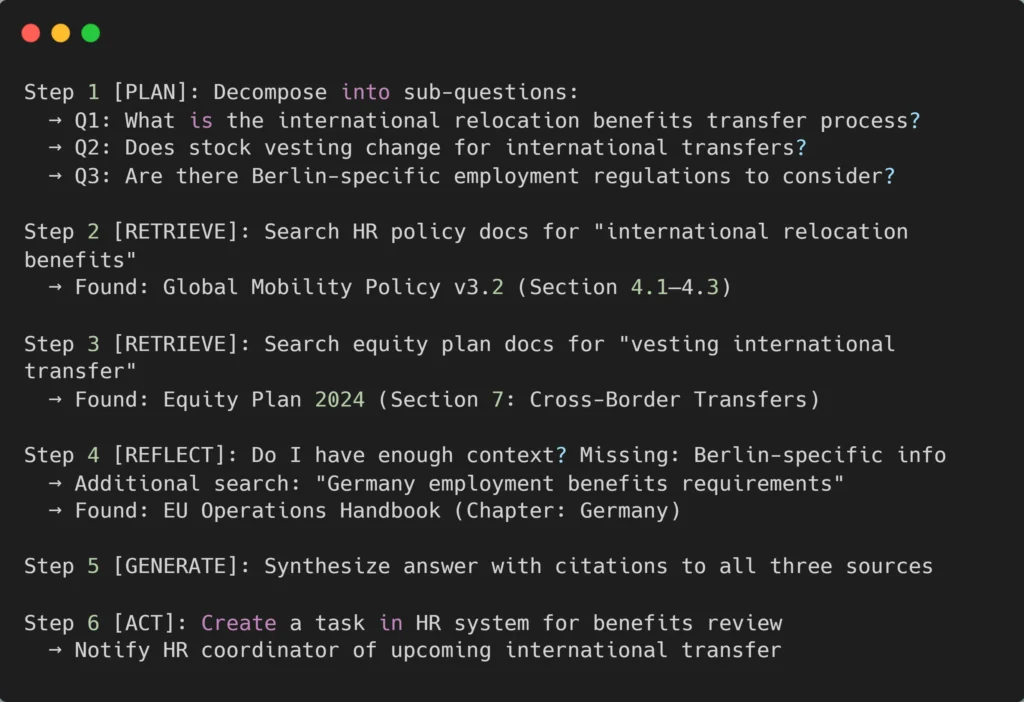
The employee gets a complete, cited answer in under 30 seconds — a process that previously required emailing HR, waiting 2–3 business days, and multiple back-and-forth exchanges.
The AI World Is Changing Quickly
Gartner has a five-step plan: by 2025, AI helpers will be in every app, and by 2026, we will see agents that do specific tasks. Next, by 2027, we will have systems where many agents work together. After that, by 2028, agents will work across apps, and by 2029, creating agents will be a normal skill for workers. A special kind of architecture called RAG is the base for steps 2 to 5.
The market for AI agents globally was $7.6 billion in 2025. It is expected to be more than $10.9 billion in 2026. AI with agency could bring $450 billion in revenue for enterprise software by 2035. Companies that build their RAG setup now will have a big advantage that others will find hard to catch up with.
Conclusion: Agentic RAG Is Enterprise AI's Next Foundation
What once was just answered now decides. Instead of waiting for prompts, it acts – pulling real data, making plans, using tools when needed. This shift started quietly but runs deep. Not merely fetching facts anymore, it works through steps like a cautious thinker. Where old systems froze at complexity, this one pushes forward. Retrieval grounds it, yes – but judgment moves it. The result? Language models that do more than respond. They participate. Real tasks get done, not just discussed.
Today, the tools are ready to run in real-world settings. Frameworks sit on shelves waiting; vector databases have seen rough combat. Large language models grow sharper every month. Success comes not from flashy parts but clear purpose at launch. Picking a focused problem matters more than speed. Data must be clean and handled early. Rules need shaping before code ships. Strong results trace back to smart choices up front.
By the end of the year, nearly half of business applications are expected to include AI agents. So it won’t be a surprise if agentic RAG turns into a basic tech setup. What matters now is whether your company is moving ahead with it or is left trying to close the gap later.
About Orbilon Technologies
Orbilon Technologies is an AI development agency that builds intelligent enterprise solutions — including agentic RAG systems, AI agent workflows, custom LLM integrations, and AI-powered SaaS platforms. With years of engineering experience and a 4.96 average rating across Clutch, GoodFirms, and Google, we help enterprises design, deploy, and scale AI agent systems that deliver measurable business outcomes.
Ready to build your agentic RAG system? Get a free architecture consultation from our AI engineering team.
- Rated 4.96 on Clutch
- orbilontech.com
- support@orbilontech.com
Want to Hire Us?
Are you ready to turn your ideas into a reality? Hire Orbilon Technologies today and start working right away with qualified resources. We will take care of everything from design, development, security, quality assurance, and deployment. We are just a click away.