Why Use Claude AI for Business in 2026: 9 Real Reasons Powering 1,000+ Enterprises
Introduction
Here’s a number that should settle the conversation: over 1,000 business customers now pay Anthropic more than $1 million annually for Claude services. Anthropic’s annual run-rate revenue has hit approximately $30 billion — up from $14 billion just months ago. The company closed a $30 billion funding round at a $380 billion valuation in February 2026 and is reportedly evaluating an IPO as early as October 2026.
Those numbers don’t happen accidentally. They happen because enterprise leaders — at AIG, Norway’s $1.7 trillion sovereign wealth fund, Citi, Behavox, Altana, and thousands of other companies — looked at every frontier AI model on the market and chose Claude for production workloads where mistakes are expensive, and reliability is non-negotiable.
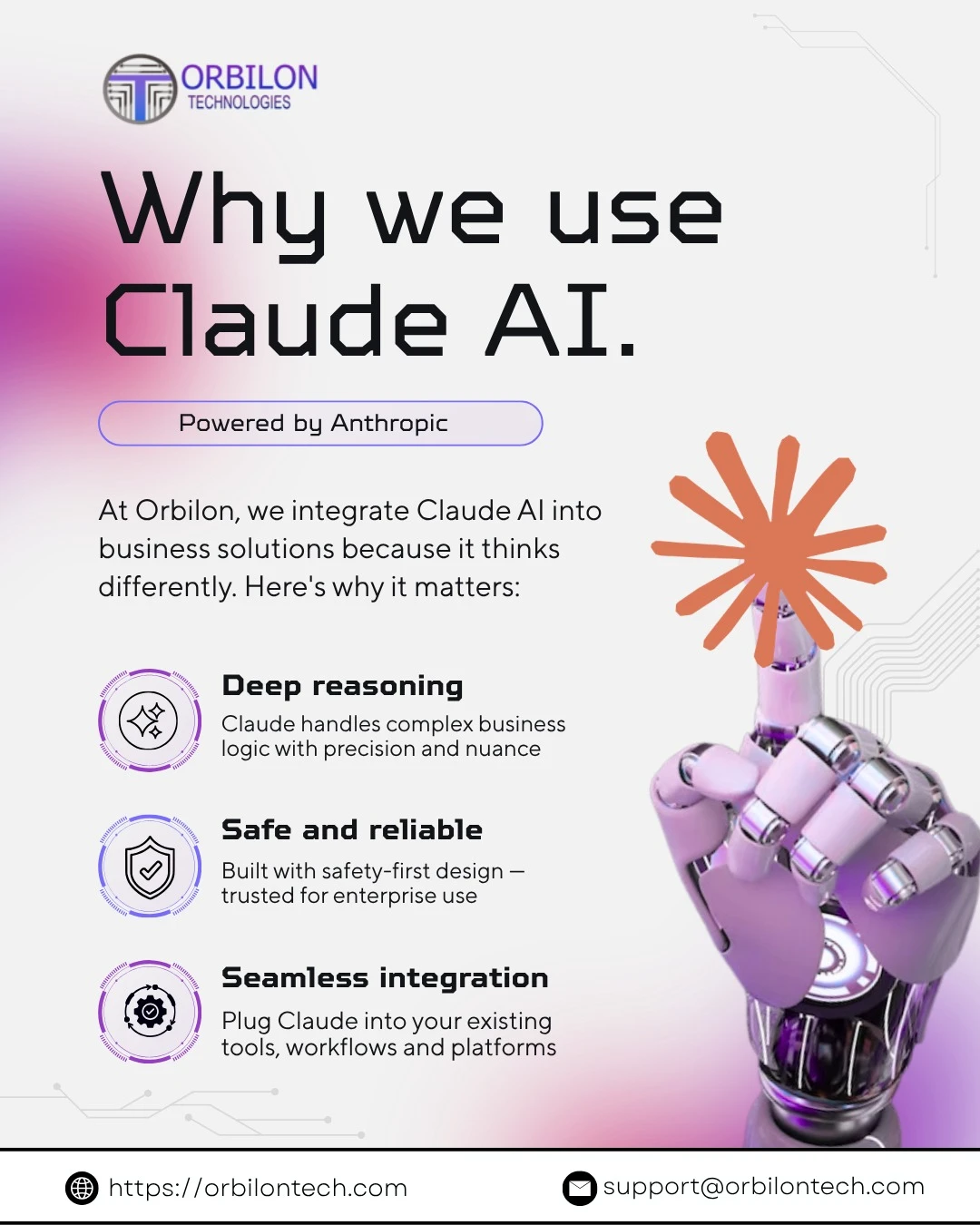
So why use Claude AI specifically? At Orbilon Technologies, we integrate Claude into business solutions because it thinks differently. Three things matter most: deep reasoning that handles complex business logic with precision and nuance, safety-first design built on Constitutional AI for enterprise use, and seamless integration that plugs into existing tools, workflows, and platforms.
Below are the 9 specific reasons Claude AI is winning the enterprise AI market in 2026 — backed by real data, real customers, and the honest tradeoffs you should know before deciding.
The Quick Answer: Why Claude AI Wins Enterprise Workloads
| Capability | Why It Matters | Real Impact |
|---|---|---|
| Constitutional AI safety | Predictable, transparent, governed AI behavior | Trusted by regulated industries (banking, healthcare, legal) |
| Deep reasoning (Opus 4.7) | Handles complex multi-step business logic | 87.6% on SWE-Bench Verified; leads on GPQA, HLE |
| Multi-cloud availability | AWS Bedrock, Google Vertex AI, Microsoft Foundry | Only frontier model on all 3 major clouds |
| 1M token context window | Reasons across entire codebases or document sets | Enterprise-grade analysis without chunking |
| Native Microsoft integrations | Excel, PowerPoint, Word add-ins | AI inside the tools your team already uses |
| Enterprise governance | SSO, SCIM, audit logs, Compliance API | Meets SOC 2, HIPAA-ready offering |
| Multi-agent orchestration | MCP-Atlas leadership at 77.3% | Production-grade agent workflows |
| Vision capability | High-resolution document processing (3.75 MP) | Legal, finance, healthcare documents |
| No model training on your data | Enterprise plan privacy by default | Sensitive data stays sensitive |
Now the deep dive.
1. Deep Reasoning That Actually Holds Up Under Pressure
Most AI models perform impressively in demos. They fall apart on real business problems where the answer requires holding 5 different facts in mind, applying domain-specific logic, and producing a response that an expert won’t immediately spot as wrong.
Claude Opus 4.7 — released April 16, 2026 — is specifically engineered for this kind of work. On SWE-Bench Verified (real-world software engineering issues), Opus 4.7 scores 87.6%. On the harder SWE-Bench Pro variant, it leads at 64.3%. On MCP-Atlas (multi-tool orchestration), it leads at 77.3% versus GPT-5.5’s 68.1%. On MMLU multilingual reasoning, it scores 91.5% versus GPT-5.5’s 83.2%.
But benchmarks tell only part of the story. The real reason to use Claude AI for complex business work is instruction adherence on long tasks. Where other models drift, hallucinate, or shortcut their way through multi-step problems, Claude maintains coherence. For agentic AI applications running for hours autonomously — coordinating across CRM, email, calendar, and internal databases — that reliability is what separates a production agent from an expensive demo.
Anthropic has even introduced task budgets in Opus 4.7 — a public beta feature giving developers an advisory token cap across an entire agentic loop. GPT-5.5 has no equivalent. This level of operational control matters when you’re running thousands of agentic sessions daily.
2. Constitutional AI: Safety That's Engineered, Not Bolted On
Constitutional AI is Anthropic’s proprietary approach to AI alignment — and it’s the reason regulated industries trust Claude with sensitive workloads where other models can’t be deployed.
Instead of training Claude purely on human feedback (the dominant approach), Anthropic trains it against a written constitution — a set of principles governing how the model should respond, handle sensitive information, and avoid harmful outputs. This produces behavior that’s:
- Predictable — the model’s reasoning follows documented principles.
- Transparent — you can understand why it responded a particular way.
- Steerable — enterprises can customize behavior for their domain.
- Resistant to jailbreaks — industry-leading resistance to misuse attempts.
For financial services, healthcare, legal, and government workflows where AI failures create regulatory exposure, this safety architecture isn’t a marketing claim. It’s the structural reason enterprises deploy Claude over alternatives. This is also why Anthropic publicly refused the US Department of Defense’s demand to remove restrictions prohibiting Claude’s use for domestic surveillance and fully autonomous weapons — the company’s safety commitments are written into its operating principles.
3. Available Everywhere Your Enterprise Already Runs
Claude is the only frontier AI model available on all three major cloud platforms: Amazon Bedrock, Google Cloud Vertex AI, and Microsoft Foundry. For enterprises with existing AWS, GCP, or Azure commitments, that means:
- No new vendor procurement process.
- AI workloads run inside your existing security perimeter.
- Data residency guarantees through regional endpoints.
- Billing consolidates with your existing cloud spend.
- Enterprise procurement, support, and SLAs you already trust.
This multi-cloud availability is a deliberate strategic moat. OpenAI’s models are tied to Microsoft Azure. Google’s Gemini runs on Google Cloud. Claude runs everywhere — which means whichever cloud your CIO already chose, Claude is already available there.
4. Native Integration With the Tools Your Team Already Uses
The biggest barrier to AI adoption isn’t capability — it’s getting people to actually use the tool. Claude solves this by embedding directly into Microsoft Office:
- Claude for Excel — Reads complex multi-tab workbooks, explains formulas with cell-level citations, modifies assumptions while preserving formula dependencies, edits pivot tables, and connects to live financial data via MCP connectors (S&P Global, LSEG, Moody’s, FactSet, PitchBook, Daloopa).
- Claude for PowerPoint — Reads your template (slide master, layouts, fonts, colors) and creates content that follows your brand guidelines, not generic decks.
- Claude for Word — Document-aware editing with native tracked changes, clickable citations, and comment thread participation.
- Claude in Microsoft 365 — Search files, emails, and Teams conversations directly. Selected Claude models are available in Microsoft Copilot Studio and the Researcher agent.
This is fundamentally different from chatbot-style AI tools. Your finance team doesn’t change workflow — they get AI inside Excel. Your legal team doesn’t change workflow — they get AI inside Word. Adoption happens because the friction is gone.
5. Enterprise Governance That Actually Meets Compliance Requirements
For regulated industries, AI without governance is AI you can’t deploy. Claude Enterprise includes the controls that compliance teams actually require:
| Feature | What It Provides |
|---|---|
| SSO and domain capture | Centralize login, auto-provision users by company domain |
| SCIM | Automated user provisioning/de-provisioning via your identity provider |
| Role-based access | Granular permissions across teams and projects |
| Audit logs | Full record of user actions, system events, and data access |
| Custom data retention | Set retention policies and selective deletion |
| Compliance API | Programmatic access to activity logs and chat history by user/time |
| Analytics API | Aggregated adoption metrics for the organization |
| No training on your data | Enterprise data is not used to improve Claude |
The new Compliance API alone is a significant differentiator. Rather than manual exports and periodic reviews, compliance teams get real-time programmatic access — enabling continuous monitoring, automated policy enforcement, and integration into existing compliance dashboards. For organizations in banking, healthcare, insurance, and government, this is the difference between “we’d like to use AI” and “we can actually deploy AI in production.”
6. The 1M Token Context Window: Reasoning Across Massive Inputs
Claude Sonnet 4.5 and Opus 4.7 ship with a 1 million token context window — roughly 750,000 words or 500+ pages of material in a single request. Most competitors cap at 128K-200K tokens.
What this enables for business:
- Analyze entire legal contracts (100+ pages) in one pass.
- Reason across complete codebases without chunking.
- Summarize quarters of meeting transcripts.
- Process whole financial models across multiple workbooks.
- Maintain coherence across hundreds of tool calls in agentic workflows.
For teams building AI agents that replace SaaS tools, this context capacity is what makes long-running autonomous workflows possible. The agent doesn’t lose track of what it’s doing 30 steps in.
7. The Anthropic Partner Network: Real Implementation Support
Technology alone doesn’t deploy itself. In March 2026, Anthropic launched the Claude Partner Network with a $100 million investment — bringing Accenture, Deloitte, PwC, KPMG, Infosys, Slalom, Tribe AI, and Turing into a formal channel ecosystem.
For businesses, this means:
- Vetted implementation partners with technical certifications (the Claude Certified Architect program).
- Standardized deployment methodologies for production rollouts.
- Industry-specific starter kits — including the Code Modernization toolkit for legacy systems.
- Centers of Excellence frameworks for governance and security.
- Co-selling support when partnering with consulting firms.
When you choose Claude AI for an enterprise deployment, you’re not deploying alone. You’re tapping into a partner ecosystem modeled on the channel programs that made Salesforce and HubSpot dominant. This is also where boutique partners like Orbilon Technologies fit in — bringing the same engineering rigor in a more cost-efficient delivery model.
8. Specialized Skills for Real Business Work
Claude isn’t just a general-purpose chatbot in 2026. Anthropic has shipped industry-specific Skills that handle real workflows out of the box:
Financial services skills:
- Discounted cash flow (DCF) models with WACC calculations and sensitivity tables.
- Comparable company analysis with valuation multiples.
- Due diligence data packs from the data room documents.
- Earnings analyses pulling from quarterly transcripts.
- Initiating coverage reports with industry deep-dives.
- Company teasers and profiles for pitch books.
Customer service: Auto-classify support tickets, draft response templates, summarize interaction histories. Haiku 4.5’s speed makes it ideal for real-time customer-facing applications.
Legal: Parse legal documents, answer questions about contracts, draft initial intake materials, and review redlines.
Healthcare: Summarize patient records, identify potential drug interactions, and assist diagnostic processes (HIPAA-ready offering available on Enterprise).
Sales & Marketing: Always-on virtual sales rep, lead qualification, content creation, market research synthesis.
These skills aren’t hypothetical. They’re shipping in the Claude apps right now, working across Claude.ai, Claude Code, and the API.
9. Cost Economics That Work at Enterprise Scale
For all the talk of AI being expensive, Claude’s pricing structure actually rewards heavy production usage:
Subscription tiers (claude.ai):
- Free — daily usage limits, no credit card.
- Pro — $20/month, includes Claude Code, file creation, and MCP connectors.
- Max — $100/month (5x usage) or $200/month (20x usage).
Team plans (5+ members minimum):
- Team Standard — collaboration features, centralized billing, and admin controls.
- Team Premium — adds Claude Code for engineering teams.
Enterprise — Sales-assisted, minimum 20 seats, includes SSO, SCIM, audit logs, Compliance API, HIPAA-ready offering. Pricing on request, with usage billed at API rates on top of seat fees.
API pricing ($5/$25 per M input/output tokens for Opus 4.7) becomes dramatically more efficient with two production features:
- Batch API — discounts for non-real-time workloads.
- Prompt caching — reuse common context at reduced cost.
Used together, these features can reduce effective API spend by up to 95% on eligible workloads. For high-volume production deployments, that’s the difference between “AI is too expensive” and “AI is the cheapest way to do this work.”
Honest Tradeoffs: When Claude Isn't the Right Choice
Being honest about limitations is part of why using Claude AI is worth answering correctly:
- No image generation — Claude is text and reasoning-focused. For image generation, you need DALL-E, Midjourney, or Imagen.
- Verbosity in agentic loops — Opus 4.7 is more verbose than GPT-5.5, which fills context faster and costs more on long autonomous runs.
- Long-prompt surcharge — 2x pricing above 200K-token prompts on Opus 4.7.
- Team plan capped at 150 seats — large enterprises need the Enterprise plan.
- Smaller plugin ecosystem — vs. the broader OpenAI/ChatGPT ecosystem with thousands of integrations.
For decisions where these tradeoffs matter, multi-model strategies make sense. We covered this in detail in our Claude Opus 4.7 vs GPT-5 comparison and the Claude Code vs GitHub Copilot vs Cursor analysis.
How Orbilon Technologies Integrates Claude AI for Clients?
At Orbilon Technologies, we build production AI systems on Claude across multiple use cases:
- Custom AI agents that automate end-to-end business workflows using Claude’s reasoning capabilities.
- CRM integrations that bring Claude’s intelligence into Salesforce, HubSpot, and custom systems.
- Document processing pipelines for legal, finance, and healthcare clients that need precision.
- Customer support automation combining AI chatbot best practices with Claude’s reasoning depth.
- Voice AI agents built on Claude for inbound and outbound calling at scale.
- Multi-cloud deployments on AWS Bedrock, Google Vertex AI, and Microsoft Foundry, depending on client infrastructure.
Our engineering team has built and shipped these systems for clients across the US, Europe, and the Middle East. We chose Claude as our default frontier model, not because it’s the only choice, but because it’s the right choice for production work where reasoning quality, safety, and reliability matter more than novelty.
Conclusion: Why Use Claude AI Comes Down to One Word — Trust
The reason 1,000+ enterprises pay Anthropic over $1 million annually isn’t that Claude has the most features or the best demos. It’s because Claude is the AI you can trust to do real work in regulated, high-stakes environments — and the AI your CIO won’t get fired for choosing.
Deep reasoning that handles complex business logic with precision. Safety-first design built on Constitutional AI for enterprise use. Seamless integration across Excel, Word, PowerPoint, and every major cloud. Enterprise governance that meets compliance requirements. A growing partner network of certified implementation experts. And cost economics that make production deployment financially sustainable.
That’s why we use Claude AI at Orbilon Technologies. That’s why Anthropic’s revenue is doubling every few months. And that’s why the answer to “why use Claude AI” in 2026 isn’t a single feature — it’s the entire architecture of an AI platform built for enterprise production from day one.
About Orbilon Technologies
Orbilon Technologies is an AI development agency that builds production AI systems on Claude — including custom agents, CRM integrations, voice AI, document processing, and enterprise automation. With years of engineering experience and a 4.96 average rating across Clutch, GoodFirms, and Google, we help businesses deploy Claude AI in ways that deliver measurable ROI, not just impressive demos.
Want to integrate Claude AI into your business? Get a free consultation from our AI engineering team.
- Website:orbilontech.com
- Email: support@orbilontech.com
Want to Hire Us?
Are you ready to turn your ideas into a reality? Hire Orbilon Technologies today and start working right away with qualified resources. We will take care of everything from design, development, security, quality assurance, and deployment. We are just a click away.