
API-First Development: Why Every Product Needs an API Strategy in 2026
Introduction
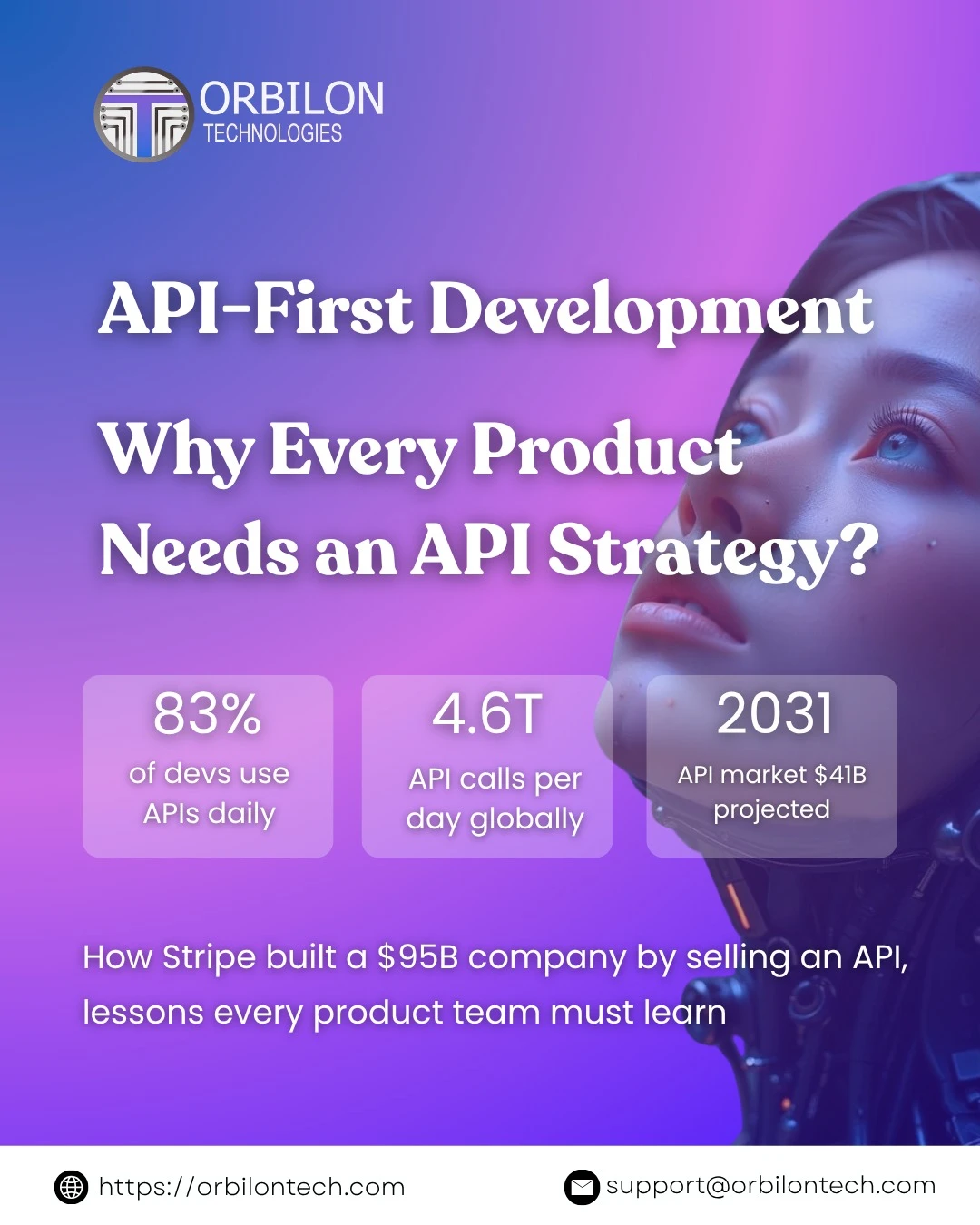
83% of developers interact with APIs every day. 4.6 trillion API calls take place worldwide on a daily basis. The API economy market recorded a value of $20.21 billion in 2026 and is expected to grow at a CAGR of 17.9% to reach $38.73 billion by 2030.
And then there’s Stripe. A company that simply by selling, more or less, seven lines of code – an API that enables any developer to accept payments – reached a $95 billion valuation. Not a dashboard. Not a portal. An API. That is the strongest endorsement of API-first development: the most valuable fintech company in the world is fundamentally an API product.
However, most product teams continue to treat APIs as something that comes later – a feature that a backend team builds after the UI is ready, is poorly documented, and somewhat luxuriously maintained. By 2026, that strategy will mean a competitive death sentence. That is why API-first development has become the default architecture for every serious product, and here is how to do it right.
What API-First Development Actually Means?
API-first development is a design philosophy where you design and build the API before anything else — before the frontend, before the mobile app, before the integrations. The API becomes the product’s foundation, and every interface (web, mobile, third-party, internal tools) is built on top of it.
This is fundamentally different from the traditional approach:
| Traditional Development | API-First Development |
|---|---|
| Build the UI first, add API later | Design the API first, build UI on top |
| API is an internal implementation detail | API is a product in itself |
| Documentation comes after launch (maybe) | Contract and docs come before code |
| Frontend and backend are tightly coupled | Frontend and backend are completely decoupled |
| Third-party integration is a feature request | Third-party integration is built in from day one |
| Changes break consumers unpredictably | Versioning and contracts protect consumers |
| One team builds everything sequentially | Multiple teams build in parallel on the API contract |
The key insight: when you design the API first, you’re forced to think about your product’s data model, business logic, and integration surface before writing implementation code. This produces cleaner architecture, fewer rewrites, and products that play well with the ecosystem from launch.
The Numbers Behind the API Economy in 2026
The scale of the API economy makes API-first development an existential strategic decision, not a technical preference:
| Metric | 2026 Data |
|---|---|
| API economy market size | $20.21 billion |
| Projected market (2030) | $38.73 billion |
| CAGR | 17.9% |
| API management market | $8.2 billion → $53B by 2034 |
| Average APIs per company | 354 |
| Daily global API calls | 4.6 trillion |
| Developers using APIs daily | 83% |
| YoY increase in API calls | 60% |
| API-first companies shipping speed | 63% deliver API in <1 week |
| APIs generating revenue | 62% of APIs |
| Companies with a formal API strategy report revenue increase | 58% |
| Potential GDP contribution by 2030 | $1.3 trillion |
Two numbers stand out. 62% of APIs now generate direct revenue — meaning APIs aren’t just technical plumbing; they’re revenue products. And companies with a formal API strategy report 58% increased revenue compared to those without. API-first development isn’t just better engineering — it’s better business.
How Stripe Built a $95B Company on API-First Development?
Stripe serves as a classic example of what it means to build an API-first product. The payments landscape back in 2011, the year Stripe was founded by brothers Patrick and John Collison, was pretty much ruled by the likes of PayPal and other conventional payment processors. The problem was that they all required very complicated integrations, merchant accounts, and the whole process of setting up took weeks.
The idea behind Stripe was that developers are actually the real buyers in economic terms. So, if you build an API so excellent that a developer can hook up a payment system in just 7 lines of code, you essentially get control of the market because developers are the ones who decide which tools to use, and of course, they prefer tools that save their time.
What made Stripe successful:
- Treating the developer experience as the main thing. Stripe’s API documentation turned into something almost mythical. It was so clear, and you’re able to try it right there in the docs, plus there are ready-to-use code snippets for every major programming language. The API was not a mere feature of Stripe; the API was at the very core of Stripe.
- API is the main source of revenue. Stripe only makes money based on how many transactions are processed through its API. The greater the API use = the larger the revenue. This really is the perfect alignment of an API-first business model usage, generating revenue.
- Platform through API. Since Stripe was API-first from the get-go, the company became a platform most naturally. Shopify, Lyft, Amazon, and a myriad of startups have all built on Stripe’s API, resulting in a network effect so strong that it’s probably impossible to break. Each and every integration further strengthens the defensibility.
- Ecosystem expansion through APIs. Stripe Connect, Stripe Billing, Stripe Atlas, Stripe Identity — every new product is launched API-first, then wrapped with a dashboard. The API is always the foundation; the UI is always the layer on top.
- The lesson for every product team: Stripe didn’t become a $95 billion company because it had a better dashboard. It became a $95 billion company because it had a better API.
The 5 Principles of API-First Development
Principle 1: Design the Contract Before Writing Code
In API-first development, you start with the API specification — typically using OpenAPI (Swagger) or AsyncAPI for event-driven systems. This spec becomes a contract between the API provider and all consumers (frontend teams, mobile teams, third-party developers, AI agents).
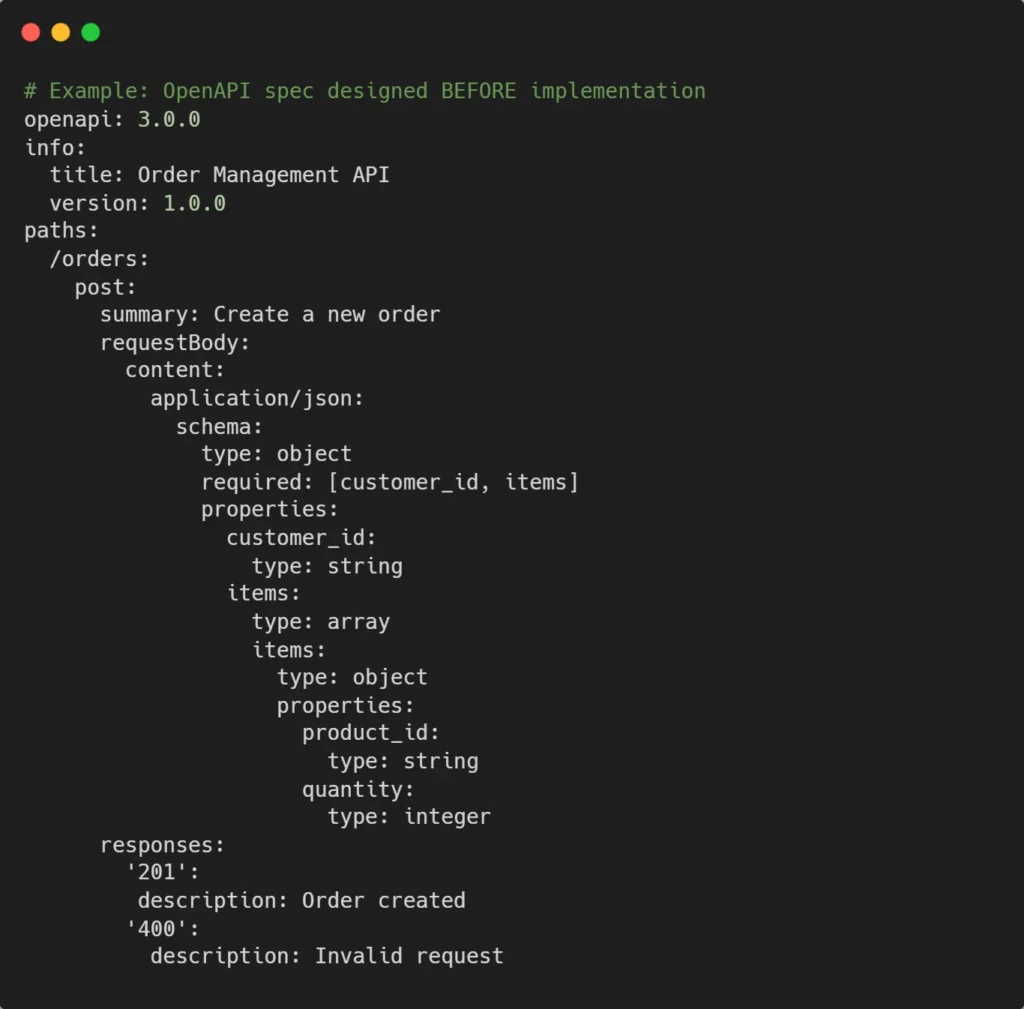
This spec is reviewed, agreed upon, and published before anyone writes implementation code. Frontend teams can build against mock APIs generated from the spec. Backend teams implement the actual logic. QA teams generate test cases. All in parallel.
Principle 2: Treat Your API as a Product
APIs require a product management focus; engineering alone is not sufficient. This involves identifying the users of your API (internal departments, third-party developers, AI agents), understanding their needs, and defining your success criteria (number of users, user retention, time-to-first-call, error rates).
Organizations that consider APIs as products experience very different results. Postman’s research indicates that 63% of developers in API-first companies are able to create a functioning API in less than a week; on the other hand, code-first companies still have very long timelines. The faster development not only benefits one release but the whole product cycle.
Principle 3: Build for Parallel Development
One of the biggest practical benefits of API-first development is enabling parallel workstreams. Once the API contract is defined:
- The backend team implements the API logic.
- The frontend team builds the web UI against mock API responses.
- Mobile team builds the app against the same mocks.
- QA writes automated tests against the contract.
- Documentation is auto-generated from the spec.
- Third-party developers can start integration planning.
Without API-first design, these teams work sequentially — backend finishes, then frontend starts, then mobile, then docs. That sequential dependency is the single biggest source of timeline bloat in product development.
Principle 4: Version and Govern from Day One
API-first development requires a versioning strategy from the start — not bolted on after your first breaking change.
The standard approaches:
URL versioning: /api/v1/orders → /api/v2/orders — simple, explicit, easy for consumers to understand.
Header versioning: Accept: application/vnd.myapi.v2+json — cleaner URLs but less discoverable.
The rule: never break a published contract without a new version. Old versions get deprecation timelines (minimum 6 months), migration guides, and sunset dates. This discipline is what separates APIs people trust from APIs people abandon.
Principle 5: Design for the AI Agent Era
This is the 2026-specific principle that most API guides miss. With Gartner predicting 40% of enterprise apps will embed AI agents by the end of 2026, your API isn’t just being consumed by human developers anymore — it’s being consumed by AI systems that discover, understand, and call APIs autonomously.
This means your API needs to be machine-readable, well-documented with clear descriptions of what each endpoint does, and semantically structured so AI agents can reason about when and how to call it. Tools like MCP (Model Context Protocol) are enabling AI models to interact with APIs directly, and APIs designed with API-first development principles are inherently better suited for this AI-driven consumption pattern.
This is the same architectural shift driving the move from AI agents replacing SaaS tools — agents orchestrate across APIs rather than navigating UIs. Products without clean APIs become invisible to the agent layer.
API-First Development by Industry
- When we talk about SaaS and B2B software, one thing is clear: having an API-first approach is not something we can compromise on. Every single B2B product needs to be able to integrate with other things. That is why Zapier has been able to connect with over 8,000 apps. All of these apps built their APIs first. If a product does not have an API, it is not going to be able to participate in the automation economy.
- For e-commerce, there are these things called commerce platforms. Companies like Shopify have something called the Storefront API. Then there are companies like commercetools and BigCommerce. All of these platforms are API-first, which means they separate the part of the platform that handles commerce from the part that users interact with. This allows brands to create their unique experiences for customers while still using the same backend infrastructure.
- In the fintech world, companies like Stripe have shown us that launching a product with an API approach is the way to go. There are companies like Plaid that handle banking data, Twilio that handles communications, and Alpaca that handles trading. All of these companies have products that are based on APIs and then have user interfaces built on top of them.
- When it comes to healthcare, there are these things called FHIR APIs, which stand for Fast Healthcare Interoperability Resources. These APIs are becoming a requirement for exchanging healthcare data. If we develop products with an API approach, we can make sure we are complying with the rules while also being able to innovate in areas like patient portals, telehealth, and clinical systems.
- For AI and automation, the entire ecosystem is based on APIs. There are companies like OpenAI, Anthropic, Claude, Google Gemini, and Hugging Face. Every single AI model is used through an API. If we are building products that use AI, we have to use an API approach. It is not something we can choose to do or not do. It is the way that works.
Common Mistakes That Kill API-First Initiatives
- Mistake 1: Designing the Application Programming Interface Around Your Database Schema – The Application Programming Interface should be about what the business does, not about the Database Schema. People who use the Application Programming Interface do not care that there is a users table and an orders table with a key in the Database Schema. They care about things like when they can use the Application Programming Interface to do something like POST checkout and GET my orders. So the Application Programming Interface should be designed for the things people will use it for, not for the data it holds.
- Mistake 2: Not Thinking About the Developer Experience – If the documentation for the Application Programming Interface is too hard to understand, people will use an Application Programming Interface. When you make an Application Programming Interface, you should also make things that help developers, like documentation, software development kits in major programming languages, sandbox environments, and error messages that clearly tell developers what went wrong and how to fix it.
- Mistake 3: Not Having Rate Limiting or an Authentication Strategy – Starting an Application Programming Interface without things like rate limiting, Application Programming Interface keys, and OAuth is like opening a store without any locks on the doors. You should think about security when you first start making the Application Programming Interface, not after someone does something to the endpoint.
- Mistake 4: Making Everything From Scratch – You should use things that are already known to work. Use REST for things like creating, reading, updating, and deleting data. Use GraphQL when people need to be able to ask for data in various ways. Use WebSockets for things that need to happen in time. Use gRPC when different parts of your system need to talk to each other. Do not make a custom protocol unless you have a good reason to do so.
- Mistake 5: Not Thinking Documentation is Important – When you make an Application Programming Interface, the documentation is just as important as the code. You should make the documentation using tools like Swagger UI or Redoc. You should keep it up to date every time you make a change. You should also test the documentation to make sure it is correct, just like you test the code. The Application Programming Interface documentation should not be something you do later; it should be something you do at the time, as the Application Programming Interface.
Implementation Roadmap: Going API-First in 30 Days
- Week 1: Audit and Plan. Inventory your current APIs. Identify which products or services need an API-first redesign. Define your API consumers (internal teams, partners, public developers, AI agents). Set success metrics.
- Week 2: Design Contracts. Write OpenAPI specs for your core APIs. Run design reviews with frontend, mobile, QA, and any partner teams. Publish the specs internally. Generate mock servers so teams can start building immediately.
- Week 3: Build and Test. Implement the API logic against the published spec. Run contract tests to verify the implementation matches the spec exactly. Set up CI/CD pipelines that fail on contract violations. Build automated integration tests.
- Week 4: Document, Launch, Monitor. Generate interactive documentation. Set up API analytics (latency, error rates, adoption). Launch with versioning and deprecation policies in place. Establish a feedback loop with consumers.
For teams building on automation platforms like n8n, API-first architecture means your product can be integrated into customer workflows on day one — not after months of custom integration work.
Conclusion: API-First Development Is Product-First Thinking
API-first development isn’t a technical methodology — it’s a product philosophy. It forces you to think about your product’s value as a service that can be consumed, integrated, extended, and automated by anyone — human developers, partner platforms, and now AI agents.
Stripe proved that an API can be worth $95 billion. The $20 billion API economy proves that APIs are revenue products, not technical plumbing. And the 4.6 trillion daily API calls prove that the world’s software already runs on APIs — whether your product participates or gets left behind.
In 2026, API-first development isn’t a competitive advantage. It’s the minimum bar for any product that intends to survive in an ecosystem where AI agents, automation platforms, and partner integrations define how software gets used.
Design the API first. Build everything else on top. That’s how modern products are built.
About Orbilon Technologies
Orbilon Technologies is an AI and software development agency that builds API-first products, microservices architectures, and AI-powered integrations. With 10+ years of engineering experience and a 4.96 average rating across Clutch, GoodFirms, and Google, we help product teams design, build, and scale APIs that become competitive moats.
Need an API-first architecture for your product? Get a free consultation from our engineering team.
- Website:orbilontech.com
- Email: support@orbilontech.com
Want to Hire Us?
Are you ready to turn your ideas into a reality? Hire Orbilon Technologies today and start working right away with qualified resources. We will take care of everything from design, development, security, quality assurance, and deployment. We are just a click away.