

The Global B2B SaaS Market 2026 Is $634 Billion — and It's Headed to $4.4 Trillion by 2034: Is Your Strategy Ready?
Introduction
Most companies are buying SaaS. The smart ones are building a strategy around it. That distinction — between reactive SaaS adoption and deliberate SaaS strategy — is exactly what separates the organizations winning in the global B2B SaaS market 2026 from the ones drowning in tool sprawl, redundant subscriptions, and disconnected workflows.
The global B2B SaaS market is valued at $634.39 billion in 2026, projected to reach $4,441 billion by 2034 at a CAGR of 27.54%. That’s not incremental growth — it’s a 7x expansion in eight years. And it’s being driven by three forces compounding simultaneously: AI integration into every SaaS product, enterprise cloud migration accelerating past the point of no return, and a new generation of vertical SaaS platforms displacing horizontal tools that no longer fit specific industry needs.
SaaS is currently responsible for around 70% of company software use, forecast to rise to 85% by 2026.
Companies use an average of 106 SaaS applications each in 2024. That’s not a portfolio — that’s chaos. And the global B2B SaaS market 2026 is rewarding the companies that bring strategy to that chaos, not just more tools.
This post covers what’s driving the $634B market, which segments are growing fastest, where the real strategic opportunities sit in the 2026–2034 window, and what it means for your organization — whether you’re a buyer, builder, or both.
What's Actually Driving the Global B2B SaaS Market 2026?
The headline growth number — 27.54% CAGR — doesn’t happen without specific structural drivers. Understanding what’s actually fueling the global B2B SaaS market 2026 tells you where the opportunities are concentrated.
1. AI Integration Is Becoming Table Stakes
By 2026, the figure would be 75% of SaaS companies that employ AI-powered automation for at least one major business process. Successful SaaS software in 2026 would not be the ones with the most features, but those in which AI significantly improves the fundamental workflow by making it faster, more accurate, or more independent.
Salesforce, with its Einstein AI, and HubSpot with its Breeze, and Microsoft Copilot are, among others, gigantic platforms that integrate AI so profoundly that it would be very expensive for users to change them. The global market for AI-generated SaaS is estimated to reach $770.32 billion in 2031, with an expected compound annual growth rate of 40.2% from 2024 to 2031. For SaaS developers, differentiating their product in 2026 will not be a question of “are you using AI?” but rather, “in which part of your workflow does AI perform so well that even your competitors can’t get close?”
2. Vertical SaaS Is Displacing Horizontal Platforms
The era of one-size-fits-all horizontal SaaS is eroding from both ends. At the enterprise level, companies are consolidating onto fewer, deeper platforms. At the mid-market level, vertical SaaS — software built specifically for healthcare, legal, manufacturing, real estate, or education — is displacing generic tools that require too much customization to be useful.
The healthcare segment sustains 22% of SaaS revenue shares and is predicted to record the highest CAGR of 26% during the projected period. Healthcare professionals migrating applications to the cloud for hybrid and remote working is driving a category expansion that generic platforms can’t serve as effectively as vertical-first products.
3. Cloud Migration Is Past the Point of Return
Almost 62% of large companies are placing their main focus on SaaS-first IT strategies, while 48% of new hardware/software integrations already include AI-driven analytics and automation. The number of companies still relying solely on on-premise solutions is decreasing every quarter. Enterprise IT budgets are being increasingly planned around SaaS subscriptions rather than hardware purchases and license fees, and this fundamental change is what keeps the global B2B SaaS market on its 2026 growth path, irrespective of the economic environment.
4. Micro-SaaS and Niche Solutions Are Multiplying
The micro-SaaS movement is raising the level of the game substantially, with tiny, niche-oriented SaaS companies that focus on particular industries or address very specific problems. For business owners and product teams, this is one of the very few opportunities left in the current market that are both highly accessible and yield high return on investment: identify a vertical workflow that large horizontal platforms treat generically, and develop a focused SaaS product that offers a specific solution to this workflow.
The $634B Market by Segment: Where the Money Is
The global B2B SaaS market in 2026 is far from uniform. Knowledge of the largest and fastest-growing segments transforms general market knowledge into a concrete strategy.
a. CRM SaaS — Largest Single Segment
CRM SaaS accounted for $94.05 billion in 2025, representing 35% of the total market, and is forecast to grow at a compound annual growth rate (CAGR) of 16.2% between 2025 and 2034, driven by AI integration, automation, and personalization.
Salesforce HubSpot Microsoft Dynamics, and Pipedrive are the leaders in this segment; however, the AI layer is generating new competition. AI-native CRM platforms that build on Claude, GPT-5.4, and Gemini for smart prospecting, automated follow-up, and pipeline analytics are beginning to gain significant market share from the old platforms that just add AI on top of 20-year-old data architectures.
b. ERP SaaS — Enterprise Infrastructure
ERP SaaS strongly influences the direction of a country’s economy and its production capabilities. ERP SaaS made up $67.18 billion in 2025, or 25% of the entire market, with a forecast that it will increase by a CAGR of 15.5% due to factors such as automation, analytics, and real-time integration. The ERP sector is the place where the biggest corporate deals are made and where AI incorporation is providing the highest measure of ROI. Real-time financial forecasting, autonomous procurement workflows, and AI supply chain optimization are all going to be core ERP functionalities in 2026.
c. HR SaaS — Fastest Human Capital Growth
HR SaaS Rapid Expansion of Human Talent HR SaaS made up $53.74 billion in 2025, which was 20% of the whole market; predicted to increase by a CAGR of 15.8%, mainly because of hybrid workforce management and talent retention strategies. Hybrid work is not just a consequence of the pandemic; it is now the normal operating mode of most knowledge-work organizations. HR SaaS systems that cover performance management, learning and development, compensation planning, and employee experience across distributed teams are experiencing significant enterprise spending.
d. SCM SaaS — Supply Chain Intelligence
SCM SaaS accounted for $40.31 billion in 2025, representing 15% of the total market, projected to grow at a CAGR of 16.0%, fueled by logistics digitalization and demand forecasting solutions.
Post-pandemic supply chain disruption drove massive investment in SaaS-based supply chain intelligence platforms. That investment is now producing real returns — and the category is growing accordingly.
Regional Breakdown: Where Global Growth Is Coming From
| Region | Market Share | Key Growth Driver |
|---|---|---|
| North America | 40% | Enterprise cloud adoption, AI-native SaaS, strong VC ecosystem |
| Europe | 25% | Manufacturing ERP, GDPR-compliant SaaS, government digitalization |
| Asia-Pacific | 25% | SME adoption in India/China, IT outsourcing, fastest CAGR at 24.6% |
| MEA | 10% | UAE digital economy, Saudi Vision 2030, Sub-Saharan mobile-first |
The Strategic Challenge: 106 Apps, No Real Connection
In 2024, companies use about 106 SaaS applications on average. This shows a big problem many businesses face in the B2B SaaS market by 2026: they’ve been buying SaaS tools without a clear plan for years, ending up with a bunch of separate apps that cause more hassle than help.
The issues show up the same way across different organizations:
- Customer info is stuck in Salesforce, financial details live in NetSuite, support tickets sit in Zendesk, and product data is in Jira — none of these systems share data in real time.
- Companies spend extra money on several tools that do the same job in different departments, often without IT knowing.
- Custom connectors between apps break whenever one tool updates, causing integration headaches.
- Adding more SaaS apps increases security risks, as each one can be a point where data might leak or be accessed improperly.
More interestingly, 40% of SaaS purchases come from people outside the IT team who buy for their own groups, not from a centralized process. This scattered buying leads to the 106-app overload. The way out involves carefully cutting down and consolidating tools, building platforms that can talk to each other through APIs, and planning SaaS use more strategically. This is what sets apart SaaS setups that actually work well from ones that just collect dust and waste money.
What Smart Organizations Are Doing Differently in 2026?
The organizations capturing the most value from the global B2B SaaS market 2026 share a set of strategic behaviors that go beyond buying more tools:
1. Choosing Platforms Instead of Adding Separate Tools
Rather than picking a new tool every time they need a new feature, they’re going for platforms that cover multiple areas. For example, using Salesforce for CRM, marketing, and service, or Microsoft 365 for productivity, collaboration, and business intelligence. This approach makes integration simpler, cuts down overall costs, and gives them more power when dealing with vendors.
2. Preferring AI-Native SaaS Over AI-Enhanced SaaS
There’s a big difference between SaaS products built with AI at their core and those that simply add AI as a feature later on. Smart buyers in 2026 want to see AI actually deliver independent results, not just provide recommendations, before they agree to a contract.
3. Knowing When to Build or Buy with Clear Guidelines
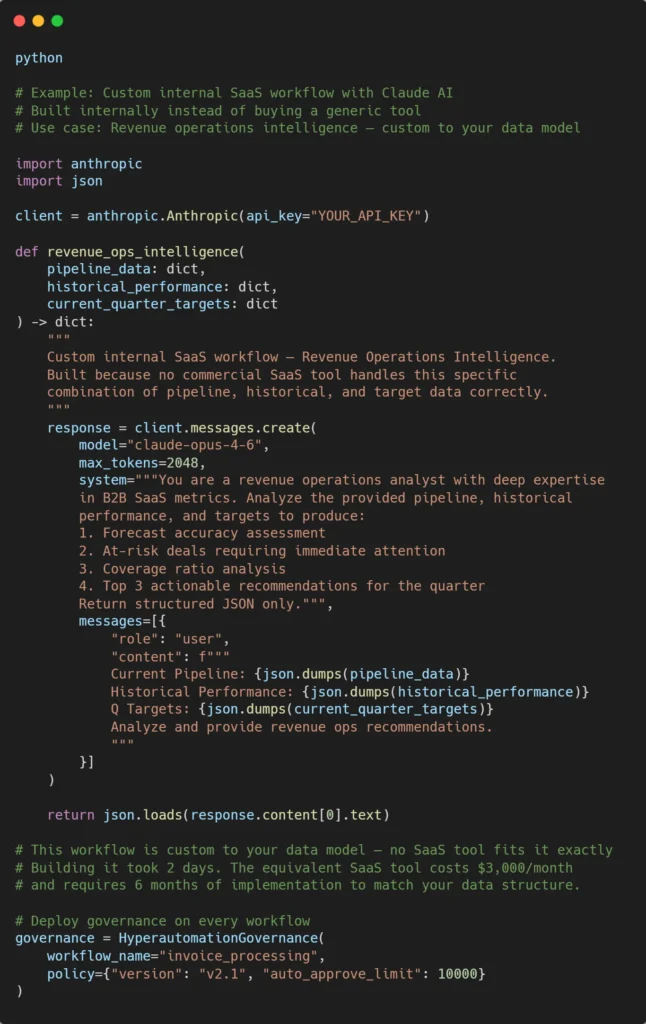
Not every process needs a SaaS tool. Companies with engineering resources are creating their own tools for workflows where existing SaaS either doesn’t match their needs or risks exposing sensitive data. The general idea is to buy standard workflows and build the ones that make the company stand out.
4. SaaS Rationalization as a Recurring Process
Nearly 70% of new users stop using software within three months, showing that user retention is a major challenge. The same dynamic applies to enterprise SaaS — tools get bought, deployed to a team, and then quietly abandoned while the subscription renews automatically. Organizations running quarterly SaaS audits — identifying underutilized tools, consolidating overlapping capabilities, and renegotiating contracts — consistently achieve 20–30% reductions in SaaS spend without losing any productive capability.
Opportunities in the Global B2B SaaS Market 2026 — For Builders
- If you’re building in the global B2B SaaS market in 2026, the white space is specific:
- Vertical AI-native SaaS — Every horizontal platform is trying to be everything to everyone. The opportunity is in being everything to one industry — with AI trained on domain-specific data, compliance requirements embedded from day one, and workflows that match how that industry actually operates.
- SaaS integration and orchestration — The 106-app problem is real and growing. Tools that help enterprises connect, rationalize, and govern their SaaS portfolios are in high demand. n8n, Workato, and Zapier Enterprise are capturing this market — but the enterprise tier, especially for regulated industries, is still largely unsolved.
- AI agents as SaaS features — The next generation of B2B SaaS doesn’t have a UI for the end user — it has an agent that operates the workflow autonomously. The companies embedding agentic AI into their SaaS products as core features — not demos — are the ones that will capture the lion’s share of the $4.4 trillion endpoint.
- Micro-SaaS in underserved verticals — Over 150 SaaS companies achieved unicorn status in 2026. Many of them are narrow, deep vertical products. The pattern is repeatable: find a workflow in a high-value industry that generic platforms handle poorly, build a focused product, charge premium pricing to buyers who have no good alternative.
Conclusion: The Global B2B SaaS Market 2026 Rewards Strategy, Not Just Spending
The global B2B SaaS market in 2026 is $634 billion for a reason: SaaS works. Cloud-delivered software on subscription pricing is the most efficient way ever invented to access enterprise-grade capabilities without enterprise-grade infrastructure investment. That’s not going to change.
What is changing is the strategic layer above the tools. The organizations capturing the most value from this $634 billion market — and positioning themselves for the $4.4 trillion endpoint in 2034 — are not buying more tools. They’re building a strategy around the tools they have: consolidating platforms, embedding AI where it delivers autonomous outcomes, building where commercial products don’t fit, and constantly rationalizing.
Most companies are buying SaaS. The smart ones are building a strategy around it. In the global B2B SaaS market 2026, that distinction compounds every quarter — in cost efficiency, in product velocity, and in the competitive advantage that comes from a coherent technology stack rather than 106 disconnected tools.
The $4.4 trillion is coming. The question is how much of it your organization captures — as a buyer who spends smarter, or as a builder who ships into the white space before it closes.
About Orbilon Technologies
Orbilon Technologies is a product engineering company that builds AI-native SaaS platforms and enterprise software for founders and enterprise teams across the US, UK, and beyond. Based in Lahore, Pakistan, our team designs and ships B2B SaaS products from architecture to launch — with AI capabilities, integration infrastructure, and scalable cloud deployment built in from day one.
Whether you’re rationalizing your existing SaaS stack, building a new vertical SaaS product, or integrating AI into your current platform, we’ve done it before — and we ship fast.
- 4.96 on Clutch and GoodFirms.
- B2B SaaS product specialists.
- From MVP to enterprise-ready in 90 days.
- Website: orbilontech.com
- Email:support@orbilontech.com
Ready to Build Your B2B SaaS Product or Rationalize Your Stack?
Orbilon Technologies offers a free SaaS product strategy session — whether you’re launching a new vertical SaaS product or optimizing your enterprise tool portfolio for the 2026–2034 growth window. Book Your Free SaaS Strategy Session.
Want to Hire Us?
Are you ready to turn your ideas into a reality? Hire Orbilon Technologies today and start working right away with qualified resources. We will take care of everything from design, development, security, quality assurance, and deployment. We are just a click away.