The $26.9B Hyperautomation Market by 2027 — Are You In or Out? The Real Barriers and How to Beat Them
Introduction
The hyperautomation market 2027 forecast is no longer a guess but a path already defied by reality. According to MarketsandMarkets, the worldwide robotic process automation (RPA) and hyperautomation industry is set to increase marginally from $9.2 billion in 2022 to $26.9 billion in 2027 at a compound annual growth rate of 23.1%.
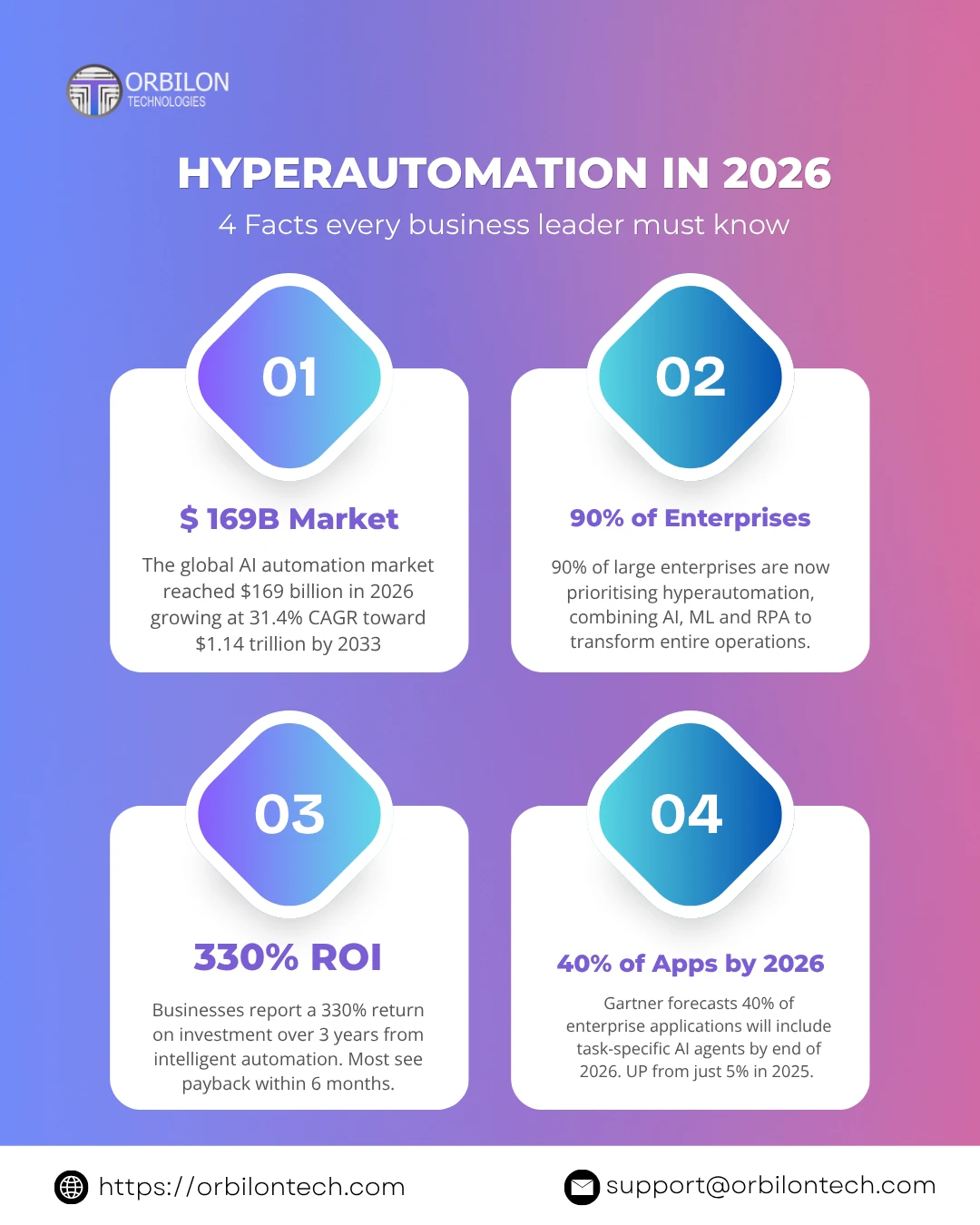
Complementary studies to Gartner have revealed that 90% of large enterprises currently consider hyperautomation as their leading priority. In fact, around 30% of enterprises will be automating more than half of their network activities by 2026, whereas in 2023, it was less than 10%. However, still 31.9% organizations are not adopting it. The figure that represents the block of organizations in utilizing hyperautomation, in reality, is the lack of skills, with 31.9% of the organizations citing it as their biggest challenge. That is not a computer issue. It is a learning and business issue. Most of the time, it’s quite a bit less difficult to fix than enterprise leaders usually think.
Here, we discuss what the hyperautomation market 2027 means for your business, why the majority of implementation difficulties can be overcome, which sectors are rapidly advancing, and the steps in creating your very first hyperautomation workflow.
What Hyperautomation Actually Is in 2026 — Not the 2022 Definition?
Hyperautomation was initially defined as “RPA plus AI.” While this was true in 2022, it doesn’t fully capture how far the technology has evolved. By 2026, hyperautomation had grown into a complete ecosystem, a holistic strategy that employs a range of tools in combination: RPA bots, AI and generative AI models, process mining, low-code applications, intelligent document processing, and orchestration layers functioning like a digital control tower for work. It’s a change in structure. Initially, automation programs would largely consist of RPA pilots, which are bots mimicking human screen interactions in areas like finance or HR.
Nowadays, we witness complete hyperautomation ecosystems where the emphasis changes from “automate this task” to “automate, connect, and continuously improve this entire process or journey.” The simplest way is to take the example of substituting a worker with a machine on one hand, while on the other hand, completely changing the workflow and replacing it with an intelligent system that not only self-monitors, learns from data, escalates whenever necessary, but also can improve without any human interference or reconfiguration. That is what the hyperautomation market of 2027 is essentially offering and what the major businesses are really purchasing.
The core technology stack in a modern hyperautomation system:
| Layer | Technology | Function |
|---|---|---|
| Discovery | Process mining, task mining | Find what to automate and where value is |
| Execution | RPA bots, APIs | Handle structured, repetitive task execution |
| Intelligence | AI/ML, LLMs, GenAI | Handle unstructured data, decisions, and language |
| Document processing | IDP (OCR + NLP) | Read invoices, contracts, claims, and emails |
| Orchestration | Low-code platforms, workflow engines | Connect everything, manage handoffs |
| Governance | Audit logs, policy engines, and monitoring | Control, compliance, auditability |
The $26.9B Market: Where the Money Is Going
The hyperautomation market growth by 2027 is not evenly distributed across industries. The sectors moving fastest and spending most are the ones with the highest volume of rule-based, document-intensive workflows — exactly the workflows that hyperautomation handles best.
BFSI preserved a 27.46% revenue foothold in hyperautomation in 2024, safeguarding compliance, KYC, and high-volume transaction integrity with straight-through processing. Healthcare, expanding at 24.81% CAGR, directs hyperautomation toward patient intake, prior-authorization, and claims coding, alleviating clinician burnout and tightening reimbursement cycles.
The ROI data from deployed hyperautomation systems is compelling and consistent:
- 20–40% reduction in operating costs in targeted areas.
- 40% faster process execution in most implementations.
- 6–12 month payback for high-volume use cases like invoice processing or insurance claims.
- $170 billion in profit gains attributed to automation in the banking sector globally
250% increase in application processing speed in HR workflows using RPA. - Healthcare prior-auth turnaround: from 72 hours to 6 minutes after AI classification integration.
- Manufacturing: 30% productivity increase and 25% reduction in operational costs
- Legal: 22–35% of tasks are now fully automated; AI adoption jumped from 19% in 2023 to 79% in 2024.
These numbers explain why 90% of large enterprises treat hyperautomation as a top priority in the hyperautomation market 2027 race. The organizations capturing this ROI aren’t doing it with experimental pilots — they’re running production systems across multiple functions simultaneously.
Why 31.9% of Organizations Are Still Not Adopting — The Real Barriers?
Barrier 1: Skills Gap (31.9% — #1 Barrier)
The main challenge to adoption is the lack of skills. Most companies will require help and training to properly use automation tools and, therefore, see the benefits over time. This is, in fact, one of the most honest findings in hyperautomation research, not that the technology is ineffective, but rather that the majority of organizations do not possess the internal expertise capable of implementing it in a correct manner.
Why it’s solvable: The hyperautomation market 2027 has taken action regarding this problem. Low-code and no-code platforms have changed the game by empowering not only technical professionals but also domain experts to develop automation workflows independently without the need for engineering support. Hyperautomation-as-a-Service (HaaS) cloud platforms offer not only tools and infrastructure, but also implementation support, and in-house expertise is no longer a requirement. Moreover, citizen developer programs where domain experts create their own automations under very simple governance guidelines are yielding measurable outcomes in enterprises of all sizes.
Barrier 2: Legacy System Integration
Legacy system integration with implementation costs, which are quite expensive, and challenges of barriers are the second most quoted ones. The majority of enterprise data resides in systems of the 1990s and 2000s – SAP, Oracle Mainframe applications, and custom-built ERPs – that didn’t anticipate API integration, so they are not suitable for it.
How is it possible to overcome? RPA tools of today are designed UI-based – they do to legacy systems the same way as a person, that is, through the existing interface, without APIs or system changes. This is the main reason why RPA was created and the main reason it is still a component of every automation stack in the automation market 2027.
Barrier 3: Process Identification
A key stumbling block in implementing RPA and hyperautomation is the identification of the appropriate business processes for automation and the optimization of those processes before automation is initiated.
How it can be done: Process mining software is getting more and more user-friendly each day, and the adoption hurdles are getting lower. Products such as Celonis, UiPath Process Mining, and Microsoft Power Automate Process Advisor can fetch you an automation priority list based on real data instead of guesswork. These products analyze your actual system logs to identify which processes are highest-volume, most rule-based, and most expensive.
Barrier 4: Governance and Measurement Gaps
Less than 20% of large companies say that they have really mastered measurement and governance for their hyperautomation projects. Most companies are heavily investing in automation, but aren’t able to clearly demonstrate what is working.
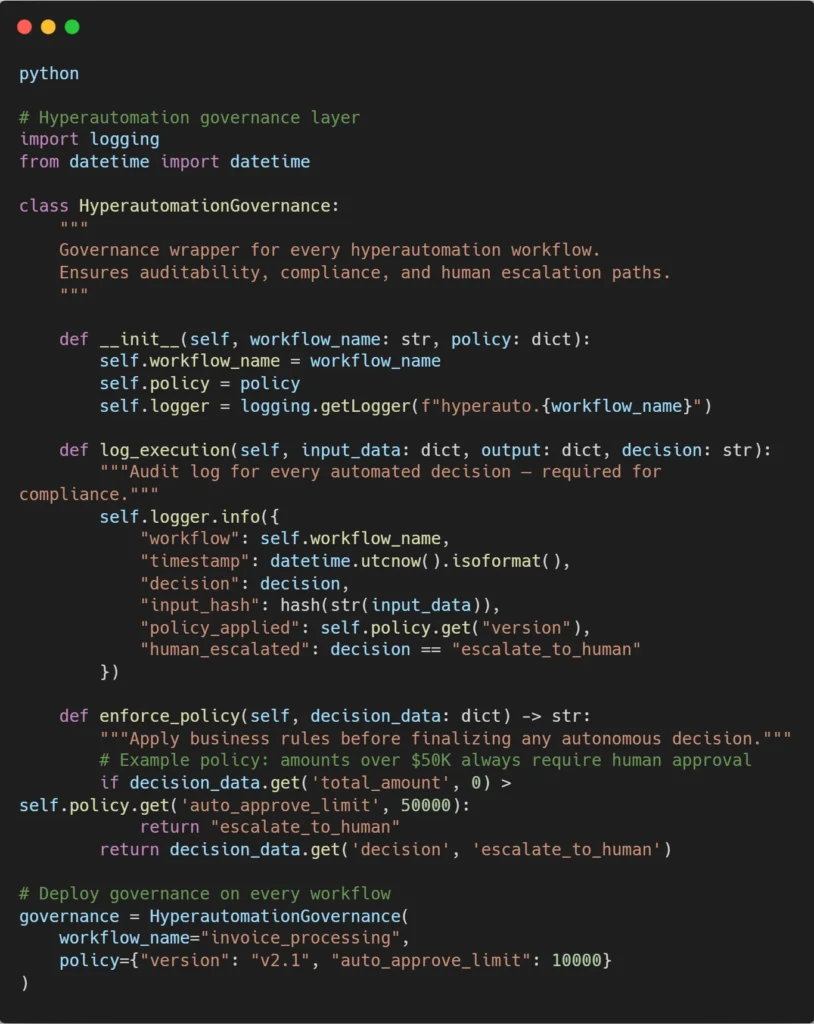
How it can be done: Vendors now offer platforms that integrate governance controls – audit logs, policy engines, explainability – directly into automation platforms instead of outsourcing them. Besides, the measurement framework has become a norm: monitoring cost per process execution, error rate vs. human baseline, throughput improvement, and payback period per workflow.
Industries Winning in the Hyperautomation Market 2027
- Banking and Financial Services: Banks and financial institutions face the highest volume of rule-based, compliance-sensitive workflows of any industry — loan processing, KYC verification, transaction reconciliation, regulatory reporting, and fraud detection. Automation is behind $170 billion in profit gains in banking globally, with 20–30% cost reductions and the potential for 54% of banking jobs to be automated in certain functions. Real production example: An Illinois health system trimmed prior-auth turnaround from 72 hours to 6 minutes after integrating AI classification and smart forms — freeing staff for care coordination. The same pattern applies in banking: mortgage processing, credit decisioning, and compliance reporting all follow the same high-volume, rule-based structure that hyperautomation handles.
- Healthcare and Life Sciences: Healthcare is the fastest-growing segment in the hyperautomation market in 2027, expanding at a 24.81% CAGR. Hyperautomation enables professionals to complete tasks in 2–3 hours less time, improves diagnosis accuracy by up to 90%, and makes telemedicine 60% more efficient. The combination of clinical and administrative automation — where AI handles documentation and RPA handles system entry — is the model every large health system is moving toward.
- Manufacturing and Automotive: Intelligent RPA is utilized by 71.4% of worldwide manufacturers, resulting in a 24.6% improvement in quality assurance. Manufacturing and automotive players overlay hyperautomation with IoT telemetry to detect micro-stoppages, sequence production orders dynamically, and trigger automated spare-parts procurement — the full Industry 4.0 workflow that makes factories self-managing.
- Legal Services: The legal sector’s hyperautomation adoption jumped from 19% in 2023 to 79% in 2024 — one of the fastest adoption curves of any professional services industry. 22–35% of legal tasks are now fully automated. 70% of clients prefer to work with a law firm that has implemented hyperautomation tools. The hyperautomation market 2027 in legal is being driven by contract analysis, case research, compliance monitoring, and document review automation.
- Retail and E-Commerce: The marketing and sales function holds the largest market share in hyperautomation adoption. Automated inventory management, dynamic pricing, customer service workflows, returns processing, and personalized campaign generation are all production use cases running at major retailers today.
How to Start: A Practical Hyperautomation Implementation Framework
Step 1: Run a Process Mining Audit
Step 2: Start With One High-ROI Workflow
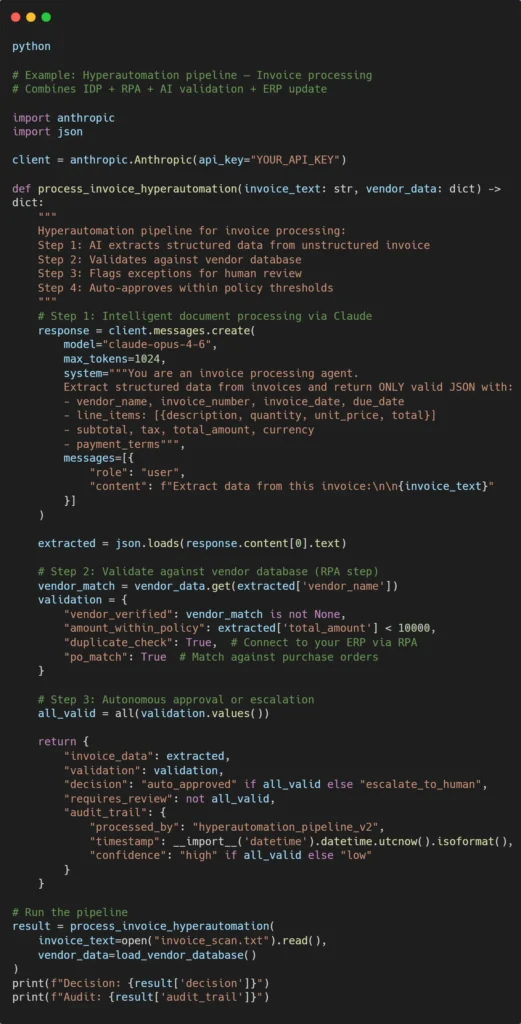
Step 3: Build Governance Before You Scale
Step 4: Measure ROI Per Workflow Before Expanding
Calculate each workflow’s ROI before scaling; monitor four metrics for each workflow: cost per execution versus manual baseline, error rate, throughput volume, and payback period. Once a workflow displays a sustained ROI of over 200% and an error rate of less than 2%, move on to the subsequent workflow on your priority list for expansion.
Step 05: Empower Citizen Developers Within Guardrails Organization
Democratization, combined with a small platform team, is the recipe for the best outcomes. The team should supply secure templates, approvals, and governance guardrails – so non-technical domain experts can build without fear of mistakes and in a uniform manner. Nobody is more familiar with the inefficiencies of the workflow than the people who are working on it daily.
The Tools Winning in the Hyperautomation Market 2027
| Tool Category | Leading Platforms | Best For |
|---|---|---|
| RPA | UiPath, Automation Anywhere, Power Automate | Structured, repetitive task execution |
| Process Mining | Celonis, UiPath Process Mining | Finding automation opportunities |
| Low-Code | Appian, Microsoft Power Platform | Building workflows without coding |
| AI/LLM Layer | Claude Opus 4.6, GPT-5.4, Gemini | Unstructured data, decisions, and generation |
| IDP | ABBYY, Hyperscience, AWS Textract | Document extraction and processing |
| Orchestration | n8n, Zapier Enterprise, Camunda | Connecting tools and managing workflows |
| HaaS Platforms | ServiceNow, IBM Cloud Pak | Full-stack managed hyperautomation |
Conclusion: The Hyperautomation Market 2027 Won't Wait for Stragglers
The hyperautomation market 2027 will reach $26.9 billion because the ROI data is undeniable, the technology is mature, and the enterprises leading their industries are all building hyperautomation into their operating models — not as a project, but as infrastructure.
The 31.9% still on the sidelines are not going to be there in 2027. They’ll either move — driven by competitive pressure, cost mandates, or a new leader who makes the call — or they’ll find themselves structurally disadvantaged against competitors who already have 20–40% lower operating costs in every workflow they’ve automated.
The barriers to the hyperautomation market in 2027 are real but solvable.
Skills gaps close with the right partner and the right platform. Legacy integration works with RPA’s UI-based approach. Process identification is now data-driven with process mining. Governance is now built into every serious platform.
The question isn’t whether hyperautomation will reach $26.9 billion. It will. The question is whether your organization is in the 68.1% capturing that value, or the 31.9% still watching from the outside.
Choose in. Start with one workflow. Measure it. Scale it. The window is open right now.
About Orbilon Technologies
Orbilon Technologies is a digital transformation engineering company that designs and deploys hyperautomation systems for enterprises across finance, healthcare, legal, and manufacturing. Our team — based in Lahore, Pakistan, with clients across the US and UK — builds end-to-end hyperautomation pipelines: process mining, RPA implementation, AI integration, governance frameworks, and ongoing optimization.
If your organization is in the 31.9% still evaluating — or the majority that has started but isn’t seeing the ROI yet — we help you move from pilot to production, fast.
- 4.96 on Clutch and GoodFirms.
- Hyperautomation deployment specialists.
- Measurable ROI in 60 days.
- Website: orbilontech.com
- Email: support@orbilontech.com
Ready to Start Your Hyperautomation Journey?
Orbilon Technologies offers a free process audit — we analyze your highest-volume workflows, identify the top 3 automation opportunities, and give you a clear implementation roadmap with projected ROI in one week. Book Your Free Process Audit.
Want to Hire Us?
Are you ready to turn your ideas into a reality? Hire Orbilon Technologies today and start working right away with qualified resources. We will take care of everything from design, development, security, quality assurance and deployment. We are just a click away.