Claude Opus 4.6 Legal AI: 90.2% Benchmark, $4.1 Trillion Opportunity, and the Smartest Business Decision of 2026
Introduction
The numbers are not subtle. Claude Opus 4.6 legal AI scored 90.2% on BigLaw Bench — the highest score ever recorded for any Claude model on a legal reasoning evaluation. At the same time, the global legal tech AI market is on track to reach $477 billion by 2035, growing at a 33.63% CAGR from a $35 billion base in 2026. When you factor in the broader $4.1 trillion in economically valuable professional knowledge work that AI models like Opus 4.6 are now capable of handling — finance, legal, compliance, research — the scale of the opportunity becomes hard to dismiss.
The legal industry has historically been slow to adopt technology. That’s changing fast. Corporate legal AI adoption more than doubled in a single year — from 23% in 2024 to 52% in 2025. By the end of 2026, the firms and enterprises that build real AI workflows into their legal operations will have a structural advantage that competitors cannot close by simply buying more headcount.
This post covers exactly what Claude Opus 4.6 legal AI can do, which industries benefit most, and how to start implementing it in practical, production-ready ways.
Why Claude Opus 4.6 Is the Legal AI Benchmark Leader?
On Harvey’s BigLaw Bench evaluation suite, Opus 4.6 scored 90.2% — the highest score yet for the Claude family of models. With 40% of tasks receiving perfect scores, the model demonstrates strong legal reasoning capability across both litigation and transactional practice areas. Deal management, risk assessment, and corporate strategy tasks were particular standouts.
To understand why this matters, you need to know what BigLaw Bench actually tests. This isn’t a multiple-choice trivia benchmark. It measures complex legal reasoning — contract interpretation, motion drafting, regulatory analysis, case law application, and cross-document synthesis. These are the exact tasks that junior associates and paralegals spend thousands of billable hours on every year.
These results highlight strengths in contract analysis, research memos, and motion drafting. The model is available via claude.ai, Anthropic API, and major cloud platforms, including Microsoft Azure. Anthropic positions Opus 4.6 for end-to-end enterprise workflows, reducing rewrites and improving first-try accuracy.
Claude Opus 4.6 legal AI doesn’t just score well on paper — it’s already deployed in production at Harvey, one of the leading AI platforms for law firms, where early feedback confirms gains in analytical depth, cleaner outputs, and better source citations in real legal research tasks.
What Makes Opus 4.6 Different for Legal Work?
a. Million Token Context Window
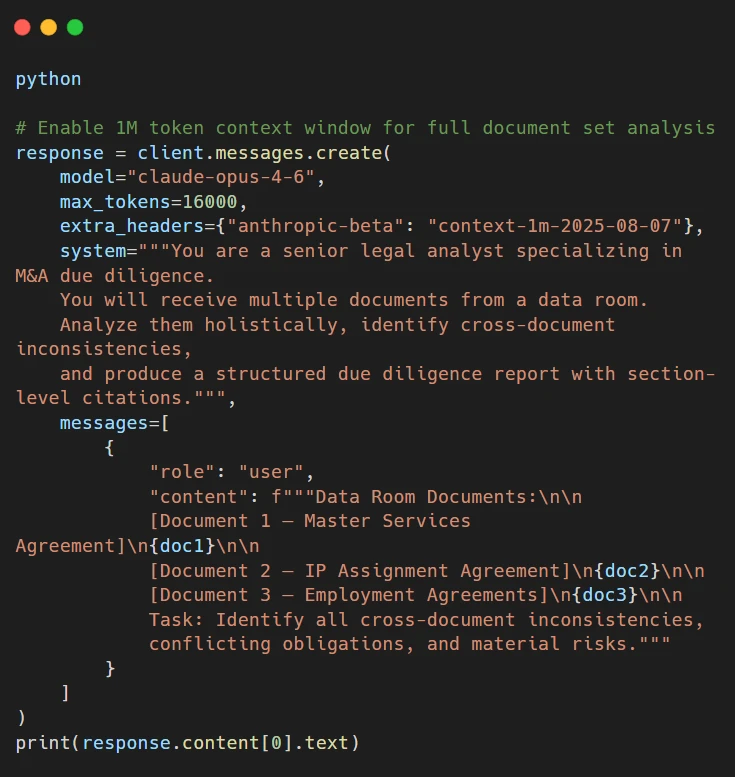
Opus 4.6 supports up to 1 million input tokens in beta. This equals roughly 750,000 words or 10–15 full research papers. The model can process entire codebases, multiple documents, or long conversation histories without performance drops. Previous models suffered from “context rot” — performance degraded as conversations grew longer. Opus 4.6 fixes this problem.
For legal professionals, this is the single most practically significant feature. Entire contracts, case files, regulatory archives, and due diligence document sets can be loaded into a single prompt and analyzed without chunking, without losing cross-references, and without the context degradation that plagued earlier models.
b. Adaptive Thinking Mode
Opus 4.6 introduces adaptive thinking mode. The model decides when and how much to reason based on task complexity. Previous models used extended thinking with a fixed token budget. Now Claude evaluates each request and adjusts automatically.
For legal tasks that range from simple clause extraction to complex multi-document risk analysis, this matters. A routine NDA review gets a fast, lightweight response. A 200-page M&A due diligence package triggers deep, multi-step reasoning automatically — without the developer or user having to configure anything.
c. #1 on Knowledge Work Benchmarks
On economically valuable knowledge work tasks, it outperforms the previous leader GPT-5.2 by roughly 144 Elo points. On GDPval-AA — which tests AI performance on real professional tasks across finance, legal, and research — Claude Opus 4.6 legal AI leads every frontier model currently available. For enterprise teams where accuracy in high-stakes documents directly affects financial and legal outcomes, this benchmark has more practical relevance than most.
Where Does the $4.1 Trillion Come From?
That $4.1 trillion? It’s the total value of work that AI like Claude Opus 4.6 can now do well. Think legal stuff, crunching financial numbers, staying compliant, digging into research, and dealing with tons of documents—all the stuff pros do around the world.
In 2025, the Legal Tech AI Market was worth $26.28 billion. It’s predicted to hit $35.11 billion in 2026, then $46.92 billion in 2027, and a huge $477.1 billion by 2035. That’s like growing by 33.63% each year! Turns out, over 68% of legal outfits are putting cash into AI to work faster, and about 54% say they’re getting more done than with old-school systems.
Corporate legal adoption shot up in one year, going from 23% in 2024 to 52% in 2025. Thomson Reuters says that AI use in legal groups went from 14% to 26% year after year, with 78% of law firms thinking AI will be a key part of how they work within five years. Maybe the biggest deal? Now, 64% of in-house teams think they won’t need outside lawyers as much because of AI.
That last number should make law firms pay attention: 64% of in-house legal teams expect to use outside counsel less because of AI. The firms that add Claude Opus 4.6 legal AI into their work now are the ones that will keep those clients. The ones that don’t are already losing them.
Real Use Cases: What Claude Opus 4.6 Legal AI Does in Practice
i. Contract Review and Risk Extraction
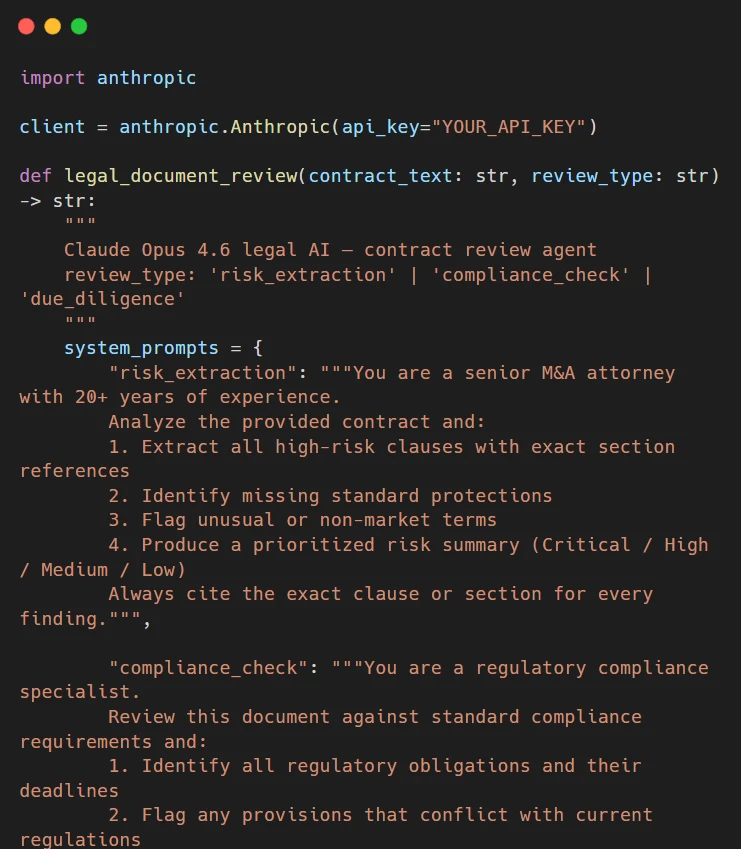
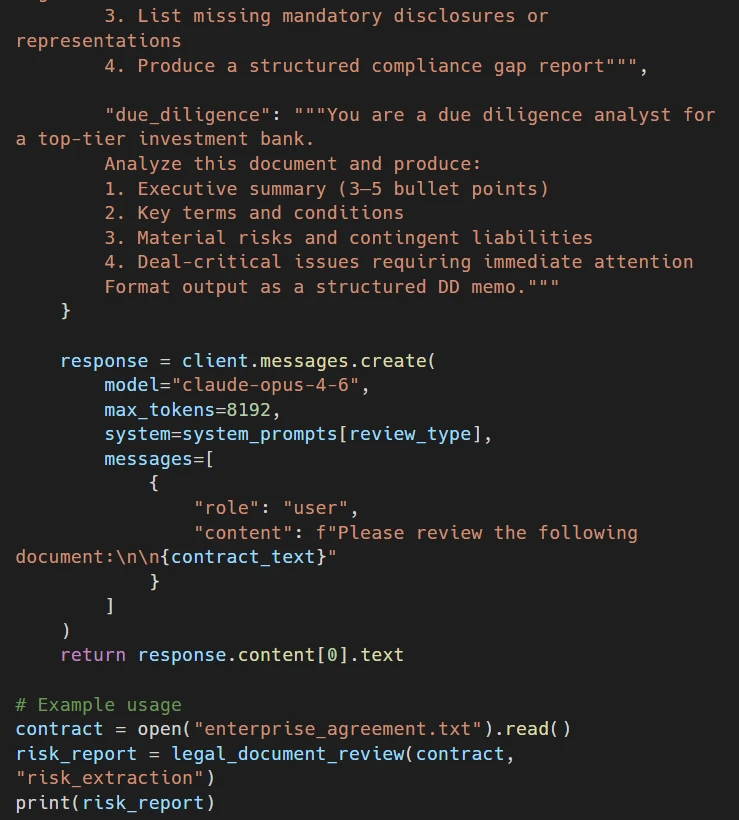
Feed Claude Opus 4.6 a full commercial contract — even a 300-page enterprise agreement — and ask it to extract all obligations, flag high-risk clauses, identify missing standard protections, and produce a prioritized risk summary. The 1M context window means the entire document is analyzed in one pass. No chunking. No lost cross-references between sections.
Opus 4.6 secures 90.2% on BigLaw Bench (40% perfect scores), successfully trapping subtle, structural vulnerabilities that standard semantic or keyword searches bypass entirely. In Box evals, it demonstrates a 10-point leap in multi-source legal and financial analysis. It is the structurally superior choice for M&A due diligence and strict compliance auditing.
ii. Legal Research and Case Memo Drafting
Claude Opus 4.6 legal AI handles multi-source legal research tasks — pulling together case law, regulatory text, internal precedents, and client context — and producing structured research memos with proper citations. Harvey reports early access testing shows improved analytical depth and better source grounding compared to any prior Claude model.
iii. Regulatory Compliance Review
Between the EU AI Act (August 2026), the Colorado AI Act (June 2026), and proliferating state requirements, formalized AI policies have shifted from best practice to a compliance obligation. Compliance teams using Claude Opus 4.6 can load entire regulatory frameworks alongside internal policies and get gap analyses, compliance checklists, and remediation plans — in a single prompt.
iv. Due Diligence at Scale
M&A due diligence traditionally involves dozens of associates reviewing thousands of documents over weeks. Claude Opus 4.6 legal AI can process entire data rooms — corporate filings, contracts, IP records, litigation history — and produce structured diligence summaries flagged by risk category. The ROI here is direct: finance and legal due diligence tasks that mitigate error risks costing $10,000+ deliver a single accurate analysis that saves $5,000–$50,000 per request, at a request cost of $2–$10.
v. Document Drafting and Template Generation
Opus 4.6 understands professional domain conventions. It produces documents, spreadsheets, and presentations that match expert-created work. For legal teams, this means drafting motions, NDAs, vendor agreements, employment contracts, and compliance policies at a quality level that requires minimal attorney review — not the heavy editing that AI-generated legal content typically demands.
Industries That Benefit Most
- Law Firms (BigLaw and Mid-Market) — The 90.2% BigLaw Bench score and Harvey integration make Opus 4.6 the clearest AI choice for firms handling complex litigation, M&A, and transactional work. Firms that deploy it in associate-level research and drafting workflows gain measurable speed and cost advantages.
- Corporate Legal Departments — With 64% of in-house teams already planning to reduce dependence on outside counsel, Claude Opus 4.6 legal AI gives in-house teams the capability to handle more work internally—contract review, compliance monitoring, and vendor agreement management—without proportional headcount growth.
- Financial Services and Banking — Legal and compliance overlap heavily in finance. Opus 4.6 leads on Finance Agent (60.7% accuracy, SOTA) and GDPval-AA (1606 Elo, a 70% win-rate against GPT-5.2). For banks, insurance firms, and investment managers handling regulatory filings, credit agreements, and compliance documentation, this is the strongest model available.
- Healthcare and Life Sciences — Regulatory submissions, clinical trial agreements, IP licensing, and FDA compliance documentation all require the same multi-document reasoning that Opus 4.6 excels at. Justin Reppert from Elicit reported Claude Opus 4.6 achieved 85% recall on a biopharma competitive intelligence benchmark — a 12-point lift over baseline through autonomous 15-minute discovery loops with zero prompt tuning.
- Real Estate and Property — Lease review, title document analysis, and development agreement drafting are document-intensive, repetitive, and high-stakes — exactly the category where Claude Opus 4.6 delivers consistent, production-grade output.
- Consulting and Professional Services — Complex engagement letters, SOW agreements, liability frameworks, and regulatory advisory documents all benefit from a model that reasons precisely across long, interconnected documents.
How to Implement Claude Opus 4.6 Legal AI?
Option 1: Claude.ai (No Code)
Available at claude.ai on Pro ($20/month) and Max ($100/month) plans. Best for individual attorneys and small teams doing document review, research, and drafting. Upload documents directly and prompt Claude in plain language.
Option 2: Direct API Integration
Model ID: claude-opus-4-6
Here’s a production-ready Python implementation for contract review:
Option 3: Extended 1M Token Context for Large Document Sets
Option 4: Cloud Platforms for Enterprise Compliance
For legal teams with strict data residency, governance, and audit requirements:
Microsoft Azure (Microsoft Foundry) — Matej Jambrich, CTO at Dentons Europe, confirmed: Claude in Microsoft Foundry delivers the frontier reasoning strength needed for legal work, backed by the governance and operational controls required in an enterprise environment.
Amazon Bedrock — Full AWS IAM, VPC, and data residency controls.
Google Cloud Vertex AI — LangChain-compatible with enterprise security built in.
Pricing for Legal Workflows
| Usage Pattern | Cost |
|---|---|
| Standard input tokens | $5.00 / 1M tokens |
| Cached input (repeated prompts/templates) | $0.50 / 1M tokens — 90% cheaper |
| Output tokens | $25.00 / 1M tokens |
| Batch processing (non-urgent tasks) | 50% discount |
| Large context >200K tokens | 1.1× pricing premium |
The ROI Case for Legal Teams
For complex monolithic refactor tasks, Opus 4.6 completes work in 1–2 requests, saving 4–8 hours of senior engineering time worth $600–$2,000, at a request cost of $1–$5, delivering 100–400× ROI. For finance and legal due diligence, a single accurate analysis saves $5,000–$50,000 versus error risks, at a request cost of just $2–$10.
Translate that to legal work specifically: a junior associate billing at $350/hour, spending 6 hours on contract review costs a client $2,100. Claude Opus 4.6 legal AI handles the same review in minutes at a cost of under $5. The attorney then spends 45 minutes reviewing and refining the output — delivering a better work product faster, at significantly lower cost to the client.
For high-volume legal work — vendor agreement review, NDA processing, employment contract standardization — the math compounds quickly across hundreds of documents per month.
Conclusion: The $4.1 Trillion Opportunity Won't Wait
Claude Opus 4.6 legal AI represents a genuine inflection point for professional services. A 90.2% score on BigLaw Bench isn’t a marketing claim — it’s a verified benchmark from Harvey, one of the most rigorous legal AI evaluation platforms in the industry. The 1M token context window removes the single biggest practical barrier to AI in legal workflows. The adaptive thinking mode means the model reasons as deeply as each task demands, automatically.
The $4.1 trillion opportunity in professional knowledge work is not a future prediction — it’s already being captured by early movers. Law firms using Claude Opus 4.6 legal AI today are completing research faster, producing cleaner first drafts, and reviewing more documents with the same team. The firms still evaluating are watching that gap widen every week.
The decision isn’t complicated. The implementation is straightforward. The ROI is documented. The only thing left is to start.
About Orbilon Technologies
At Orbilon Technologies, we build AI-powered web apps, mobile applications, SaaS platforms, and custom software solutions for startups and enterprises worldwide. Based in Lahore, Pakistan, with a US presence, our team brings production-grade experience integrating enterprise AI models — including Claude Opus 4.6 — into legal, financial, and business workflows.
With a 4.96 rating on Clutch and GoodFirms and clients across the US, UK, and beyond, we build AI solutions that deliver measurable results — not pilot programs that never ship.
Website: orbilontech.com
Email: support@orbilontech.com
Ready to Build Claude Opus 4.6 Legal AI Into Your Workflow?
Whether you’re a law firm, corporate legal team, or enterprise compliance department, Orbilon Technologies can help you design, build, and deploy a Claude Opus 4.6 legal AI workflow that delivers real ROI from day one. Book a Free Consultation
Want to Hire Us?
Are you ready to turn your ideas into a reality? Hire Orbilon Technologies today and start working right away with qualified resources. We will take care of everything from design, development, security, quality assurance, and deployment. We are just a click away.