
AI Agents Replacing Apps: Why 2026 Is the Year of Agents?
Introduction
The app store era is ending. Every app you use today will eventually be replaced by an AI agent. And here is what that actually means for your business.
That might sound dramatic, but look around. OpenAI just rolled out workspace agents in ChatGPT that connect your tools, run on schedules, and complete entire workflows on their own. Google launched its Gemini Enterprise Agent Platform at Cloud Next 2026 and openly called this the start of the “agentic era.” Microsoft is pushing Copilot Studio as a place to build agents that connect to your business data and run autonomous processes. When the three biggest tech companies on earth all pivot to the same idea in the same year, it is not a trend. It is a turning point.
For fifteen years, the internet was organized around apps. You opened one app to message, another to order food, another to manage customers, and another to track money. The app became the doorway to everything digital. But in 2026, that doorway is changing shape. The next interface is not another app you open. It is an intelligent agent that moves across all your apps and just gets the job done.
So let me break down what “the year of agents” really means, why this shift matters more than the hype suggests, and most importantly, what your business should actually do about it.
From Apps You Open to Agents That Act
Here, the simplest way to understand the shift is. For fifteen years, software worked one way: you navigated the tools. You opened the app, clicked the buttons, filled the forms, and did the work yourself. The app was a place you went to, basically.
AI agents flip that in a totally different fashion. Now the software navigates the tools for you. You just say what you want, in plain language, and the agent figures out the steps, then runs them across whatever apps it needs. One industry analysis described it pretty well, like, “the app era taught people how to operate software, while the agent era will teach software how to operate work”.
Think about booking a business trip. The old way: you open a flight site, then a hotel site, then your calendar, then your expense tool, juggling five apps and like a dozen tabs. The agent way: you say, “Book me a trip to Dubai under $1,500 next Tuesday,” and the agent searches for flights, compares hotels, checks your schedule, and completes the booking. Same result, but there is zero app-switching.
Here is the shift in one picture:
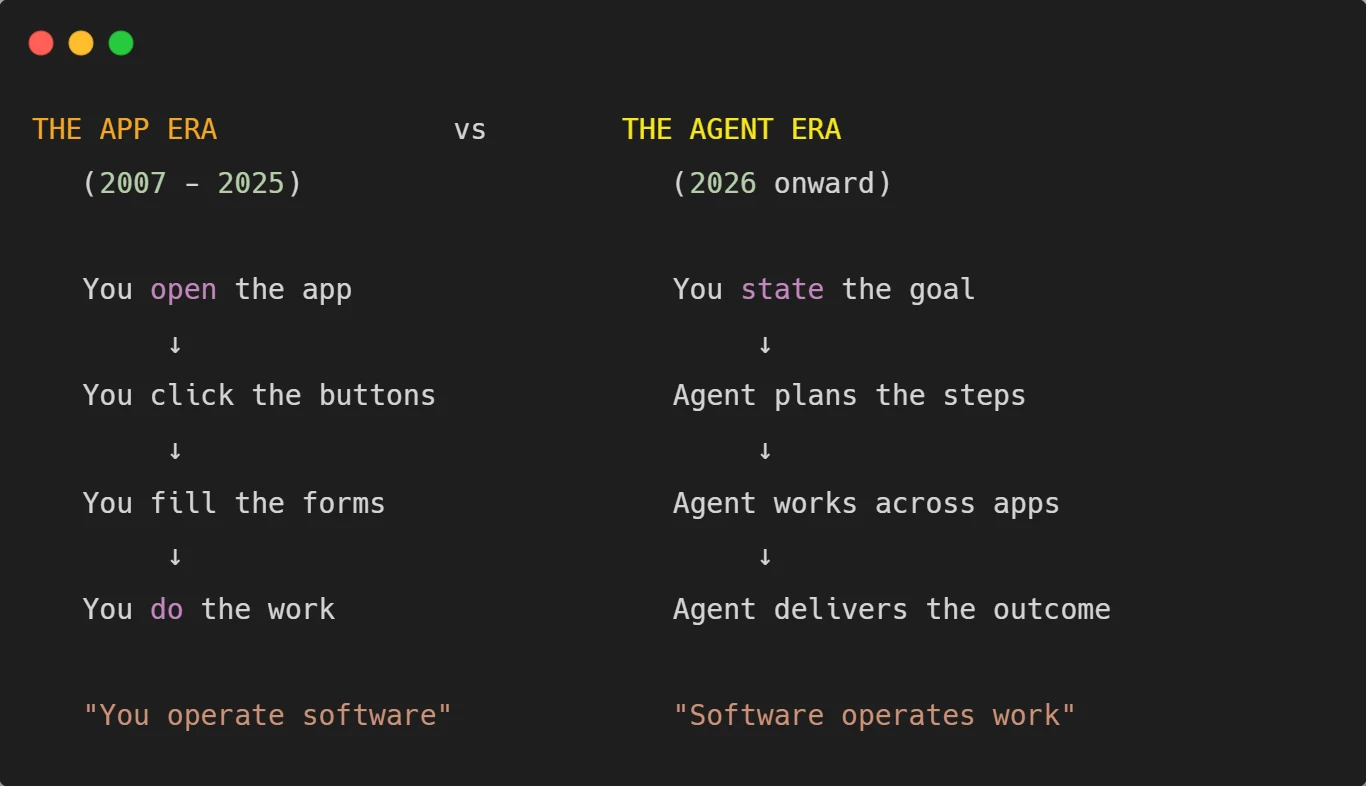
That single change, from “tapping and swiping” to “reasoning and delegation,” is why people are calling this the biggest interface shift since the smartphone. And it is exactly the pattern we have been documenting in our coverage of AI agents replacing entire SaaS tools, now playing out at the consumer level too.
Why This Is Happening Now (And Not Two Years Ago)?
You might wonder why this is exploding in 2026 specifically. The idea of AI agents replacing apps has floated around for years, after all. The honest answer is that the infrastructure finally caught up.
A few things clicked into place at once. Models can reason well enough now to handle multi-step tasks without falling apart. Tool integrations have become reliable. Enterprise data connectors became standard. Admin controls and security have matured to the point where businesses can actually trust agents with real work. None of that was true two years ago. Today it is.
There is also a deeper reason the app era is ending: it created too much fragmentation. Every task needs its own app, its own login, its own subscription, its own notifications. Switching between all of them creates what one writer called a “context-switching tax” that quietly kills your focus and productivity.
Agents remove that tax entirely by becoming a single intelligent layer over everything. This is the natural next step beyond hyperautomation in 2026, where businesses have already started combining tools into coordinated systems. The next interface is not another app. It is the thing that moves across all of them.
The Real Battle: Who Controls the Agent Layer?
Here is the part most coverage misses, and it is the part that actually matters for business. This shift is not really about smarter chatbots. It is a battle over who controls the layer between you and your work.
Think about it. Whoever controls the agent layer controls the workflow. Whoever controls the workflow controls the enterprise. That is why OpenAI, Google, Microsoft, Anthropic, Salesforce, and ServiceNow are not just competing to build smarter models. They are racing to become the control layer for how work actually gets done. The model is almost beside the point now. The real prize is owning the agent that sits on top of everything.
For your business, this raises a question you cannot ignore: in a world where agents do the choosing, will an agent choose you? When a customer’s agent goes looking for a service, a vendor, or a tool, your business is either in the agent’s consideration set or it is invisible. There is no storefront to walk into, no ad to catch the eye.
The agent decides, and it decides based on data, not branding. This is the same shift we explored in our piece on how AI agents are reshaping B2B buying, where Gartner predicts agents will mediate the majority of business purchases.
What the End of the App Era Means for Your Business?
Look, let’s keep it practical. This shift changes real things, like how businesses have to run day to day. Not theory. Here’s what actually counts, and no, it’s not only “AI buzzwords”.
- Your software has to be agent-readable: Back in the app era, you basically won by having the smoothest interface and the most stubborn user habits. But in the agent era, the advantage moves somewhere else entirely. The best product is the one an agent can actually operate, not only the one that looks polished. So your software needs clean APIs, structured information, clear permissions, and outputs that behave every time. If you’re a founder building anything in 2026, you should ask a very simple thing: can an agent use it, not just a person? If the answer is no, it might still feel fine for users, but it will quietly fall behind in agent-based workflows.
- Distribution shifts from app stores to agent actions: For a long time, distribution meant rankings in app stores, search pages, and brand gravity. In the agent era, distribution becomes about which tools agents pick to complete a task. A user won’t really “search best invoicing software” anymore. Instead, they’ll just say, ” Send an invoice to this client, then nudge them 7 days later. Whoever the agent reaches for wins. And that is a totally different game. It also rewards companies that make themselves easy to discover and easy to use, by agents, without friction.
- Apps do not vanish; they turn into engines: Now here’s the nuance the loud doom stuff tends to miss. Apps are not disappearing. They are changing their job. Think about apps like engines inside a car. You used to deal with the engine directly. Now you interact with the car, and the engine does its thing in the background. So apps become specialized service layers that agents call on, instead of places people “visit” for everything. Some apps will stay strong as direct tools for pros who want granular control. But for most routine stuff, the agent is the front door.
Which Businesses Win in the Agent Era?
Not every business feels it equally. This shift, it seems, hits hardest when the workflows are built up in a structured way, kinda repetitive, and they stretch across multiple tools. That’s where agents are moving the fastest, not later :
- Sales: enriching lead data, drafting outreach, updating the CRM, and scheduling follow-ups.
- Customer support: classifying tickets, pulling account details, issuing refunds with approval rules.
- Finance operations: reconciling invoices, summarizing spend, flagging anomalies, and creating payment requests.
- Recruiting: sourcing candidates, drafting scorecards, scheduling interviews, syncing records.
If your company lives in any one of those areas, then the agent shift is not some far-off plan. It is landing right now. A lot of these workflows already run on the kind of automation we covered in our guide to workflow automation tools for 2026, and well, that’s the base layer agents stack on top of. The businesses that prepare, by making their systems agent-ready, will ride that wave.
Meanwhile, the ones who cling to UI-heavy manual routines will slowly lose visibility, even if the core product is genuinely strong. And yeah, this is the same blunt truth at the heart of our analysis on why AI projects fail: the gap is rarely the tech, it’s mostly that the business didn’t adapt around it.
How to Prepare Your Business for the Agent Era?
Okay, so what do you actually do about all this? You do not need to panic, and you definitely do not need to rebuild everything overnight. But you do need to start. Here is a sensible sequence.
- Audit your agent-readiness. Look at your core systems and ask honestly: could an AI agent interact with these today? Do you have clean APIs, structured data, and clear permissions? Most businesses discover real gaps here, and finding them now beats finding them when a customer’s agent skips you.
- Expose your best workflows to agents. Pick the repetitive, high-value workflows in sales, support, or finance and make them agent-accessible. Good documentation, standardized outputs, and narrow permission scopes go a long way. This connects directly to having a solid API-first architecture, which is fast becoming the foundation of agent-ready business.
- Build trust and governance early. Agents acting on your behalf, or your customers’ behalf, need guardrails. Decide what agents can do autonomously and where a human signs off. This is not optional once real money and data are involved. If you want this built properly, this is exactly what our agentive AI application development focuses on: AI agents replacing apps that act proactively while staying safe and governed.
- Think outcomes, not interfaces. Stop asking “how do we make our app prettier” and start asking “what outcome does our customer want, and how do we deliver it, whether they use our interface or an agent does.” That mindset shift is the whole game.
- Start small and learn. Pick one workflow, make it agent-ready, and measure what happens. You will learn more from one real pilot than from a year of strategy decks.
Conclusion: The Door Is Changing, Not Closing
The app store era really is ending, but here is the reassuring part: this is an opportunity, not a catastrophe. The businesses that understand the shift early, and make themselves agent-ready, will have a real edge over competitors still polishing app interfaces nobody will open.
The year of agents is not about apps vanishing overnight. It is about the interface to your business changing from something people tap to something agents call. Your customers will increasingly delegate their tasks to AI agents, and those agents will choose which tools, services, and vendors to use. The only question that matters is whether they choose you.
So do not wait for the shift to wash over you. Audit your systems, expose your best workflows, build the trust layer, and start thinking in outcomes instead of interfaces. The door to the digital world is changing shape. Make sure your business is on the other side of it, ready to be chosen, when the agents come knocking.
Get Agent-Ready With Orbilon Technologies
The agent era rewards businesses whose systems agents can actually use. Orbilon Technologies helps you get there, building agent-ready APIs, structured data layers, custom AI agents, and secure automations using GPT, Claude, and LLaMA across AWS, Azure, and Google Cloud, so your business stays visible and usable when customers’ agents come looking.
As a government-approved IT service provider with international clients across the US, Europe, and the Middle East, we deliver compliant, dependable AI systems for fintech, healthcare, and enterprise teams, the kind built to perform in an agent-first world. Clients stay with us for our transparent workflows, fair pricing, and full post-launch support, reflected in strong ratings across Clutch, Google, Upwork, and GoodFirms.
Want your business ready for the agent era? Get a free consultation. We will assess your agent-readiness and build a practical roadmap to keep you visible when AI agents replacing apps become the new front door.
Want to Hire Us?
Are you ready to turn your ideas into a reality? Hire Orbilon Technologies today and start working right away with qualified resources. We will take care of everything from design, development, security, quality assurance, and deployment. We are just a click away.