
Multi-Agent Dashboards: How to Manage a Fleet of AI Agents in 2026?
Introduction
Picture this: you’re running a business with 50 employees, but you have no CRM, no org chart, and no real way to see who’s doing what. People keep doing the same thing twice; they bump into each other, and nobody can tell where things stand. Sounds like chaos, right? Well, that’s basically how most companies are running their AI agents in 2026, and yeah, it’s starting to sting.
Here is the thing. Deploying one AI agent is easy. Deploying ten, or fifty, or a few hundred, that’s an entirely different game. The moment you scale past a couple of agents, they start living in little silos, duplicating effort, and generating conflicting answers, with no real trail of evidence to show what happened. The industry even has a name for this particular mess now: agent sprawl. And the only genuinely solid fix is a multi-agent dashboard, a single control panel that helps you see, manage, and govern your whole fleet of AI agents from one place.
Trying to manage agents without a dashboard feels kind of like running a company without a CRM. You might limp along for a while, but you’re basically flying blind, and sooner or later it comes due. So let me break down what multi-agent dashboards are in practice, why they have suddenly become required, and how to set one up the right way, without overcomplicating it.
Why a Single Agent Is Easy, But a Fleet Is Hard?
When you have just one AI agent doing one job, life is kinda simple. You can watch it, fix it if it breaks, and pretty much keep the whole thing in your head. But businesses aren’t stopping at one agent anymore. They are rolling out specialized agents for sales, support, finance, coding, research, and a dozen other functions, and then things start to get messy, very messy.
One industry guide said it pretty bluntly, without a centralized control layer, agents end up in silos. They duplicate work, they churn out conflicting outputs, and there’s basically no audit trail. Picture two agents trying to update the same customer record at the same time, or three agents independently emailing the same lead. That is not automation at that point; it’s more like a liability with extra steps.
The numbers show clearly how fast this is moving. MCP, the open protocol that helps agents talk to tools and even to each other, went from about 2 million monthly SDK downloads at its November 2024 launch to 97 million by March 2026. That’s roughly a 4,750% jump in 16 months, plus there are now more than 10,000 active MCP servers running across places like ChatGPT, Claude, Cursor, and Microsoft Copilot. Agents are multiplying everywhere, and the companies deploying them are quickly realizing they need a way to manage the whole fleet, not only individual bots.
This feels like the natural next chapter in the enterprise AI agents story we’ve been telling. Gartner even predicts 40% of enterprise applications will embed agents by the end of 2026. And if every app has an agent, then somebody still has to manage all of them, end to end, otherwise it falls apart.
What Exactly Is a Multi-Agent Dashboard?
Let me keep it kinda simple. A multi-agent dashboard is like a single pane of glass that helps you observe, steer, and run multiple AI agents all at once. It’s basically mission control for your AI fleet, but you know, without the sci-fi headset
A good one pulls together a few important abilities into one screen, and it doesn’t feel like you’re stitching stuff together:
- Observability: you can see what each agent is doing, in real time, which jobs they’re chewing on, what inputs they pulled, and how each workflow actually moved along. No more black boxes, no mystery smoke
- Cost tracking: you track token usage and cost breakdowns per agent and per workflow, so you’re not blindsided by the bill later in the month. It should be obvious before you’re stuck.
- Routing and coordination: you decide which agent takes which work item, in what sequence, and with what level of authority, so they stop “stepping on” each other like busy coworkers
- Governance and audit: every agent action is logged, so you can show what happened, enforce rules, and stay compliant. Like real compliance, not just “trust me”
- Human oversight: if an agent does something risky, say it tries applying a discount above an approved cap, the dashboard pauses, then routes it to a person for review before it proceeds. Nothing scary goes out the door automatically.
Without those pieces, you’re basically debugging a distributed system with no logs, which anyone who’s done it will tell you is pure nightmare fuel.
The CRM Analogy That Makes It Click
The image headline nails it: managing agents without a dashboard is like running a business without a CRM. And honestly, that comparison is more accurate than it first sounds.
Think about what a CRM does for your sales team. Before CRMs, salespeople kept customer info in their heads, in spreadsheets, in sticky notes. Deals fell through the cracks. Two reps would call the same lead. Nobody knew the real pipeline. The CRM fixed all that by giving everyone one shared, visible system of record.
A multi-agent dashboard does the exact same thing for your AI agents. Here is the parallel side by side:
| Situation | Without the System | With the System |
|---|---|---|
| Sales team (CRM) | Leads lost, reps duplicate calls, no pipeline visibility | One source of truth, clear ownership, full visibility |
| AI agents (Dashboard) | Tasks lost, agents duplicate work, no fleet visibility | One source of truth, clear agent ownership, full visibility |
The parallel is almost perfect. And just like no serious business would run sales without a CRM today, pretty soon no serious business will run AI agents without a dashboard. We are just early in that shift right now.
Real Proof: How AIG Manages Its Agent Fleet?
This is not a theory. Some of the biggest companies in the world are already doing this, and the results are showing up on their earnings calls.
Insurance giant AIG, working with Palantir and Anthropic, built an orchestration layer that manages fleets of specialized agents as one coordinated system. The payoff was real and measurable. In its Q1 2026 earnings call, AIG revealed this orchestration layer was live across its commercial lines, processing 370,000 submissions without adding a single new employee. Even more telling, Claude aligned with human adjusters 88% of the time on claim assessments, one of the first hard numbers any major carrier has shared on AI-human agreement.
And the financial impact? AIG’s general insurance underwriting income more than tripled to $774 million, up from $243 million a year earlier. The lesson the analysts drew was clear: the winners in enterprise AI are not the ones deploying smarter individual agents. They are the ones building coordination layers that manage agent fleets as unified systems.
That is the whole point of a multi-agent dashboard. It is the difference between a pile of clever bots and an actual system you can trust to run your business. This is exactly the kind of disciplined deployment that separates success from the failures we covered in ” Why AI Projects Fail, where the gap is almost always governance and coordination, not model quality.
The 4 Things Every Multi-Agent Dashboard Needs
If you are going to build or buy one, here are the four components that actually matter. Skip any of these and you will feel the pain later.
Here is how the four layers stack together into one dashboard:
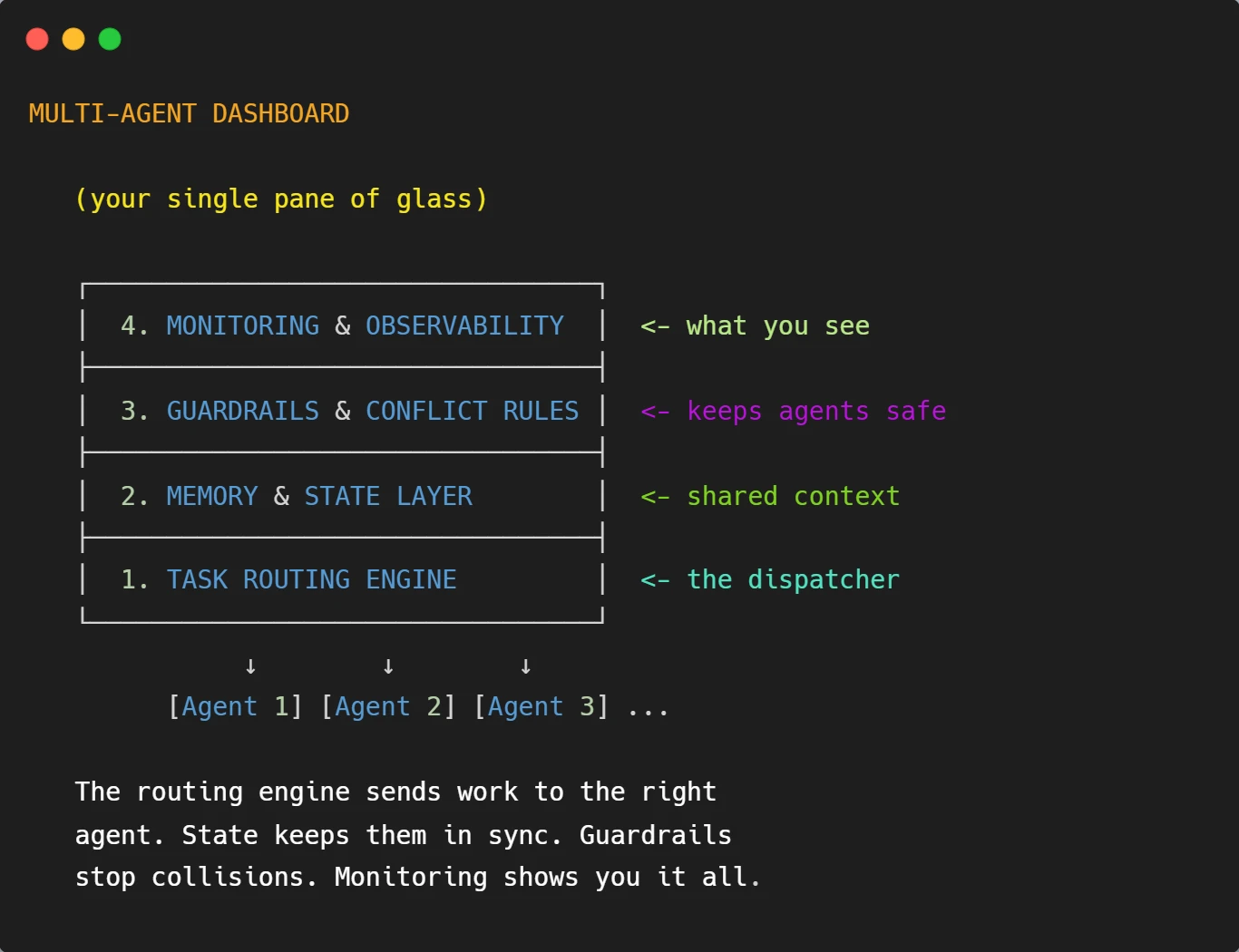
Now let me break down each layer:
- A Task Routing Engine: This is the dispatcher. It decides which agent handles each incoming task. Routing can be rule-based (“billing questions always go to the billing agent”) or smarter and dynamic, where an orchestrator reads the task and picks the best agent based on context. Without good routing, tasks land on the wrong agent or get handled twice.
- Memory and State Management: Agents need to remember context as work moves between them. This layer keeps shared information consistent, so an agent picking up a task knows what happened before. For real-time workflows, this needs to be fast; we are talking sub-millisecond reads, which is why in-memory stores with vector search have become the standard here.
- Guardrails and Conflict Resolution: When multiple agents work at once, they will eventually disagree or collide. This layer stops them from making conflicting changes, scans inputs and outputs for problems like prompt injection or exposed personal data, and keeps everyone in their lane. This connects directly to the security concerns we covered in our guide to AI agent security risks, where uncontrolled agents become a real attack surface.
- Monitoring and Observability: This is the dashboard part everyone pictures. Real-time tracking of performance, token costs, latency, and errors per agent and per workflow, plus full audit trails. Without it, you cannot debug, cannot optimize, and cannot prove compliance when someone asks.
Why This Is Suddenly a Big Deal in 2026?
You might be wondering why this is all blowing up now. The answer is a mix of explosive growth and a looming problem that Gartner has been warning about.
Gartner calls it “agent sprawl,” and it is exactly what it sounds like: companies ending up with a chaotic zoo of AI agents from different vendors, built on different frameworks, with no central way to manage them. To address this, a whole new category of software has emerged, called Agent Management Platforms (AMPs), which are essentially enterprise-grade multi-agent dashboards.
Gartner’s prediction here is striking. By 2030, they expect these platforms to dominate 80% of all successful agent-to-agent interactions and capture over 60% of AI’s compounded value. In plain terms, the dashboard layer, not the individual agents, is where most of the value and control will live. The standards are maturing fast, too, with protocols like MCP and Agent-to-Agent (A2A) now governed by the Linux Foundation’s new Agentic AI Foundation, backed by Amazon, Anthropic, Google, Microsoft, and OpenAI.
There is also a sobering reason this matters. While Gartner predicts 40% of enterprise apps will embed agents by the end of 2026, they also warn that over 40% of agentic AI projects may be canceled by 2027, largely due to governance gaps. A multi-agent dashboard is how you stay on the winning side of that statistic. The same disciplined, system-level thinking underpins what we have called hyperautomation in 2026.
How to Get Started Without Overcomplicating It?
Ok, so you think you really need this, but like, how do you even kick it off? I mean, practically, you want a sequence that keeps everything sane-ish, not chaotic. So here’s one way to start.
- First, map what you already have. Before you buy anything, take a notebook or spreadsheet and list every agent running in your business. What it does, what it can access, and who owns it. Yeah, most companies get a surprise here because there’s always more stuff than they remember. You really can’t govern what you never mapped, not in any meaningful way.
- Next, go with a vendor-agnostic route. The protocols like MCP and A2A are still kind of settling down, so don’t lock yourself into one company’s ecosystem. A dashboard that only manages agents it built itself, that’s not management, that’s more like a walled garden with extra steps. Pick something that can govern agents across frameworks and clouds, and you’ll paint yourself into a corner quietly.
- Then begin with observability, and after that add control. You do not need the entire feature set on day one. Please don’t. Start with just seeing what your agents are doing, the costs, the errors, and the actual workflows. Once you have that visibility, then layer in routing, guardrails, governance, all the fun things.
- Also, build in human oversight from the start. Decide which actions need a person to approve, things like financial transactions, data access, or anything irreversible. Make your dashboard pause and escalate automatically when those moments happen. And no, this part is not optional for anything that matters, like at all.
- Then measure outcomes, not activity. Track what the fleet actually delivers: tasks done, costs saved, errors caught, time reduced. Not just how many agents you’re running or how many “runs” you logged last week. That’s the stuff that keeps it honest and justifies the investment when the budget folks ask.
Teams that follow this path usually end up with systems that scale more cleanly. The teams that skip it often wind up in that 40% that gets canceled or rewritten. And almost every time, the real difference is whether they treated their agents like a managed fleet or like a pile of disconnected scripts. Same core lesson, again and again, at the heart of building an API-first architecture where all these pieces actually work together.
What This Means for Your Business?
Let me bring this home a bit. If your business is using more than two or three AI agents, or planning to, you are going to need a multi-agent dashboard sooner than you think. Here is the quick read, by role, kind of fast.
- If you are a business leader, Agent sprawl is a real cost, even if you cannot see it yet. Duplicated work, runaway token bills, and compliance gaps add up. Treat the dashboard as core infrastructure, not some “later” nice-to-have.
- If you are a technical leader: Prioritize observability and governance before you scale your agent count. It is way easier to build the control layer early than to bolt it on after you have fifty agents running wild.
- If you are just starting with AI agents: Good news, you can build this from the start. Get your dashboard and governance in place before the sprawl shows up, and you will dodge the painful cleanup phase completely.
Conclusion: Your Agents Need a Mission Control
Multi-agent dashboards are not a luxury or a far-off idea. They are quickly becoming the thing that separates businesses getting real value from AI agents from the ones drowning in agent sprawl and canceled projects.
The CRM comparison really is the perfect way to think about it. Just as no serious company would run a sales team without a CRM today, no serious company will run a fleet of AI agents without a dashboard tomorrow. AIG proved the payoff is real, tripling underwriting income while processing 370,000 submissions with the same headcount. Gartner is telling us the dashboard layer will capture most of AI’s value by 2030. The signals could not be clearer.
So if you are deploying AI agents, do not wait until the chaos forces your hand. Build your mission control now, while your fleet is still small enough to organize easily. Your future self, staring at a clean dashboard instead of a tangle of rogue agents, will thank you.
Build Your Agent Dashboard With Orbilon Technologies
When you’re ready to manage AI agents like a real fleet, Orbilon Technologies builds the control layer that makes it work. Like, actually work. We’re the ones who design multi-agent dashboards, orchestration systems, and agent management platforms, with real-time observability, smart routing, cost tracking, guardrails, and human-in-the-loop governance, using GPT, Claude, and LLaMA across AWS, Azure, and Google Cloud.
As a government-approved IT service provider with international clients across the US, Europe, and the Middle East, we build compliant, dependable AI systems for fintech, healthcare, and enterprise teams, the ones that survive an audit and scale without snapping. Our clients stay because our workflows are clear, our pricing stays fair, and our post-launch support is real, not vague, and you can see that in our solid ratings across Clutch, Google, Upwork, and GoodFirms.
Are you drowning in agent sprawl, or trying to sidestep it? Get a free consultation. We’ll review your current agents and sketch a dashboard that puts you back in control, in a calm, coordinated way.
Want to Hire Us?
Are you ready to turn your ideas into a reality? Hire Orbilon Technologies today and start working right away with qualified resources. We will take care of everything from design, development, security, quality assurance, and deployment. We are just a click away.