
The $58B Shake-Up: How AI Agents Productivity Tools Will Replace Every Software You Use by 2027
Introduction
Gartner does not make predictions lightly. So when they say that AI agents‘ productivity tools will create a $58 billion market disruption by 2027, the first real challenge to mainstream productivity software in 35 years, it is a matter of consideration. This idea of AI agents replacing the search bar is far from it. It is more of a complete transformation of how work will be done in the future. AI agents can do more than just assist your team.
They can work, make decisions, and carry out tasks on their own, even across different systems and without instructions. By 2027, they are predicted to be capable of automating between 15% and 50% of routine business processes. Those who are using AI agents have seen their operational efficiency increase by 55%, and their costs go down by 35%. Surprising, isn’t it? Same headcount. Totally different outputs. Something drastic is happening; it concerns us all, and you can start acting on it immediately.
What Are AI Agents Productivity Tools — and Why Are They Different?
So, what’s the deal with AI agent productivity tools, and how are they different from each other? We’ve probably all messed around with an AI chatbot. You type something in, and it spits out an answer.
That’s reactive AI – it just sits there waiting for you to tell it what to do. AI agent productivity tools are a whole different ball game.
They’re proactive, self-driving systems that can plan, do many things at once, work with other tools and info, take action, see what happens, and fix mistakes, all without us having to step in. Think of them less like a search engine and more like a digital coworker who takes a task and sees it through to the end.
For example, an AI customer service agent doesn’t just answer tickets. It can sort them, find account info, automatically fix simple problems, send complicated cases to real people, and keep track of everything that happens. An engineering agent can do more than suggest code; it can understand the code, make changes, run tests, and submit a merge request. That’s the huge shift that is happening fast.
The Numbers Behind the Big Change
The numbers speak for themselves:
- Gartner thinks that using GenAI and AI tools will really shake up how we use regular work programs – the first time in 35 years! This could mean a $58 billion change in the market by 2027.
- By the end of 2026, many business apps (40%) will have AI helpers for specific jobs. That’s a big jump from less than 5% in 2025.
- Companies that use AI helpers say they are much better at getting things done (55% better!) and save a lot of money (35% less costs!).
- Experts think AI helpers will do a lot of the work automatically – maybe 15–50% of business tasks by 2027.
- The AI helpers market is set to get much bigger, growing by 45.8% each year. It could go from $7.63 billion in 2025 to $50.31 billion by 2030.
- Most top bosses (88%) say they’re going to spend more money on AI in the next year because of what AI helpers can do.
- More and more companies are expected to start using self-ruling AI helpers, from 25% in 2025 to about 50% by 2027.
This isn’t just a small thing that only a few people are doing. It’s a huge change in how business software is made, sold, and used.
What's Actually Changing: From Tools to Agents
For decades, productivity software was built around one idea: give humans better tools. Better spreadsheets. Faster email. Smarter project boards. The assumption was always that a human would sit in the loop, making every decision.
AI agents break that assumption.
Enterprise applications are moving beyond the traditional role of enabling employees with digital tools to accommodate a digital workforce of AI agents. Tech leaders are now being forced to decide how far to go in digitizing business processes and orchestrating workflows independent of human workers.
Instead of opening Jira to update a ticket, an agent monitors your deployment pipeline and updates it automatically. Instead of pulling a report from Salesforce, an agent analyzes pipeline health every morning and flags what needs attention before you ask. The software doesn’t disappear — but the human interaction layer around it changes completely.
The era of copilot-only models is fading as organizations adopt agentic systems that deliver outcomes rather than suggestions.
Industries Being Reshaped Right Now
a. Software Development
By 2026, over 70% of enterprise software teams will use AI-assisted development tools across multiple stages of the software development lifecycle — not just coding. McKinsey research shows organizations applying AI across engineering workflows can improve developer productivity by 20–45%.
AI coding agents now read entire codebases, write features, run tests, fix bugs, and submit pull requests. Tools like Claude Code, GitHub Copilot, and Cursor are moving from suggestion engines to execution engines.
b. Finance & Banking
Financial companies think they’ll be spending around $97 billion on AI stuff by 2027 in areas like banking, insurance, markets, and payments. A lot of financial bigwigs (like 70% of them) figure AI will help them make more money.
For example, there’s this old bank in Latin America called Bradesco. They’ve been around for 82 years! They started using AI helpers and got things done faster. It freed up about 17% of their employees’ time and sped up their processes by 22%.
c. Legal Stuff
People think legal tech will be a $50 billion market by 2027. Agent AI, automation, analytics, and safe cloud services are behind it all.
For example, BakerHostetler, a big law firm in the US, used an AI tool for legal research. It dropped research time by 60%, and the accuracy of their case searches went up. This gave their lawyers more time to work with clients.
d. Healthcare
Autonomous AI agents are expected to deliver $150 billion in annual savings for the US healthcare sector by 2026, through clinical documentation, diagnostic support, patient triage, and administrative automation.
e. Customer Service
ServiceNow’s AI agent integration led to a 52% reduction in the time required to handle complex customer service cases. AT&T cut operational expenses by 15%. BT Group automated up to 60,000 customer interactions per week using AI agents.
f. Manufacturing
Manufacturing is hitting a $17.44 billion AI market, with factory agents managing production scheduling and cutting maintenance costs by roughly 25%.
g. Retail & E-Commerce
AI agents now run inventory management, dynamic pricing, and product recommendations autonomously. Retail AI agents are improving in-store conversion rates by around four percentage points through real-time personalization and supply chain optimization
How to Implement AI Agents Productivity Tools in Your Business?
Getting started doesn’t require rebuilding your entire stack. Here’s a practical path:
Step 1: Identify the Right Workflow
First, figure out which process to automate.
Don’t try to do it all at once. Start with stuff that:
- High volume: Happens a lot and has the same steps each time.
- Well-defined: Is super clear on what goes in, what comes out, and how to know if it worked.
- Low-risk: Won’t cause a major disaster if something goes wrong; mistakes should be fixable.
Some good places to start are: sorting customer support requests, making reports, entering data, reviewing code, summarizing documents, and dealing with invoices.
Step 2: Choose Your Agent Platform
| Platform | Best For |
|---|---|
| Claude (Anthropic) | Complex reasoning, document analysis, coding agents |
| OpenAI Agents SDK | General-purpose agentic workflows, GPT-4o integration |
| Microsoft Copilot Studio | Enterprise Microsoft 365 integration |
| Zapier Agents | No-code automation across 8,000+ apps |
| LangChain / LangGraph | Custom multi-agent systems for developers |
| n8n | Self-hosted open-source agent orchestration |
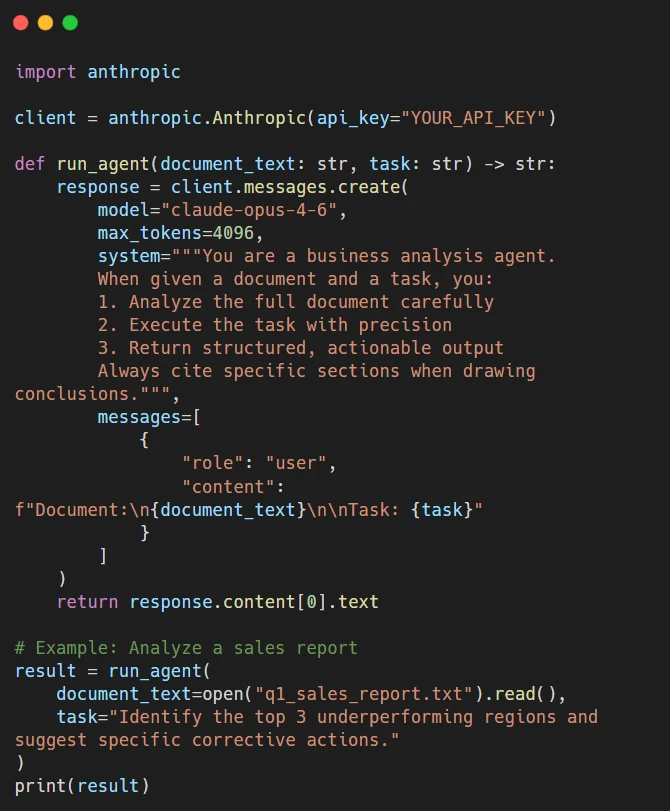
Step 3: Build a Simple Agent with the Claude API
Here’s a minimal Python implementation of an AI agent that reads a document and produces a structured business report:
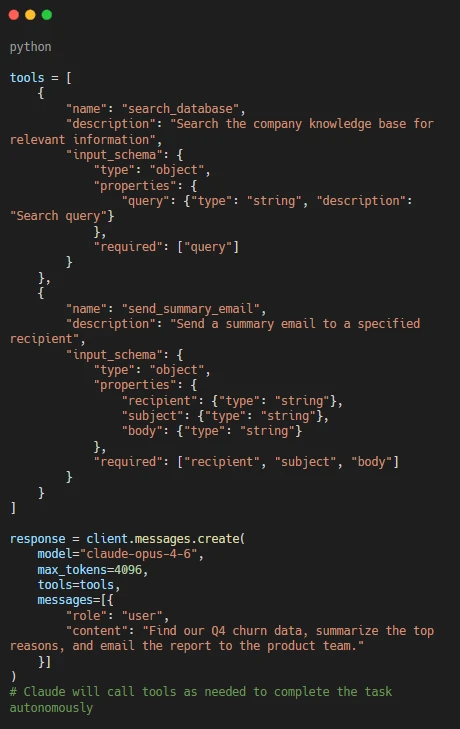
Step 4: Add Tool Use for Real Autonomy
The real power of agents comes when they can take actions — not just generate text. Here’s how to give an agent the ability to search the web and read files:
Step 5: Get Your Act Together Before Growing
Right now, not many companies (only 21%) really have good AI guidelines. It’s thought that a lot of AI projects (over 40%) will get canned by 2027 because people don’t see the point, they cost too much, or the risks aren’t handled well.
So, before you get bigger, figure out:
- What calls need a person to sign off.
- How are you tracking and checking what the agents do?
- When things go wrong, who steps in?
- How are you tracking what you’re getting back (time saved, fewer mistakes, how much each task costs)?
What This Means for Your Software Stack?
The $58B shake-up doesn’t mean your existing tools disappear overnight. It means the way you interact with them changes fundamentally. Salesforce, Jira, Slack, Notion — these tools aren’t going away. But are the humans manually operating them? That layer is getting replaced by agents that work across all of them simultaneously.
Sunk costs in enterprise systems will be abstracted away using agentic AI as a user interface. Your CRM becomes something an agent queries and updates. Your project management tool becomes something an agent monitors and reports from. The UI matters less. The workflow intelligence matters more.
The companies that win this transition are the ones that stop thinking about AI as a feature to add to their stack and start building AI as the operating layer of their stack.
Conclusion: Start Using AI Agents Productivity Tools — The Window Won't Stay Open Forever
Productivity is no longer tied to the number of people you hire. It’s tied to how effectively you deploy AI agents’ productivity tools that never wait for instructions and never lose context across your workflows.
The $58B figure isn’t a warning to panic — it’s a signal to move. The organizations building agentic workflows today are pulling ahead of competitors who are still debating pilots. By 2027, 50% of enterprises will have autonomous agents deployed. The other 50% will be playing catch-up.
35% cost cuts. 55% more efficiency. Same team. The math is straightforward. The implementation is the work.
If you’re ready to start, the tools exist, the platforms are mature, and the ROI is proven. The only real risk now is waiting too long.
About Orbilon Technologies
At Orbilon Technologies, we build AI-powered web apps, mobile applications, SaaS platforms, and custom software solutions for startups and enterprises worldwide.
Based in Lahore, Pakistan, with a US presence, our team brings hands-on experience integrating AI agents, large language models, and automation pipelines into production systems.
We’ve built AI solutions for clients across the US, UK, and beyond — and with a 4.96 rating on Clutch and GoodFirms, we deliver work that holds up in the real world.
Website: orbilontech.com
Email: support@orbilontech.com
Ready to Build AI Agents for Your Business?
Whether you’re integrating your first AI agent or building a full multi-agent workflow, Orbilon Technologies can help you architect, build, and deploy it right — with measurable ROI baked in from day one. Book a Free Consultation
Want to Hire Us?
Are you ready to turn your ideas into a reality? Hire Orbilon Technologies today and start working right away with qualified resources. We will take care of everything from design, development, security, quality assurance, and deployment. We are just a click away.