60% Believe AI Will Transform Their Job in 5 Years—Only 23% Are Preparing
Introduction
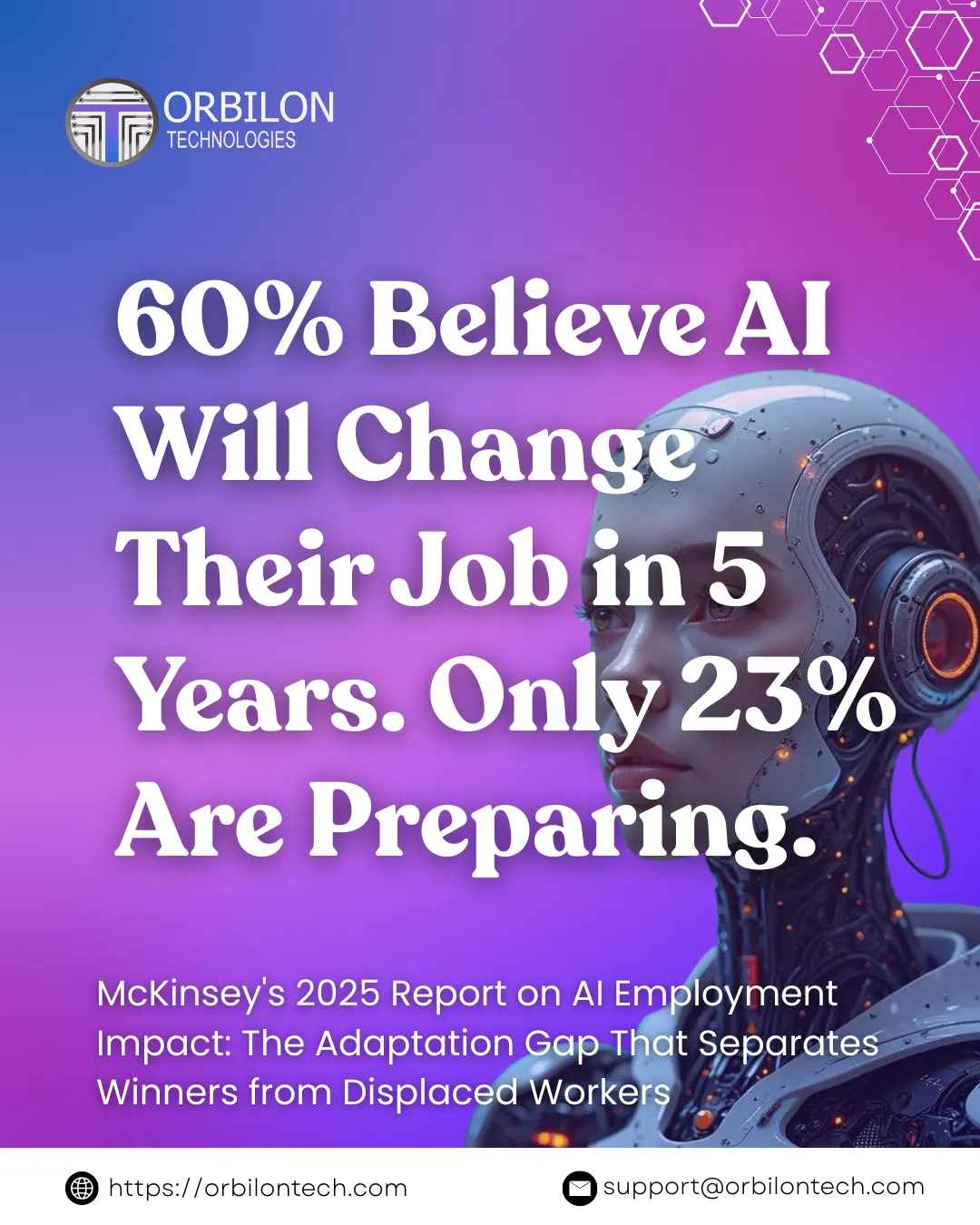
McKinsey 2025 report released a bombshell: 60% of workers think that artificial intelligence will drastically change their work in the next five years. The surprising part is that only 23% of them are actually taking any steps.
It’s more than just a preparation gap. It’s a gulf.
You’re already ahead of 77% of the workforce if you’re reading this. It’s not a question of whether AI job displacement will get to you, but whether you’ll be one of those who adapt and thus win, or the ones who don’t and thus get displaced. Let’s discuss how to be on the right side of that divide.
The Reality Check: What the Numbers Actually Mean
- Developers: while AI will not be your replacement, if developers who use AI to help them write code 10 times faster replace developers who don’t, then that’s reality.
- Marketers: AI copywriting tools won’t take your job; however, marketers who utilize AI to deliver a personalized experience at a large scale will be able to outperform those who don’t.
- Accountants: Your job won’t be eliminated by automated bookkeeping, but CPA’s that implement AI for predictive financial analysis will become essential, while the rest of them who do manual data entry will have difficulties.
- The trend is obvious: AI, which caused job reduction, is not the story of humans versus machines. Rather, it is the story of humans with AI versus humans without AI.
Why Only 23% Are Preparing (And Why That's Actually Good News)?
There are three main reasons for the prep gap:
- No clear guidance: People are aware that they should prepare, but are at a loss as to how to go about it. Should you get familiar with Python? Prompt engineering? Data analysis? The choices are so many that they cause the feeling of being overwhelmed.
- Illusion of safety: A lot of professionals are under the impression that AI will not affect their particular roles. Attorneys, doctors, and executives each think that my job is so creative that AI can never replace me. The record has it that this kind of conviction is very often wrong.
- Less time available: It seems to be out of the question to acquire new skills while at the same time taking care of present job responsibilities. Hence, people keep delaying preparation till it is too late.
The 23% prep rate is a silver lining:
- When 77% of your rivals are inactive, a little preparation can put you at a great advantage. You don’t have to turn into an AI guru. You just have to be better equipped than the average individual in your industry.
Industries Facing the Biggest Transformation
1. Software Development and IT
- Change: AI coding assistants are capable of writing entire functions, debugging code, and suggesting optimizations in real time. Tools like GitHub Copilot and Amazon CodeWhisperer are already being used as standard in top tech companies.
- Preparing: Get familiar with collaborating with AI tools. Work on areas such as system architecture, complex problem-solving, and business logic, which still require human judgment.
- Schedule: This is happening now. If by the middle of 2025 you are not equipped with AI coding tools, you will be considerably less productive.
2. Marketing and Content Creation
- Change: AI is capable of generating blog posts, social media content, advertisement copy, and even videos. With the help of AI, what took a team of five can now be done by two people.
- Preparing: Make a transition from being a content creator to a content strategist. Get knowledge of prompt engineering, AI tool orchestration, and ways to keep brand voice consistent in AI-generated content.
- Schedule: 2025 – 2026. Actually, they are trimming content team sizes while expecting the same or better output.
3. Customer Service and Support
- The Change: AI chatbots are now capable of dealing with 70 – 80% of the normal queries. Human agents only deal with the cases of complex, emotionally charged, or high-value interactions.
- The Preparation: Master the product inside and out and develop high emotional intelligence. Be the escalation expert who does the job that AI can’t.
- Timeline: The change is coming quicker than expected. Most companies are already running AI, with the first support with a human as a backup.
4. Finance and Accounting
- The Change: Automated bookkeeping, expense categorization, and simple financial analysis have become the norm. The work is moving from data entry to data interpretation.
- The Preparation: Take a deep dive into financial modeling and predictive analytics, and learn how to translate AI-generated insights into strategic business recommendations.
- Timeline: 2025 – 2027. The change from a “bean counter” to a “financial strategist” is well underway.
5. Healthcare
- The Change: AI will take over initial diagnostics, analysis of medical imaging, and patient data monitoring. At the same time, the roles of doctors and nurses will be more about treatment decisions and patient relationships.
- The Preparation: Practice checking AI, based diagnostic suggestions, understand the technology limitations, and maintain the healthcare human touch.
- Timeline: 2026 – 2028. The adoption rate is held back by the regulatory approval, but the trend is clear.
6. Legal Services
- The Change: AI can do document review, contract analysis, and legal research much faster than a human. The replacement of junior associate tasks with automation is happening very rapidly.
- The Preparation: Work on negotiation, client relationships, courtroom presence, and legal strategy areas that require complex thinking and that AI will not be able to replicate.
- Timeline: 2025 – 2027. A recent trend is that big law firms are making junior positions redundant while expecting senior lawyers to use AI tools efficiently.
How People are Actually Dealing With AI at Work?
Here are some stories from people who’ve figured out how to handle AI changing their jobs:
Case Study 1: The Marketing Manager Who 10x'd Output
Sarah was leading a content team of five. When the company decided to use AI writing tools, she didn’t resist but rather welcomed the change. She became an expert in prompt engineering, trained her team on AI tools, and helped them transition from just being writers to editors and strategists.
Result: The same number of people in the team can now produce 10 times the amount of content. Instead of laying off staff, they were given bigger budgets because they were able to scale their campaigns beyond what was previously their limitation.
The Lesson: Don’t be the person who refuses to accept AI. Be the one who realizes how to leverage it.
Case Study 2: The Developer Who Became Invaluable
Mike was a Python developer who had a mid-level position and was worried about the fact that GitHub Copilot would replace him. However, instead of challenging AI at writing code, he focused on architecting complex systems, which Copilot couldn’t figure outmicroservices orchestration, database optimization, and security architecture.
Outcome: His salary rose by 40% as he became the only developer able to create systems which AI, assisted junior developer teams could then implement.
The Takeaway: It’s a Value Chain Upgrade. AI makes basic skills a commodity. So, focus on developing advanced skills.
Case Study 3: Accountant Turned CFO Advisor
Jennifer had been doing month-end closes and preparing financial reports for 15 years. After she learned that her role might be removed because of automation, she attended classes in financial modeling and data visualization. Today, she utilizes AI to produce reports in a matter of minutes, after which she is able to advise the executives on their financial strategy.
Result: Jennifer’s role has changed from a bookkeeper to a strategic finance partner. Her salary has been doubled.
The Lesson: First, use AI to get rid of your dull work, then spend that time on high-value activities.
The Skills That Matter in 2025
According to McKinsey research and real-world trends, the following skills distinguish future winners from the workers who are just managing to get through displacement:
- AI Literacy (Not AI Expertise): You do not have to be an engineer, but you should know what AI can and cannot do and how to use it properly. Action Step: Dedicate 30 minutes each day to discovering AI tools that are relevant to your job.
- Prompt Engineering: Being able to communicate clearly with AI will be as important as knowing Excel once was. Action Step: Use proven frameworks to practice writing well-structured prompts.
- Critical Thinking and Verification: As great as AI sounds, it is not always right. Therefore, human judgment will always be a vital part. Action Step: Check the results with several sources and use your knowledge.
- Emotional Intelligence: AI will never be able to give empathy, leadership, or the ability to create relationships. Action Step: Improve your interpersonal skills and ways of communication.
- Creative Problem-Solving: AI is good at dealing with known problems, but it is creativity that leads to real innovation. Action Step: Challenge yourself with new things that require you to think differently.
Practical Preparation Roadmap
Here’s a realistic 90-day plan that takes you from unprepared 77% to the ready 23%:
Days 1 – 30: AI Immersion
- Week 1: Interact with ChatGPT or Claude every day for regular work activities. Draft emails, brainstorm ideas, do research, basically any work. Acquaint yourself with AI partners.
- Week 2: Choose three AI tools tailored to your industry. Get trial versions and try out all of them.
- Week 3: Get an online class on AI basics for free. Coursera, edX, and YouTube offer a wide selection of courses.
- Week 4: Participate in digital forums about AI in your profession. LinkedIn groups, Reddit, and Discord communities explore and connect.
Days 31 – 60: Skill Development
- Week 5 – 6: Pick one AI skill to master thoroughly. Prompt engineering, data analysis, or AI tool integration. Choose the one that fits your professional ambitions.
- Week 7 – 8: Use your skill on a work project. Count the saved time and the output.
Days 61 – 90: Strategic Positioning
- Week 9: Make your resume and LinkedIn profiles reflect the AI skills you have. Do not wait until you are looking for a job.
- Week 10: Sign up for AI-related assignments at the office. Make your name synonymous with the knowledge of this technology.
- Week 11: Spread the word about what you know of AI. Write articles, hold talks, or guide the newbies. Teaching helps to understand.
- Week 12: Plan your AI path for the next 2 years. What skills do you need to learn? Which certifications are important? How will you stand out?
Implementation Examples
Let’s check out some code and real-world examples that you can use.
Example 1: AI-Assisted Data Analysis
Like this one: Let’s say you’re not a data scientist, but you need to look at data. AI can help you with that:


What this does: So basically, people who aren’t techy can now check out data by just asking questions in plain English. The system uses AI to write the code, do the analysis, and tell you what it all means. You don’t need to be a data scientist to use it.
Example 2: AI Meeting Assistant
Turn meetings into actionable insights automatically:


What this does: So basically, managers and team leads can now actually pay attention in meetings instead of scribbling notes. The AI takes care of recording everything, figures out what’s critical, and even writes the follow-up emails.
The Mindset Shift Required
Being able to survive AI job displacement is not only about skills but also about mindset. The following are what needs to change:
- As a Learner, Not an Expert: You can no longer rely on what you already know. Make learning continuously your forever career plan.
- Value Creator, Not Task Executor: Stop limiting your identity to the tasks you do. Instead, base your identity on the value you bring.
- AI Collaborator, Not AI Skeptic: AI isn’t your enemy or replacement. It is the most powerful tool that you can use, if only you learn to handle it, and most probably it will be the last tool you ever need to use.
- From Comfort Zone to Growth Zone: The reason for the gap in preparation is that growth is uncomfortable. Make getting out of your comfort zone a habit.
Common Mistakes to Avoid
- Mistake 1: Expecting Your Employer to Train You: In most cases, employers will wait until their employees’ situation gets severely bad before they restructure them. So, don’t depend on others, but rather, be the one to take the initiative for your growth.
- Mistake 2: Learning AI INSTEAD OF Learning WITH AI: You do not need to know every little detail about the transformer architectures. What really counts is your proficiency in the use of AI tools in your work domain.
- Mistake 3: Ignoring the Importance of Soft Skills: AI technical skills matter on one side. On the other hand, human skills such as creativity, leadership, and emotional intelligence become the key differentiators.
- Mistake 4: Trying to Be the One Who Is Better Than AI: It is not a good idea to challenge AI at the points where it performs excellently. Focus on improving your capacities with AI.
- Mistake 5: Analysis Paralysis: You’ve done enough research, and now it’s time for action. Pick an AI tool by today and utilize it for one of your work tasks. Doing is much more important than flawless planning.
Conclusion
The McKinsey report should not be seen as a forecast, but rather a call for change and an opening for development. Over the next five years, 60% of jobs will transform. However, only 23% of workers are getting equipped.
It will be an AI job displacement scenario in your career, whether you like it or not. So the issue is not if, but whether you will prepare or procrastinate over the next five years.
The winners in the professional game won’t be those who either resist or fear AI. Instead, they will be the people who figured out how to work together with AI, leveraging AI to automate their boring and repetitive tasks, deepen their knowledge, and bring the kind of value that was impossible before.
You don’t have to be an AI engineer. You don’t have to graduate with a computer science degree. You only need to start getting ready now, while 77% of your competition is doing nothing.
Five years is shorter than you imagine. Preparing time is not when your job is at stake, but it is now, while you still can, and there are other possibilities.
Orbilon Technologies who we are and what we do:
At Orbilon Technologies, we assist both individuals and companies in successfully undergoing the AI transformation. We don’t only discuss AI adoption. We execute real strategies that equip your people for the upcoming changes.
No matter if you are looking for AI skill development for your staff, strategic direction for the workforce transformation, or assistance in the implementation of AI solutions that increase productivity, we are the ones to offer the right combination of technical knowledge and change management experience.
We have enabled marketing departments to increase their output by ten times, development teams to double their pace, and finance teams to switch from the reporting function to strategic advisory, all this by showing people the benefits of working alongside AI rather than competing against it.
If you want to be among the 23% prepared, visit us at orbilontech.com or drop us a line at support@orbilontech.com to talk about how we can make your team ready for the AI-fueled workplace.
Want to Hire Us?
Are you ready to turn your ideas into a reality? Hire Orbilon Technologies today and start working right away with qualified resources. We will take care of everything from design, development, security, quality assurance and deployment. We are just a click away.