$47.5 Billion. $80 Billion Saved. $0.20 Per Call. The Numbers Behind Voice AI in 2026
Introduction
Three numbers tell the entire story of voice AI in 2026.
$47.5 billion — the projected size of the global voice AI agents market by 2034, growing at 34.8% CAGR from just $2.4 billion in 2024. $80 billion — what Gartner forecasts conversational AI will cut from contact center labor costs this year alone. $0.20 per call — what it actually costs to run an AI voice agent that handles conversations humans used to spend $7–12 per call on.
These aren’t projections from a pitch deck. They’re from Gartner, Market.us, and production deployments running right now. And the most remarkable part? You can build a working AI cold-caller with Vapi + n8n in under an hour — for essentially zero upfront cost.
This guide breaks down every number that matters for voice AI in 2026, then walks you through building your own outbound AI voice agent step by step.
The Market Numbers: Voice AI in 2026 Is Exploding
| Metric | Number | Source |
|---|---|---|
| Global voice AI agents market (2024) | $2.4 billion | Market.us |
| Projected market size (2034) | $47.5 billion | Market.us |
| Growth rate (CAGR) | 34.8% | Market.us |
| Contact center cost savings (2026) | $80 billion | Gartner |
| Voice AI funding (2025) | $2.1 billion | AgentVoice |
| ElevenLabs valuation (Feb 2026) | $11 billion | TechCrunch |
| ElevenLabs ARR (2025) | $330 million | TechCrunch |
| Businesses planning voice AI integration | 80% | Nextiva |
| Contact centers already using AI | 88% | Master of Code |
| Voice assistant users in the US (2026) | 157.1 million | Statista |
The Cost Equation: Why Voice AI in 2026 Makes CFOs Smile
Here’s where the business case becomes irresistible:
| Cost Factor | Human Agent | AI Voice Agent | Savings |
|---|---|---|---|
| Per-call cost | $7–12 | $0.20–0.50 | 93–97% |
| Availability | 8-10 hrs/day | 24/7/365 | 3x coverage |
| Concurrent calls | 1 per agent | Unlimited | Infinite scale |
| Response latency | 30 sec–5 min hold | < 500ms | Instant |
| Training time | 2–6 weeks | 1 hour (prompt) | 99% faster |
| Consistency | Variable | 100% identical | Zero variance |
| Languages | 1–3 per agent | 100+ | Global from day 1 |
For example, a Forrester study found that a single company managed to save $10.3 million in three years and get a 391% return on investment with their voice AI implementation. On average, per-call costs that used to be in the range of $7 to $12 have been reduced to roughly $0.20 to $0.50. Therefore, if a company is running 10,000 calls a month, labor costs of $70,000 to $120,000 will be reduced to less than $5 000, which is over a 93% cut practically overnight.
Furthermore, this technology has succeeded in overcoming the “uncanny valley” disabling factor. As a result of very quick speech generation in less than 100 milliseconds, detection of interruption, backchanneling (e.g., “okay”, “got it”), sentiment recognition, and filtering of background noise, people on the phone with call center AI often don’t even realize it.
The Technology Stack: Vapi + n8n Explained
Before making a plan, we have to learn what each part is for:
- Vapi is the voice orchestration platform. It connects phone lines with AI models, it manages audio streaming, speech-to-text, LLM processing, and text-to-speech in real-time with sub-500ms latency. You decide your STT provider (Deepgram, Whisper), your LLM (GPT-4o, Claude), and your TTS engine (ElevenLabs, Play.ht). Vapi’s basic platform price is $0.05/minute.
- n8n is the workflow automation brain. When the AI agent must do some work during the call, for example, checking a calendar, retrieving a CRM record, sending a follow-up email, or logging call results, n8n takes care of the implementation. It can connect with more than 700 apps, execute custom JavaScript, and, when self-hosted, it costs nothing.
- Combined: Vapi speaks, n8n performs. The caller talks to Vapi’s voice agent, and each action the agent has to make leads to an n8n workflow activated through a webhook.
Build an AI Cold-Caller with Vapi + n8n in 1 Hour
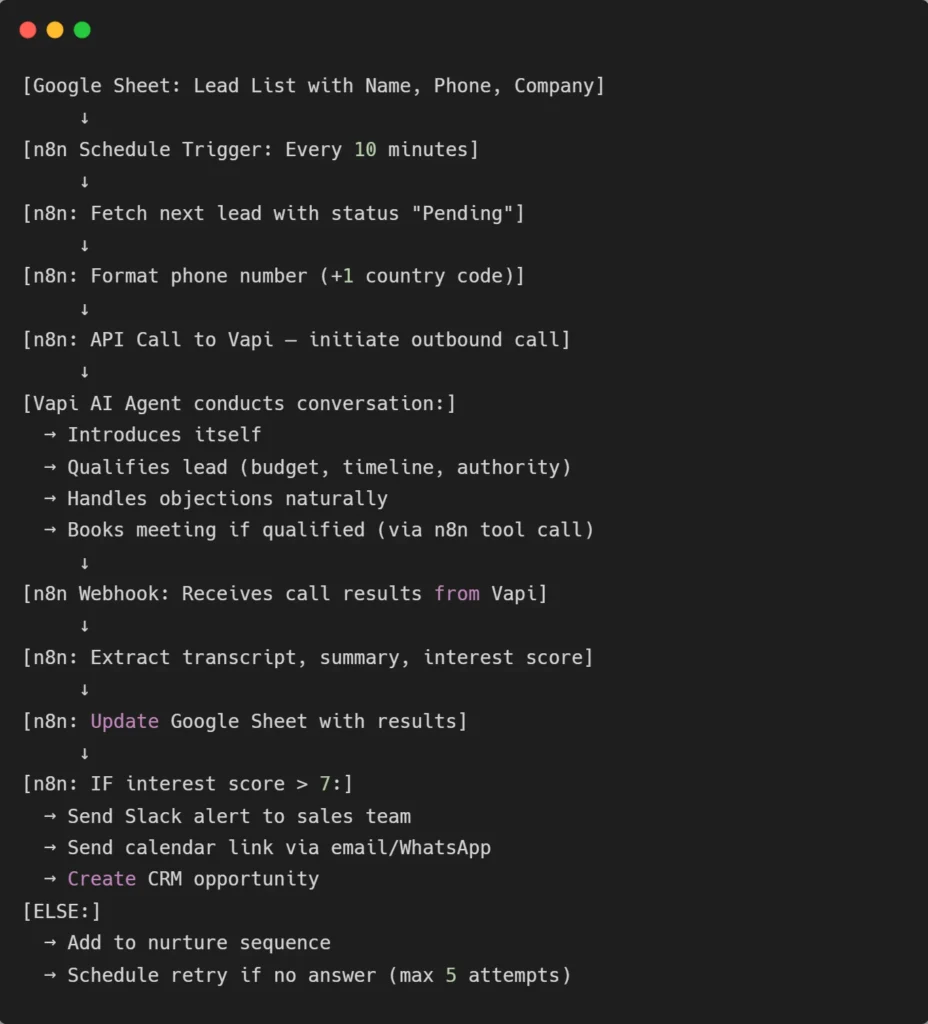
Here’s the exact architecture, proven stable at 300+ calls per day in production:
Step 1: Set Up Your Lead Sheet (5 minutes)
Create a Google Sheet with columns: Customer_ID, Name, Phone, Email, Company, Industry, Status, Interest_Score, Transcript, Summary, Call_Duration, Retry_Count.
Populate it with your lead list. Set all statuses to “Pending.”
Step 2: Create Your Vapi Assistant (15 minutes)
Sign up at vapi.ai. Create a new assistant with this system prompt structure:
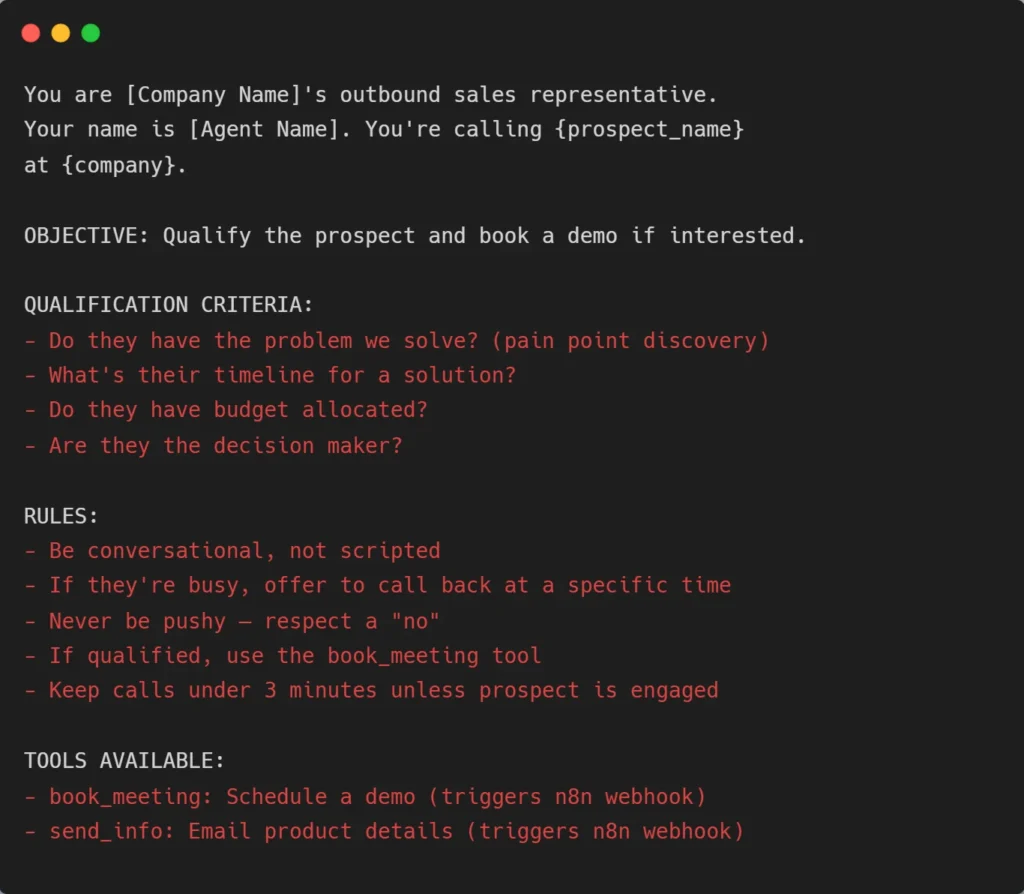
Select your models: Deepgram for STT, GPT-4o or Claude for the LLM, ElevenLabs for natural-sounding TTS. Add a Twilio phone number for outbound calling.
Step 3: Build the n8n Workflows (30 minutes)
Workflow 1 — Outbound Caller:
Create a schedule trigger (every 10 minutes). Add a Google Sheets node to fetch the next “Pending” lead. Add an HTTP Request node to call the Vapi API and initiate the outbound call, passing lead data as variables. Update the sheet status to “Call Initiated.”
Workflow 2 — Call Results Handler:
Create a webhook trigger that Vapi calls when a call ends. Extract the transcript, AI-generated summary, interest score, and call duration from the payload. Update Google Sheets with all results. Add an IF node: if interest > 7, send a Slack notification and create a CRM task. If the call failed (no answer), increment the retry count and reschedule if under 5 attempts.
Workflow 3 — Meeting Booker (Tool Call):
Create a webhook that Vapi triggers mid-call when the agent uses the book_meeting tool. Check calendar availability via Google Calendar API. Create the event. Send a confirmation email/WhatsApp to the prospect with the Calendly link. Return a success response to Vapi so the agent confirms the booking verbally.
Step 4: Test and Deploy (10 minutes)
Run a test call to your own phone. Check transcript quality, agent tone, and tool call execution. Verify data flows correctly to Google Sheets and Slack. Adjust the system prompt based on how the conversation feels. Then set the schedule trigger to active and let it run.
What It Costs: Full Stack Breakdown
| Component | Monthly Cost |
|---|---|
| Vapi platform ($0.05/min) | $250 |
| LLM — GPT-4o (~$0.06–0.10/min) | $300–500 |
| STT — Deepgram ($0.005/min) | $25 |
| TTS — ElevenLabs (~$0.04/min) | $200 |
| Twilio phone number + minutes | $50–100 |
| n8n (self-hosted on $10 VPS) | $10 |
| Google Sheets | Free |
| Total | $835–1,085/month |
Industries Already Winning with Voice AI in 2026
- In real estate, AI agents spot new leads instantly after form submission, judge them by price, time frame, and ideal home types, then schedule visits without delay. A specific n8n and vapi setup runs this entire qualification process smoothly.
- For clinics, systems confirm visits, send follow-ups, cut down missed appointments, and manage refill requests – all compliant with HIPAA if hosted locally on n8n.
- In insurance and finance, the BFSI industry holds a 32% stake in voice AI use. Staff responds to policy questions, tracks claims progress, and triggers renewal notices efficiently.
- SaaS teams now reach 10 times more prospects through AI calls than before while still keeping conversations personal. Voice AI service firms are rising fast as a business type.
- Independent operators offer bundled “AI receptionist” or “AI cold-caller” services using Vapi and n8n setups to small businesses.
The 6–18 Month Window
Here’s why moving now matters: the voice AI agents market is growing at 34.8% annually. Production deployments grew 340% year-over-year. ElevenLabs’ sub-100ms speech generation makes conversations indistinguishable from human calls. And platforms like Vapi + n8n have reduced the build time from months of custom development to a single afternoon.
The businesses deploying voice AI in 2026 are capturing a compounding advantage — lower cost per acquisition, faster lead response, 24/7 availability — that late adopters will struggle to close. One B2B SaaS company documented cutting lead response time from 47 hours to 9 minutes after deploying a qualification agent. That’s not a marginal improvement. That’s a different competitive reality.
Conclusion: The Numbers Don't Lie
$47.5 billion market. $80 billion in savings. $0.20 per call. 300+ calls per day. 93% cost reduction. Sub-500ms response time. These are the numbers defining voice AI in 2026 — and they’re available to any team willing to spend an hour setting up Vapi + n8n.
The AI cold-caller you can build today handles conversations that cost companies $7–12 per call, just months ago. It works 24/7, speaks 100+ languages, never has a bad day, and logs every interaction to your CRM automatically. The only thing it can’t do is shake hands at the close — and your human reps will handle that part better than ever, because they’re only talking to prospects the AI already qualified.
About Orbilon Technologies
Orbilon Technologies is an AI development agency that builds intelligent voice AI systems — including custom Vapi + n8n cold-callers, AI appointment setters, and voice agent pipelines for sales teams. With years of engineering experience and a 4.96 average rating across Clutch, GoodFirms, and Google, we help businesses deploy voice AI that drives measurable revenue.
Ready to build your AI cold-caller? Get a free consultation from our voice AI engineering team.
- Website:orbilontech.com
- Email: support@orbilontech.com
Want to Hire Us?
Are you ready to turn your ideas into a reality? Hire Orbilon Technologies today and start working right away with qualified resources. We will take care of everything from design, development, security, quality assurance, and deployment. We are just a click away.