
Using LLMs with APIs: A Complete Guide to Intelligent Automation
Introduction
It is no longer a secret that the use of APIs to integrate large language models has changed the way companies operate and make automated, intelligent decisions. If you are a developer creating conversational agents for customer support, writing content automatically, or building tools that analyze data, then knowing how to use LLM APIs effectively is a must-have skill for you. This in-depth manual is your go-to resource when you want to learn real-world tactics for embedding LLM API calls into your work processes. It even goes beyond basic configuration to discuss various optimization methods that can help you run your operations at low costs yet high efficiency.
Understanding LLM APIs
Large Language Model APIs are basically tools available for developers to leverage great AI capabilities without the need for heavy computational power or deep machine learning knowledge. APIs that conform to REST principles provided by OpenAI’s GPT-4, Anthropic’s Claude, and Google’s PaLM can be used with practically any software by just plugging them in.
Some of the major advantages are:
- Being able to rapidly develop without the need to train new models from scratch.
- Having a scalable infrastructure that is taken care of by the providers.
- Getting the models updated and improved regularly.
- Having pricing models based on usage.
Getting Started with LLM API Integration
1. Selecting an Appropriate LLM Provider
Various providers have different advantages. For instance, OpenAI is best used for creative works, Claude can be used when there is a need for longer context windows and more detailed reasoning, and Google’s PaLM is perfect for situations where one needs to work with Google Cloud services.
Criteria for evaluation:
- Length of context window.
- Quality and correctness of the response.
- Price policy.
- API rate limits.
- Quality of documentation.
- Specialized areas (coding, analysis, multilingual support).
2. Authentication and Setup
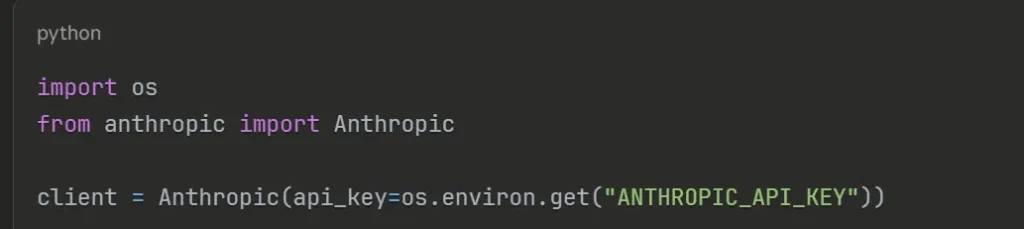
Most LLM APIs require API keys for authentication. Store these securely using environment variables or secret management services, never hardcoding them into your application.
Best Practices for LLM API Implementation
i. Prompt Engineering
It is a must to have an effective prompt if you want to get the best responses. Try to be as clear and specific as possible, and also give the necessary context. A system message is best used when setting the behavior parameters, whereas a user message should be used when asking a certain question.
Good prompt format:
- Definite instructions
- Pertinent context
- Desired output form
- Usage of examples only
ii. Token Management
- Not saving the parts of the context that are redundant or not needed.
- Using streaming for long responses.
- Implementing response caching.
- Setting proper max_token limits.
iii. Error Handling and Retry Logic
The API calls may fail because of network issues, rate limits, or service outages. Therefore, one should put in place a tough error-handling system with retries done using exponential backoff.
Advanced Integration Techniques
a. Function Calling
Modern LLMs have the capability of function calling, which enables them to access external tools and databases. LLMs thereby become not just text generators but intelligent agents capable of handling complex tasks.
b. Streaming Responses
In the case of user-facing applications, streaming responses enhance the performance as the generated text is displayed on the screen and the user does not have to wait for complete responses.
c. Context Window Management
In situations of long conversations or documents, you can use various strategies to overcome the limitations of the context window:
- Conversation summarization
- Sliding window approaches
- Relevance-based context selection
Security Considerations
- Input Validation: It is necessary to validate and sanitize user inputs at all times before they are sent to LLM APIs. This stops prompt injection attacks and maintains the integrity of your system.
- Output Filtering: Use content filters to identify any offensive or injurious replies that are directed at the users but have not been displayed to them yet.
- Rate Limiting: Defend your app against malicious users by putting into effect rate limiting at the application level alongside provider limits.
Cost Optimization Strategies
Costs related to large language model (LLM) APIs can increase quickly if they are not handled well:
- Cache interactions with a chatbot for FAQ-type questions that are repeated frequently.
- Use small models to carry out simple tasks.
- If it is possible, have one request that is a batch of several requests.
- Analyze how the service is being used in order to have the possibility of optimizing it.
- Have budget alerts that you avoid.
Real-World Use Cases
- Customer Support Automation: Level 1 support questions can be managed by LLM APIs, thus the company can have a great reduction in time and costs of operations, and still keep a high level of customer satisfaction.
- Content Generation: Blog drafts, product descriptions, and marketing copy can be automatically created, and the brand voice can be kept consistent through prompt engineering.
- Data Analysis: Have the ability to convert any kind of text into insightful data, get the essential information from records, and create, without human intervention, analytical reports.
- Code Assistance: Use LLMs to enhance the developers’ coding, for instance, to make code review, prepare the documentation, and locate bugs.
Monitoring and Analytics
Keep track of the most important metrics to make sure that your LLM integration is working efficiently:
- Response latency.
- Token usage per request.
- Error rates.
- User satisfaction scores.
- Cost per interaction.
Make such a move a habit by constantly refining your implementation with the help of these metrics and spotting improvement opportunities from time to time.
Future Trends
The LLM API landscape evolves rapidly. Stay informed about:
- Multi-modal capabilities (image, audio, video).
- Longer context windows.
- Improved reasoning capabilities.
- Reduced latency.
- More competitive pricing.
Conclusion
LLM API integration in your workflow is a great way to reduce your manual work and automate tasks in an efficient manner. If you follow best-practice guidelines for implementation, security, and cost management, you will be able to create AI-powered applications that are powerful, secure, and inexpensive.
Firstly, isolate a small use case to demonstrate the effectiveness of the method. Then, scrutinize the results. When you see steady improvements, go ahead and expand your solution with confidence. The combination of potent LLM features and well-thought-out integration planning is a winning strategy for your applications to dominate the AI revolution.
Therefore, if you want to reengineer your operations with intelligent automation, LLM APIs are definitely the right tools to investigate at the moment. Get started with your experiments today and let the opportunities of AI-driven solutions reveal themselves to you.
Want to Hire Us?
Are you ready to turn your ideas into a reality? Hire Orbilon Technologies today and start working right away with qualified resources. We will take care of everything from design, development, security, quality assurance and deployment. We are just a click away.