

Hyperautomation 3.0 Human Error Elimination: How Enterprises Achieve 99.2% Uptime and Save $3.1M Yearly
Introduction
Every dollar of that $3.1 million was preventable. And Hyperautomation 3.0 human error elimination is exactly how enterprises are proving it with 99.2% uptime rates, 20–30% operational cost reductions, and zero tolerance for the manual mistakes that used to be written off as the cost of doing business.
Human error is no longer an acceptable line item. It never was, but until now, most organizations had no practical alternative. That alternative is here, and its name is Hyperautomation 3.0.
What Is Hyperautomation 3.0 and How Does It Eliminate Human Error?
Hyperautomation is the integration of several intelligent technologies working together to automate complicated, end-to-end business processes. The technologies involved include Robotic Process Automation (RPA), Artificial Intelligence (AI), Machine Learning (ML), process mining, and low-code orchestration. It is not just about automating individual tasks but the entire workflows.
- Hyperautomation 1.0 was RPA: bots that imitated human clicks.
- Hyperautomation 2.0 brought AI to the table and made those bots smarter.
- Hyperautomation 3.0 is the latest generation a combination of AI agents, process mining, real, time analytics, and agentic decision, making that creates self, correcting, adaptive automation systems capable of handling exceptions, learning from patterns, and operating independently without constant human monitoring.
The statistics support the need for change. The worldwide hyperautomation market was worth $58.4 billion in 2025 and is expected to grow to $278.3 billion by 2035, with a 16.9% CAGR. In 2026 alone, the market stands at $68.2 billion businesses are no longer discussing whether to adopt it. They are competing on how fast they can implement it.
The Real Cost of Human Error: Why $3.1 Million Is Just the Visible Part
The $3.1 million figure is what organizations report on paper. The actual cost is much higher once you account for what typically goes unmeasured:
- 88% of all data breaches involve a human element — errors, misuse, or social engineering. The average cost of a single data breach hit $4.44 million globally in 2025 (IBM Cost of a Data Breach Report).
- 80% of manufacturing defects originate from human mistakes, with unplanned downtime alone costing manufacturers $50 billion annually.
- The average employee makes 118 workplace errors per year — from incorrect spreadsheet entries to missed process steps — each carrying downstream consequences.
- NIST research shows human errors lead to scrap and rework costing 5–30% of total manufacturing expenses.
- A 1% error rate in a large enterprise with 18,000 employees paying average salaries can generate up to $9 million in annual losses from compensation errors alone.
- 95% of senior executives report that poor-quality data — largely driven by human input errors — has undermined business performance.
The problem isn’t that employees are careless. The problem is that humans are fundamentally unreliable for high-volume, repetitive, rule-based tasks. That’s not an insult — it’s biology. Hyperautomation 3.0 doesn’t fight this reality. It works around it.
How Hyperautomation 3.0 Eliminates Human Error?
The architecture of Hyperautomation 3.0 attacks error at every layer of a business process:
- Process Mining shows you exactly how work gets done now, not how it should be done. It shows you where people cause things to change, where problems cause delays, and where mistakes happen a lot. You can’t fix what you can’t see, and process mining makes everything clear.
- RPA Bots take care of the boring, routine stuff that people mess up because they’re tired, not paying attention, or don’t get it. Things like processing invoices, entering data, checking forms, and updating systems – bots do these perfectly every time, all day and night, without taking breaks.
- AI and ML handle the tricky decisions. Unlike old RPA that fails if a PDF is slightly off, AI automation spots patterns, deals with changes, and works with unstructured info – like emails, documents, pictures, and voices – that old automation couldn’t touch.
- Agentic AI Orchestration is what makes the newest kind different. AI agents now work together across systems at the same time. They make smart decisions based on the situation, only pass real problems to people, and keep getting better.
- Real-Time Monitoring and Alerting means you see problems quickly, not days later. Instead of finding out about a mistake after it has impacted data, new systems catch problems as they happen and fix them before anything bad happens.
The payoff? Automated processes are up 99.2% of the time, compared to the 85–90% accuracy you see with good manual teams working on a big scale.
Industries Being Transformed Right Now
- Finance & Banking: Banks that have adopted hyperautomation report 20–30% reductions in operational costs. 93% of financial firms surveyed are confident in AI’s positive impact. Citi data links automation capital investment to nearly $170 billion in profit growth across global banking.
Real-world example: Prior authorization in finance — a process prone to manual entry errors, missed deadlines, and compliance exposure — is now being handled end-to-end with hyperautomation, cutting processing time from days to hours with zero manual touchpoints in standard cases. - Healthcare: Healthcare is the fastest-growing sector for hyperautomation, expanding at a 24.81% CAGR. An Illinois health system reduced prior-authorization turnaround from 72 hours to 6 minutes by integrating AI classification and smart forms. Hyperautomation professionals report saving 2–3 hours daily on administrative tasks, redirecting that time to patient care. The stakes of human error in healthcare are uniquely high. Incorrect medication dosing, missed diagnostic codes, and billing errors carry both financial and patient safety consequences. Hyperautomation 3.0 eliminates these at the source.
- Manufacturing: 23% of unplanned manufacturing downtime is caused by human error on the shop floor. Hyperautomation overlaid with IoT telemetry detects micro-stoppages, sequences production dynamically, and triggers automated spare-parts procurement — reducing maintenance costs by up to 25% and extending production line lifespan by 10–20% (Deloitte).
- Legal & Compliance: With 74% of lawyers projected to be using AI tools by mid-2026 and 83% of in-house legal departments already using AI-based automation, the legal sector is rapidly eliminating the manual review errors that have historically caused compliance failures and missed filing deadlines.
- Retail & E-Commerce: Inventory errors cost businesses 10–30% of annual profits. Hyperautomation addresses this at every point — automated receiving, real-time stock reconciliation, and dynamic reordering — replacing the error-prone manual counts and spreadsheet-based inventory tracking that still plague most mid-market retailers.
- Education & EdTech: Universities using RPA report 250% growth in application processing volume with no additional staff. Manual data entry errors in admissions, financial aid, and enrollment — common causes of student dissatisfaction and compliance issues — are effectively eliminated.
How to Implement Hyperautomation 3.0 Human Error Reduction in Your Organization?
Step 1: Map Your Processes Before You Automate Them
A lot of hyperautomation projects fail ’cause people try to automate stuff that’s already broken. Use process mining tools – like UiPath Process Mining, Celonis, or Microsoft Power Automate’s process advisor – to see exactly how your processes are working right now. That way, you can spot the problem areas and fix the biggest or riskiest ones first.
Step 2: Start With High-Error, High-Volume Workflows
Best first candidates for Hyperautomation 3.0:
- Invoice processing and accounts payable.
- Employee onboarding and offboarding.
- Customer data entry and CRM updates.
- Compliance reporting and audit trails.
- IT ticketing and service desk automation.
- Claims processing (insurance/healthcare).
Step 3: Choose Your Platform Stack
| Platform | Best For |
|---|---|
| UiPath | Enterprise RPA, end-to-end automation orchestration |
| Automation Anywhere | AI-powered agent-based automation, cloud-native |
| Microsoft Power Automate | Microsoft 365-integrated workflows, low-code |
| ServiceNow | IT and service management automation |
| IBM Watson Orchestrate | AI-driven task orchestration across enterprise apps |
| Deloitte + UiPath Agentic GBS | Finance, HR, supply chain, IT (launched July 2025) |
Step 4: Integrate AI Agents for Intelligent Decision-Making
Here’s a practical example — an AI-powered document validation agent that catches data errors before they enter your systems:
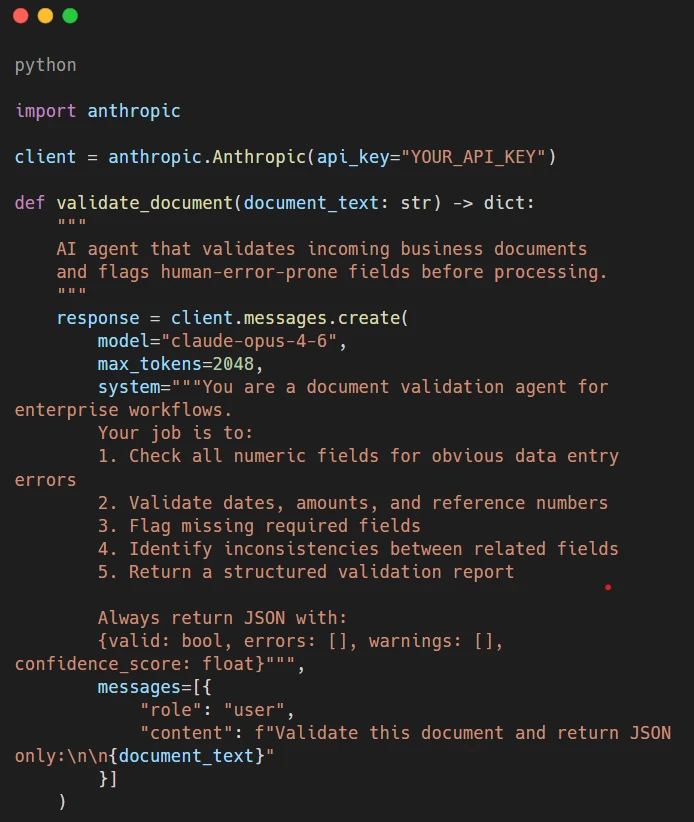
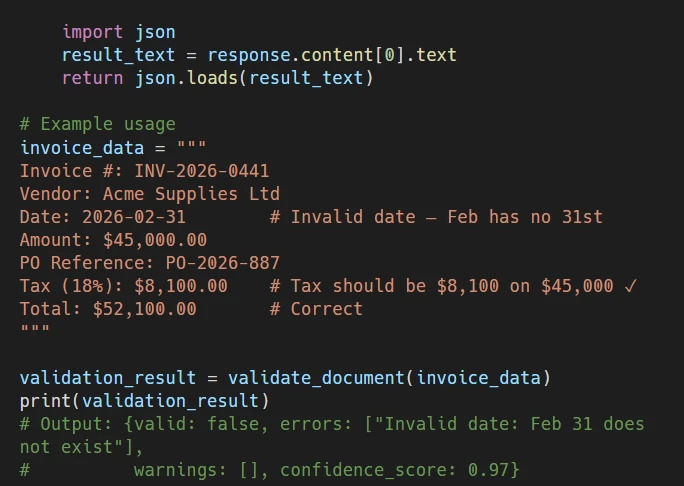
This agent runs before any invoice enters your ERP — catching the exact type of manual entry error that creates reconciliation nightmares downstream.
Step 5: Get Humans in the Loop When Needed
Hyperautomation 3.0 isn’t about kicking humans out of every decision. It’s about getting them out of the decisions they shouldn’t be dealing with to begin with. Good systems only send the weird, confusing, or really important stuff to people. The normal stuff gets taken care of automatically.
Make sure you know what should be sent to a human:
- Amounts over a set limit.
- Info is missing after the
- AI tries to fix it.
- A low confidence score.
- Content that breaks rules.
Step 6: Track Progress, Get Better, and Expand
From the get-go, watch these numbers:
- Error rate: Aim for automation to slash mistakes by 95% or more.
- Process time: How long things take – think approving invoices, getting new folks set up, or resolving support tickets.
- Workflow uptime: Keep your automated workflows up and running no matter what!
- Escalation rate: This should drop as the AI learns more and gets smarter.
- Cost per transaction: What it costs to do things automatically versus doing them by hand.
Conclusion: Every Dollar Was Preventable — Start Your Hyperautomation 3.0 Human Error Fix Today
The technology to eliminate enterprise human error at scale is no longer experimental. The Hyperautomation 3.0 human error elimination playbook is proven across finance, healthcare, manufacturing, legal, and retail. The market is at $68.2 billion in 2026 and accelerating. The enterprises that have implemented it are reporting 99.2% uptime, 20–30% cost reductions, and fundamentally different operational baselines.
Every manual process you’re running today carries an error rate. Every error carries a cost. And every cost was preventable.
The only question worth asking now is: which process are you automating first?
About Orbilon Technologies
At Orbilon Technologies, we build AI-powered web apps, SaaS platforms, automation pipelines, and custom software for startups and enterprises worldwide. Based in Lahore, Pakistan, with a US presence, our engineering team has deep hands-on experience deploying hyperautomation systems, integrating AI agents, and building production-ready automation workflows that reduce errors and drive measurable ROI.
With a 4.96 rating on Clutch and GoodFirms and clients across the US, UK, and beyond, we build things that work in the real world.
Ready to Eliminate Human Error from Your Business Processes?
Whether you’re building your first automation workflow or scaling a full Hyperautomation 3.0 architecture, Orbilon Technologies can help you design, build, and deploy it — with measurable error reduction from day one. Book a Free Consultation.
Website: orbilontech.com
Email: support@orbilontech.com
Want to Hire Us?
Are you ready to turn your ideas into a reality? Hire Orbilon Technologies today and start working right away with qualified resources. We will take care of everything from design, development, security, quality assurance, and deployment. We are just a click away.