The 12 B2B Automation Implementation Challenges Killing $2.3M Projects — And the Proven Frameworks That Guarantee Success
Introduction
Enterprise automation projects average $2.3 million in investment. And a staggering number of them fail — not because the technology doesn’t work, but because of B2B automation implementation challenges that are entirely predictable, entirely preventable, and seldom discussed honestly before the project starts.
The numbers are consistent across every major research source: 70% of digital transformation projects exceed original timelines by an average of 45%. Technical hurdles, including automation, fail to meet objectives due to integration issues. 63% of organizations must rely on a dedicated external partner just to implement RPA — reflecting a widespread shortage of in-house specialist skills. And the majority of executives feel their organizations lack the necessary AI and data science skills to execute automation correctly.
These aren’t technology failures. They’re execution failures — caused by specific, identifiable B2B automation implementation challenges that repeat across industries, company sizes, and automation platforms. Every one of them is solvable. But you have to know what you’re solving before you start.
This post names all 12 challenges directly, explains why each one kills projects, and gives you the proven framework to avoid each one before it costs you the budget.
Why B2B Automation Projects Fail at Such High Rates?
Automation, operations, and people are the key components to a successful change, which is why B2B implementation challenges are so common.
And most companies treat automation just like a software purchase: they buy a tool, deploy it, and expect quick results. In fact, the truth is a lot more complicated. Before choosing the technology, successful automation requires process clarity. Change management should be done together with technical implementation, governance infrastructure must be established before scaling, and continuous measurement should be from day one. Companies that miss any of these steps usually suffer the challenges below, most often, when at the deep end of the project, carrying substantial expenses.
Corporations that are implementing hyperautomation can expect labor cost decreases of 40%, with some even achieving an ROI of 2,560% – but only if the implementation is done properly. Pretty much the same technology, badly implemented, generates the $2.3M failures this article refers to.
The 12 B2B Automation Implementation Challenges — And How to Beat Each One
Challenge 1: Automating Broken Processes
Why it kills projects: The biggest and costliest problem in B2B automation is trying to automate a process that’s already flawed. Automation doesn’t fix bad processes—it just makes their mistakes happen faster and more often. For example, a manual invoice approval that takes three days might turn into an automated system producing errors on 1,000 invoices an hour.
Common issues in workflow automation happen when people try to automate without redesigning the process, or don’t realize how complex the business rules really are.
The fix: Start with process mining. Use tools like Celonis or UiPath Process Mining to study the real system logs before you write any automation scripts. Understand how the current process actually works, find all its variations and exceptions, then redesign it before automating. The rule is simple: don’t automate anything until you fully understand and improve it first.
Challenge 2: Legacy System Integration Failures
Why it kills projects: The majority of enterprise data is stored in systems first developed in the 1990s, SAP Oracle mainframes, and custom-built ERPs, which were not designed for API integration. Integration of new technologies like ML, RPA, and AI with existing systems is a major time, effort, and skill-consuming process. The level of integration complexity is very often underestimated during the project planning stage, thus causing delays that keep snowballing.
The solution: RPA-first for legacy systems, as UI-based automation operates legacy systems in the same way a human would, it does not necessitate API access or system change. For contemporary systems, develop API-first integrations. Identify and document each integration point before project kickoff, and add an extra 40% time to the integration timeline estimation.
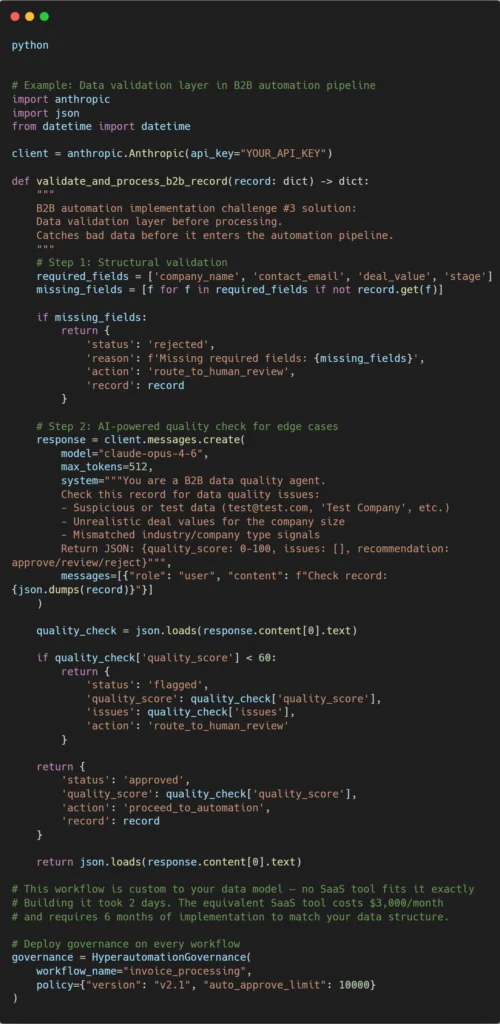
Challenge 3: Data Quality Issues
You kick off three Claude Code sessions before your morning standup: one fixing a flaky CI pipeline, one writing integration tests for a new endpoint, and one migrating a deprecated API. You walk to the meeting with your phone, checking on each session’s progress in real-time. When Claude asks a clarifying question about the test cases, you respond from your phone without interrupting the meeting. By the time the standup ends, all three tasks have been progressing for 30 minutes with your ongoing guidance.
Challenge 4: Resistance to Change
Why resistance to change kills projects: Resistance to change ranks 3rd among the challenges to automation implementation. Employees who have developed their skills based on manual processes often see their jobs being automated as a threat to their existence. This leads to resistance, which shows up in the form of poor adoption, people creating ways to avoid automation, and secretly damaging the quality of the data so that the system appears to be failing.
The fix: Change management is a project workstream, not an option. Get frontline staff engaged in designing the process before the automation build. Be honest about the scope of automation (what it replaces and what it does not). Form “automation champion” groups within each department. Straightforwardly present the business case: automation takes away the boring tasks, but it does not get rid of people.
Challenge 5: Scope Creep During Build
Automation projects are like magnets for stakeholder requests. A project that starts as “automate invoice processing” can quickly turn into “also handle PO matching, also integrate with the new vendor portal, also add fraud detection.” Approximately 70% of projects exceed their original timeline on average by 45% due to underestimating the complexity. Scope creep is the factor that can multiply a 45% time overrun to a 200% time overrun.
The fix: MVP scoping becomes very strict, and change control is documented. Specify the minimum viable automation, the exact workflow, exact inputs, and exact outputs, and do that first. Each new requirement is submitted for formal change control, with time and budget implications documented. Deliver the MVP, measure it, then scale up.
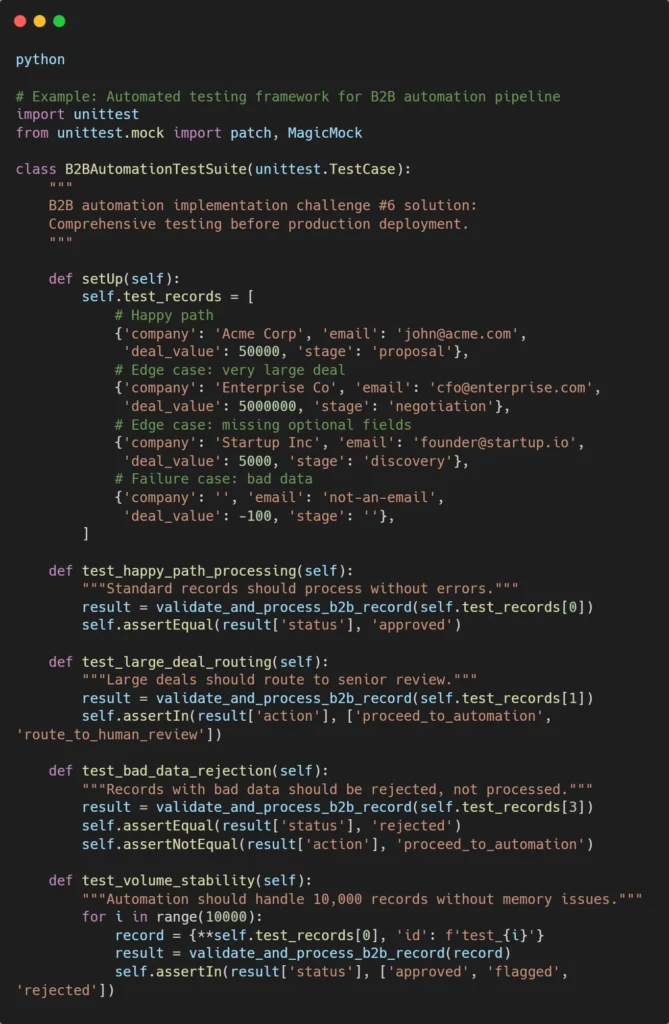
Challenge 6: Inadequate Testing Before Deployment
Why it kills projects: One of the biggest reasons why B2B automation implementation projects fail is that the teams involved do not test the system adequately before deployment. When the team is under time pressure, they shorten the testing cycles and end up with the automation running fine in the test environment but failing in production. This happens because either the edge cases that got missed, the exception handling was not built, or the data from the live environment is different and messier than the test data.
The fix: We suggest setting up three-environment testing: development, staging (with production-equivalent data), and production parallel run. In production, run the automation side by side with the manual process for at least two weeks before the manual workflows are phased out. In fact, one hundred successful production executions should be the requirement before the sign-off is done.
Challenge 7: Lack of Governance or Audit Trail
Why it kills projects: Automation without governance is an open door to a compliance disaster. When an automated decision leads to a customer complaint, a regulatory inquiry, or a financial error and there is no audit trail, the organization is unable to explain what happened, prove compliance, and address the cause of the problem.
The solution: Record every automated decision. Note every exception. Record every escalation to human review with the reason, timestamp, and outcome. Set up a governance framework before going live, not as a reaction to the first problem.
Challenge 8: Wrong Tool for the Wrong Use Case
| Use Case | Right Tool | Wrong Tool |
|---|---|---|
| Legacy system, no API | RPA (UiPath, AA) | Custom code |
| Modern API integrations | n8n, Zapier, Make | RPA |
| Complex reasoning + AI | Claude + Python | No-code only |
| Simple linear workflows | No-code platform | Enterprise RPA |
| Multi-system orchestration | Hyperautomation suite | Point solutions |
Challenge 9: Lack of Executive Sponsorship
Why it kills projects: When automation initiatives are started by IT only and lack the ownership of the C-suite, they tend to be deprioritized when new needs arise. As a result, the budget is reduced, the time frame is extended, and eventually, the project dies a silent death without any formal cancellation.
The fix: Get a named executive sponsor committed to the project before its launch – preferably the COO or CFO who has the P&L of the business that the automation is targeting. Create a business case with clear ROI objectives that the sponsor will own. Plan monthly executive sessions where the focus is on business results, not technical progress.
Challenge 10: Measuring the Wrong Metrics
Why it kills projects: Instead of measuring bot activities – automation, tasks completed – teams measure bot activities – automation, tasks completed. A project saying it runs 10,000 automated tasks a month is considered successful till someone finds out the error rate is 15%, revealing the level of customer dissatisfaction.
The fix: Agree on business result metrics first: Start tracking these from the very beginning and not after the project is “complete.”
Challenge 11: Ignoring Exception Handling
Why it kills projects: Difficulty capturing exception handling for edge cases is one of the most cited B2B automation implementation challenges. Every process has exceptions — the invoice with a non-standard format, the customer with a special pricing agreement, the order that doesn’t fit the standard routing rules. Automations built for the happy path break on exceptions and require manual intervention at the worst possible moments.
The fix: Map every known exception before building. For each exception, define the automated handling path (can the bot handle it?) or the human escalation path (who gets notified, with what information, within what timeframe?). Build exception handling as a first-class feature, not an afterthought.
Challenge 12: No Post-Deployment Maintenance Plan
Why it kills projects: One of the major reasons why the absence of a post-deployment maintenance plan results in failure of automation projects is that software keeps changing. APIs get updated. Business processes are modified. An automation made on the basis of today’s systems ceases to function when the upstream application comes out with a new version. If there is no post-deployment plan, then the automation keeps failing without anyone noticing until a very big failure leads to the need for emergency fixing.
The fix: Give the person(s) responsible for each production automation a formal title, e.g., ‘automation owner’. Set up the automated health monitoring systems that will send you alerts once there is a decrease in the number of successful executions, an increase in the number of errors, or a change in the systems to which you are connected. Do quarterly reviews. Think of automations as production software that needs maintenance from time to time, and not only deployment.
The Framework Proven to Work for Successful Implementation
Once each of the 12 challenges to implementing automation for B2B has been resolved, you can see a pattern of successful implementation, which is consistent with organizations that have the highest return on investment (ROI) from automation. These organizations share a framework for implementing an automated process as outlined below:
Step 1 – Discover (Week 1 – 4): Analyze your highest-volume workflows using process mining and rank them by the potential for automation. Use three criteria—volume, rule clarity, and cost per execution—to determine whether you should select your first candidate for automation. The first candidate would be easy to determine the ROI and is low in terms of complexity.
Step 2 – Design (Week 5 – 8): This is when you redesign the process before automating it. You must create a process map to show all variants, exceptions, and integration points between the new and existing processes. Develop data quality standards and obtain stakeholder signature approval of the designed process before commencing with a build.
Step 3 – Build (Week 9 – 16): Develop an MVP first. Build the happy path first and then build in exception handling, governance/management logging, and a suite for testing. No change orders or exception requests will be allowed; you have had plenty of opportunity to get it right at this point.
Step 4 – Test (Week 17 – 20): Conduct development (or unit) testing, followed by staging testing, followed by a parallel production run. You will decommission the manual version of the process only after 1,000 successful executions of the automated version in a production environment.
Step 5 – Scale (Week 21 onward): Evaluate the ROI of the automation process against the metrics that were established. Document your lessons learned during the previous implementation and use those lessons learned for the next automation process in the plan. Create a Centre of Excellence to create standardization for the automation processes throughout your organization.
Conclusion: B2B Automation Implementation Challenges Are Predictable — Which Means They're Preventable
Every B2B automation challenge mentioned here is a source of pain that can be anticipated. Those organizations that are aware of them even before initiating a project turn prevention strategies into a part of their DNA from day one. On the other hand, the ones who find them only during the course of the project end up paying for the experience lesson through their project timelines, budgets, and ROI misses. Automation projects worth $2.3 million are not failing because the automation platforms are not effective.
They are simply failing because ordering a product is easier than getting the job done, getting people to accept new ways of working is harder than setting up the system, and governing is less fun than showing off. In 2026, those organizations that will be leading with automation are the ones that view these B2B automation challenges as a project checklist rather than a list of reasons to get out. Do all these 12 steps. Develop frameworks. Take measurements right from the beginning. The benefits, such as 40% cost reduction and even 2,560% ROI in some cases, are indeed tangible. However, they are definitely not something that just happens by itself.
About Orbilon Technologies
Orbilon Technologies is an enterprise automation and AI engineering company that has helped 30+ organizations navigate B2B automation implementation challenges and ship production-grade automation systems that deliver measurable ROI. Based in Lahore, Pakistan, with clients across the US and UK, our team covers the full automation stack — process mining, RPA implementation, AI integration, governance frameworks, and post-deployment support.
We’ve seen all 12 challenges in this list in real client engagements. We’ve built the frameworks to solve them. And we deliver automation projects on time, on budget, with ROI targets defined before we start.
- 4.96 on Clutch and GoodFirms.
- 30+ enterprises automated.
- Zero failed implementations.
- Website: orbilontech.com
- Email: support@orbilontech.com
Ready to Automate Without the $2.3M Failure Risk?
Orbilon Technologies offers a free automation readiness assessment — we evaluate your top 3 automation candidates, identify which of the 12 challenges apply to your environment, and give you a risk-mitigated implementation roadmap before you spend a dollar on build. Book Your Free Automation Readiness Assessment.
Want to Hire Us?
Are you ready to turn your ideas into a reality? Hire Orbilon Technologies today and start working right away with qualified resources. We will take care of everything from design, development, security, quality assurance, and deployment. We are just a click away.