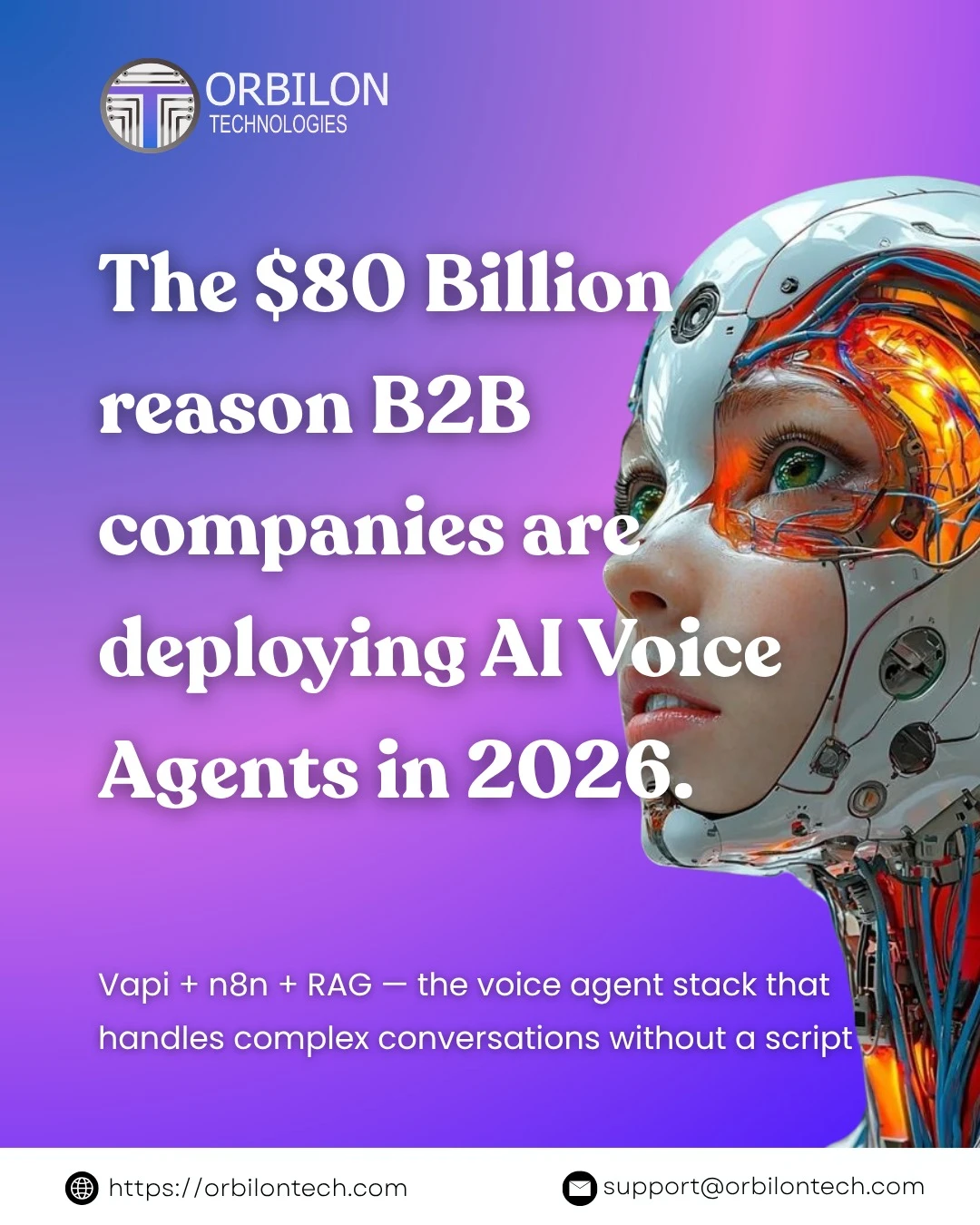
The $80 Billion Reason B2B Companies Are Deploying AI Voice Agents in 2026
Introduction
One figure receiving serious attention in corporate meetings is the prediction by Gartner that conversational AI will reduce contact center labor costs by $80 billion in 2026. It is not that this amount will be saved over ten years. It is for this year alone. Besides the companies that have Fortune 500 status and budgets in millions, other organizations are also benefiting from this technology.
Mid-market B2B companies, for example, are now equipping AI voice agents to manage complex, unscripted conversations – such as scheduling appointments, lead qualification, ticket resolution, order processing – all without anyone from the human side having to come to the phone.
What is the technology stack that makes this happen?
Vapi + n8n + RAG. Let’s first discuss why it is essential for your business and then go over the steps to actually build it.
Why AI Voice Agents Are a Game-Changer for B2B?
The traditional IVR systems, like selecting 1 for sales or 2 for support, are slowly fading away. AI voice agents for B2B don’t follow rigid scripts. They pay attention, capture the context, search your knowledge base for the right piece of information, and respond naturally. You might liken them to co-workers who are always at your disposal and have instant access to every document, policy, and customer record in your company.
The gap in cost is quite significant. Employing a human agent will set you back by $7 to $12 per call. An AI voice agent, on the other hand, is capable of handling that exact call for about 30 to 50 cents per minute, which includes all the model and telephony costs. If a B2B business is conducting thousands of calls a month, that is a 60 to 90 percent reduction in expenses right coming, practically.
However, cutting costs is merely the start. The true power of AI voice agents is in what they can do far beyond human teams: they can handle an unlimited number of calls simultaneously, are available 24/7, respond in less than half a second, speak over 100 different languages, and without fail, maintain the quality of every interaction consistently.
The Voice Agent Stack: Vapi + n8n + RAG Explained
Building a production-grade AI voice agent requires three core components working together. Here’s what each layer does and why this specific stack is winning among B2B teams.
a. Vapi — The Voice Orchestration Layer
Vapi is a developer-first platform that connects your phone system to AI models. It handles the hard infrastructure problems: audio streaming, speech-to-text transcription, sending the text to a language model, and converting the response back to speech — all in real-time with sub-500ms latency.
What makes Vapi stand out for B2B deployments is the level of control it offers. You choose your own STT provider (Deepgram, AssemblyAI, Whisper), your LLM (GPT-4o, Claude, Gemini), and your TTS engine (ElevenLabs, Azure, Play.ht). It also supports advanced conversational features like interrupt detection, backchanneling (“okay,” “got it”), emotion recognition, and background noise filtering — features that make the agent sound human, not robotic.
Vapi’s platform fee starts at $0.05/minute, with additional costs for the AI models and telephony you plug in. For B2B companies, the total stack cost typically ranges from $0.20–0.35/minute fully loaded.
b. n8n — The Automation Brain
Vapi handles the voice. But what happens when the agent needs to do something — check a calendar, update a CRM, send a confirmation email, look up an order, or route a call to a human?
That’s where n8n comes in. As an open-source workflow automation platform, n8n connects your voice agent to every tool in your stack. When a caller asks to book a meeting, the Vapi agent triggers an n8n webhook that checks Google Calendar availability, creates the event, sends a confirmation email, and logs everything in your CRM — all within the same call.
The beauty of n8n in this stack is that each of those actions (calendar check, booking, email, CRM update) counts as a single workflow execution. If you self-host n8n, the automation layer costs you essentially nothing beyond server expenses.
c. RAG — The Knowledge Layer
RAG (Retrieval-Augmented Generation) is the factor that distinguishes a run-of-the-mill chatbot from a voice agent that really understands your business. Rather than depending only on the LLM’s (language model) training data, RAG allows the agent to browse your business documents, FAQs, product specifications, price lists, and company policies in real-time during a conversation.
Here is the process: when a caller poses a question, the system first transforms it into an embedding (a numerical representation), then looks up a vector database such as Pinecone, Qdrant, or Supabase for the most appropriate pieces of your documentation, and finally provides that context plus the question to the LLM. The output is a response based on your real data, not a hallucinated guess.
This is a must-have for B2B companies. Your voice agent ought to be capable of quoting the correct prices, referencing the exact contract clauses, and properly elaborating on product features. RAG enables that.
Industries Benefiting from AI Voice Agents for B2B
- SaaS and Technology Companies: One way they operate is through AI voices that take care of first-level help, guiding new users, sending renewal prompts, while also suggesting upgrades when activity shows it makes sense. Running through n8n, the system pulls customer data straight from your CRM, linking live records into each call. Product details come alive during conversations because a RAG-driven setup fetches precise answers on demand. Speed improves noticeably under this model – issues close faster, handoffs drop off, leaving room for human staff to dive into complex cases instead
- Health Care and Medical Services: Calls about appointments, medicine updates, coverage questions, or signing in patients get handled by voice helpers following HIPAA rules. Your servers running n8n mean health details stay under your roof. Since the assistant taps into drug lists, doctor networks, and payer data through RAG, answers come fast and correct.
- Financial Services and FinTech: A single question about your balance gets sorted fast by these automated voices. When fraud warnings pop up, they respond without delay. Loan status changes come through clearly on each call. Payment due dates are shared straight up, no confusion. Many banks pick Vapi’s voice checks to confirm who is speaking. Insurance firms do too, relying on sound patterns unique to you. Instead of guessing, responses pull facts from rule books using RAG systems. Compliance isn’t an afterthought – it shapes every reply before it leaves
- Real Estate and Property Management: Every time a lead comes in, calls go out without anyone lifting a phone. Budget, timeline, or specific needs decide what happens next behind the scenes. One system dials numbers using Vapi, asking questions that match how someone wants to rent. After sorting who fits, details land quietly inside a spreadsheet. Tasks like repairs or visits get lined up only when conditions are just right. Follow-up steps start on their own, no waiting needed
- Logistics and Supply Chain: Every day, voices powered by machines take care of checking where packages are, setting drop-off times, talking with suppliers, and confirming what was bought. Since lots of shipping groups keep using phones, these digital helpers link into business software through n8n, handling routine calls fast while staff deal with rare hiccups instead
- E-Commerce (B2B Wholesale): When a client asks about large orders, they look into it straight away. Inventory status? Checked on the spot, live updates guiding every reply. Returns go through them, step by step, no guesswork involved. Pricing details tied to individual accounts come up often – those get clear answers fast. For choosing price levels, the agent leans on RAG, fitting the option like a key in a lock.
How to Build a Vapi + n8n + RAG Voice Agent: Step-by-Step
Step 1: Define Your Use Case – Start with one type of call that happens often and is repetitive. This could be scheduling appointments, qualifying leads, or checking order statuses. Outline the typical conversation flow: what questions people ask, what information the agent needs, and what steps it should take.
Step 2: Set Up Your Knowledge Base (RAG) – Collect your documents—FAQs, product details, pricing info, policies. Use an embedding model like OpenAI’s text-embedding-3-small to turn these documents into vectors. Save them in a vector database such as Qdrant, Pinecone, or Supabase. You can use n8n to visually create this whole process without writing custom code.
Step 3: Build Your n8n Workflows – Make workflows triggered by webhooks that your Vapi agent can call during conversations. Typical workflows include:
- check_availability — checks Google Calendar or your scheduling system.
- book_appointment — adds an event to the calendar and sends confirmation.
- lookup_order — fetches order details from your database or CRM.
- rag_search — searches your vector database and returns relevant information.
Each workflow gets a JSON request from Vapi, handles it, and sends back a structured response that the agent can speak to the caller.
Step 4: Configure Your Vapi Assistant – Set up a new assistant in the Vapi dashboard. Write clear system prompts explaining when to use each n8n tool. Choose your speech-to-text, language model, and text-to-speech providers based on your needs for speed and cost. Add your n8n webhook URLs as API tools in Vapi’s configuration. Assign a phone number through Twilio or Vapi’s telephony and set it up to answer incoming calls.
Step 5: Test, Iterate, Deploy – Make test calls and review the transcripts for accuracy. Fine-tune your RAG search settings, like chunk size and similarity threshold, so the agent finds the right information reliably. Adjust your system prompt to better handle unusual cases. When everything is working smoothly, launch it for real use and keep an eye on call data.
Example: AI Voice Agent for B2B Customer Support (Vapi + n8n + RAG)
Here’s a simplified n8n workflow structure for a customer support voice agent:
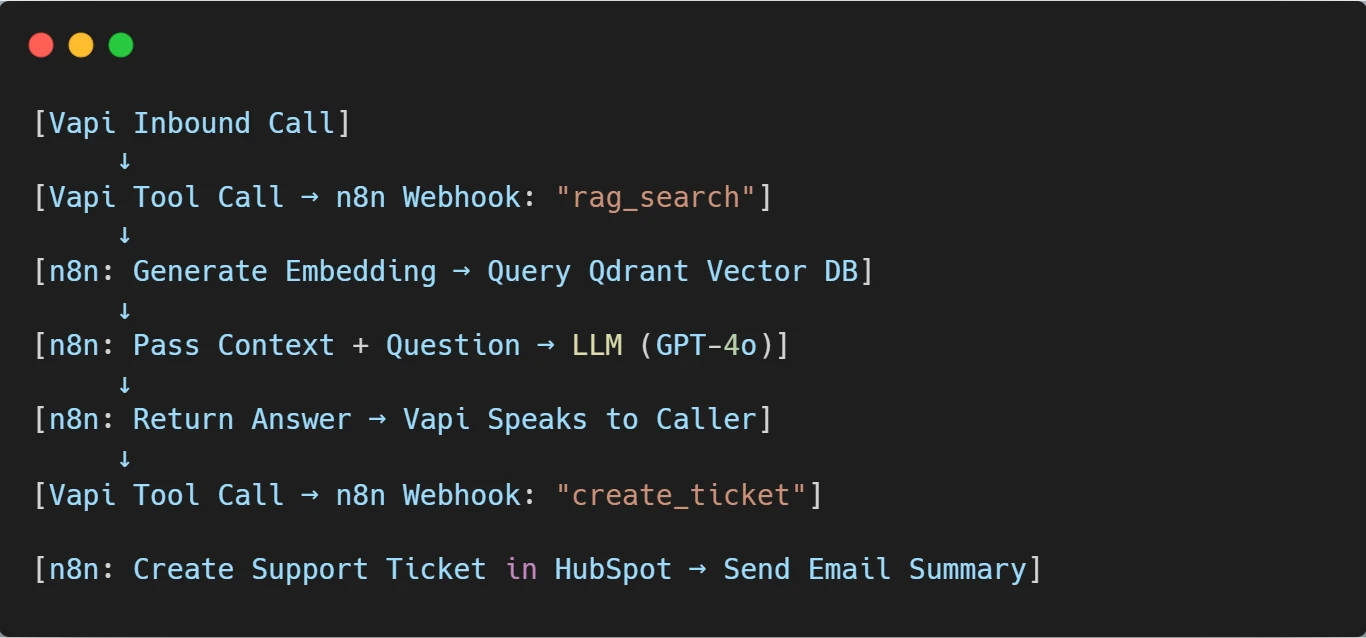
The entire call flow — from speech recognition to knowledge retrieval to CRM update — happens in real-time during a single phone conversation. The caller never waits on hold, never gets transferred to a department that can’t help, and always receives an answer grounded in your actual documentation.
What It Costs: A Realistic Budget Breakdown
A B2B company with 5,000 minutes of calls per month can expect the stack to cost them something like this:
- Vapi platform fee: approx. $250/month($0.05/min).
- LLM expenses (GPT-4o): approx. $300500/month (depends on prompt length).
- STT + TTS (Deepgram + ElevenLabs): approx. $150 to 250/month.
- n8n (self-hosted): approx. $15 to 30/month (server costs only).
- Vector database (Qdrant cloud): approx. $25 to 50/month.
Total: around $7501,080/month for a voice agent that can handle calls around the clock with no vacation days, no training time, and no inconsistency.
If you look at a single full-time customer service representative who earns $3,500 to 5,000/month (plus benefits, training, and turnover costs), then the ROI is clear.
Conclusion: The Window Is Open — But It Won't Stay Open
The $80 billion in contact center savings that Gartner predicts isn’t theoretical. B2B companies are deploying AI voice agents for B2B right now and capturing measurable ROI within weeks, not quarters.
The Vapi + n8n + RAG stack gives technical teams the control and flexibility to build agents that genuinely handle complex conversations — without locking you into an expensive, closed platform.
The companies that move on this in 2026 will build a significant operational advantage. The ones that wait will spend the next two years paying human teams to do work that a voice agent handles better, faster, and cheaper.
About Orbilon Technologies
Orbilon Technologies is an AI development agency that builds intelligent software solutions — including custom AI voice agents, workflow automations, and AI-powered SaaS platforms. With years of engineering experience and a 4.96 average rating across Clutch, GoodFirms, and Google, we help B2B companies design, deploy, and scale AI agents that drive real business results.
Ready to build your AI voice agent?
Talk to our AI engineering team and get a free architecture consultation.
- Rated on Clutch
- Website: orbilontech.com
- Email: support@orbilontech.com
Want to Hire Us?
Are you ready to turn your ideas into a reality? Hire Orbilon Technologies today and start working right away with qualified resources. We will take care of everything from design, development, security, quality assurance, and deployment. We are just a click away.