AI RPA and Analytics: Why Each Technology Alone Is Incomplete — And Together They're Unstoppable?
Introduction
In 2026, we can see this scene being repeated in many companies: one that implements artificial intelligence is fascinated by the excellent demonstrations, but no one can see any real impact on the operation. Another one is thinking about RPA bots, automates 50 tasks, but suddenly comes up against a barrier since the bots are unable to solve exceptions. The third one is spending on analytics dashboards, producing very nice insights that nobody actually implements.
Each technology brings some value when used separately. However, none of them has the power to change the whole business on its own. The biggest breakthrough is experienced when you integrate AI RPA and analytics into one hyperautomation stack, where analytics identifies the opportunities, RPA does the work, and AI manages the decisions and exceptions that neither of the other two could handle on their own.
This is not a speculation but a fact. In 2025, the worldwide hyperautomation market, which comes from the mix of integrating AI RPA and analytics, was valued at 65-70 billion dollars, and it is expected to reach 280-300 billion by 2035. Almost 90% of large organizations have this fusion as their number one strategic issue. Now we come to why one single technology can fail and how the combination can bring about a dramatic change.
The Gap AI Leaves When It Operates Without a System
AI is essentially good at interpreting language, identifying patterns, predicting, and producing text. However, many things AI, even with its abilities, cannot do without human interaction.
For instance, it cannot click buttons. AI might be able to determine that an invoice could be approved, but it can’t log into your ERP, find the approval page, and physically click “approve.” It has no hands, after all.
Secondly, it cannot always follow the business rules that are so tightly regulated. Of course, AI is very good at making decisions where there is non-verbal and unstructured data. On the other hand, for processes where there is no room for mistakes, like tax submission, compliance reporting, and data entry, the probabilistic character of AI is actually a disadvantage. What is needed here is precise and guaranteed execution.
Thirdly, it cannot figure out the things you need to automate. AI doesn’t understand where your bottlenecks are, which operations waste most time, or where the biggest mistakes are. Without having a clear view of the processes, AI will be applied to the wrong issues.
Consequently, companies acquire AI chatbots, content generators, and copilots, but their main operations continue to be manual. As such, AI only turns into a side tool instead of a thorough operational backbone.
The Ceiling RPA Hits Without Intelligence
RPA bots are really good at doing what they are told. They can log into systems, copy information from one place to another, fill out forms, click buttons, and do tasks. Faster and more accurately than people can all the time.
But the old way of doing RPA does not work when things do not go as planned:
RPA bots cannot deal with information that is not organized. If an invoice comes as a PDF and it looks a little different, the bot will stop. If a customer sends an email with a complaint, but it is hard to find, the RPA bot will not see it.
RPA bots cannot make choices. When a bot runs into a problem. Like a missing piece of information, a strange transaction, or a new kind of document. It will. Fail or send the problem to a person to fix, which means it is not efficient anymore.
RPA bots cannot get better on their own. RPA bots that were made in 2020 will still work the same way in 2026 unless someone updates them. They do not learn from the things they do they do not adapt to changes. They do not make themselves work better.
The result is that companies hit a roadblock with RPA. They have automated the tasks, but 60-70% of their processes are still not automated because they need people to use their judgment, or they have unorganized information, or they have problems that the RPA bots cannot solve because they can only follow rules.
The Frustration Analytics Creates Without Execution
Through analytics platforms, you get a comprehensive view: charts that reveal customer churn rates, pinpoint process bottlenecks, highlight revenue trends, and track operational KPIs. Today’s process mining solutions are so advanced that they can essentially create a map showing how work moves through your business. However, analytics by itself has a serious drawback:
Data without follow-up actions remains mere reports. Your graph reveals that the average invoice processing time is 14 days. Where does one go from there? It’s still a matter of redesigning the procedure, constructing the automation, and rolling it out. Analytics indicates where the problems lie, but it won’t just change anything.
Moreover, it is inherently a look back at events. Typically, analytics informs us of what has already taken place. When a person eventually reads the report, makes a decision, and carries out the changes, the moment for intervention is often gone. The circle isn’t completed.
In the absence of AI to make sense of results and RPA to implement alterations, analytics will keep making a gap between knowing and doing.
Ultimately, organizations are heavily investing in their BI tools and process mining, but are still having difficulty in their efforts to turn findings into tangible operational improvements. The insights remain in the PowerPoint presentations, not in the automated workflows.
The Hyperautomation Stack: How AI RPA and Analytics Work Together?
When you combine AI RPA and analytics into a coordinated system, each technology compensates for the other’s weaknesses. Here’s how the integrated stack works:
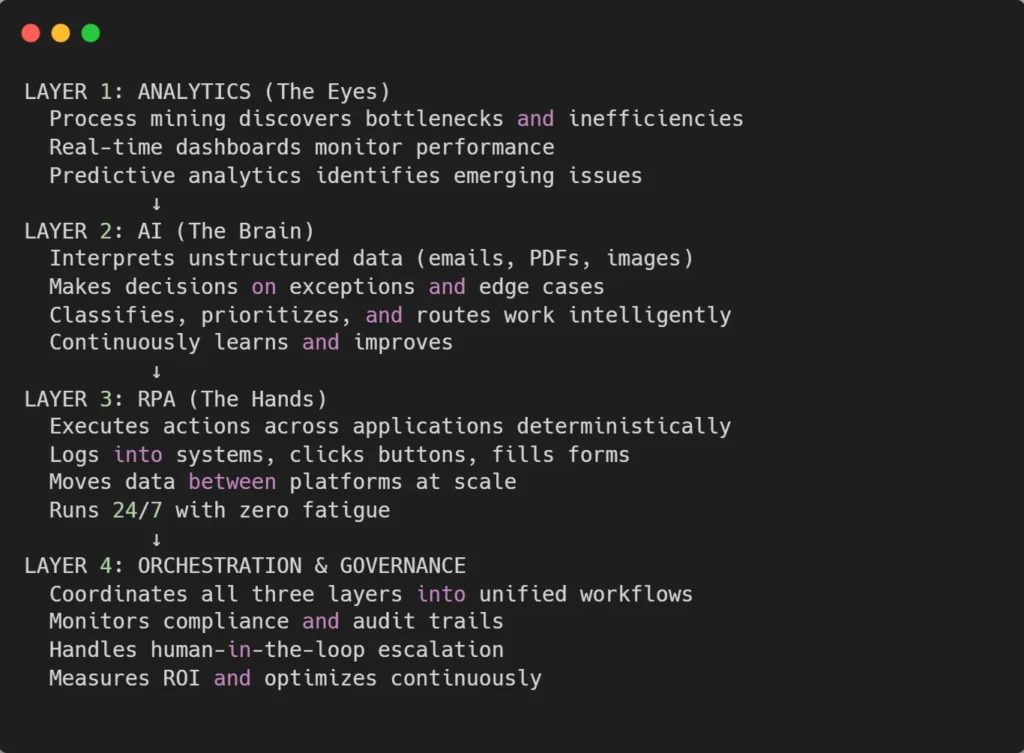
The flywheel effect: Analytics pinpoints a process that requires 14 days to complete. AI extracts relevant information from the unstructured documents and makes classification decisions. RPA carries out the steps which have been structured. Afterwards, Analytics measures the improvement and identifies the next bottleneck. The system keeps on discovering, deciding, and doing – without a human having to connect the dots.
AI RPA and Analytics in Action: Real-World Examples
1. Invoice Processing (Finance)
Without integration: Invoices come via email as PDF files. This means that someone has to physically open every single one, see what information is on them, key in data into the ERP, send for approval, and finally, make payment. The whole procedure takes, on average, more than two weeks.
Using AI RPA and analytics together: Analytics show that invoice processing is the biggest source of delay. AI-based OCR recognizes invoices even if the shapes are different, and it is able to get the information about the vendor, amount, line items, and PO numbers. AI compares invoices with purchase orders and highlights exceptions. RPA will enter the verified data into the ERP, send it for approval, and make a payment. Analytics monitors the cycle time, error rate, and cost per invoice continuously.
Outcome: Time required to process is reduced from two weeks to less than a day. Error rate decreases by more than 80%. Finance personnel concentrate their efforts on handling exceptions and vendor interactions rather than on data entry.
2. Customer Onboarding (SaaS / Financial Services)
Without integration, Customers who are new fill out the forms. The staff has to hand-check the identity, check the compliance, open the accounts, send the welcome communications, and set the follow-ups. Account opening can be delayed for days, and experience might also be inconsistent.
Combined AI RPA and analytics: AI uses computer vision to identify the identity document. RPA sets up the accounts in different systems, initiates the welcome series, and fixes the time for follow-up. The analytics keep track of the customer onboarding rate, find out where the customer drops off, and notify the team if a new customer is stuck.
Outcome: The time for customer onboarding has been reduced from days to minutes. The reason why the customer satisfaction record went up is that the customer experience is both instant and consistent.
3. Supply Chain & Inventory (Logistics / Retail)
Without Integration: Demand planning is based on historical spreadsheets. Purchase orders are manually created. Stockouts and overstocking occur quite often.
Combined AI RPA and analytics: Analytics performs process mining of supply chain workflows. AI utilizes weather data, seasonal trends, and market signals to forecast demand. RPA automatically creates purchase orders, updates inventory systems, and even notifies suppliers. Analytics tracks inventory turnover, lead times, and measures the accuracy of the forecast.
Result: When all three technologies are combined, companies show 30% reduction in logistics costs and 50% improvement in inventory turnover.
The Numbers: Why This Convergence Is Accelerating?
| Metric | 2025 | 2026 Projection |
|---|---|---|
| Hyperautomation market size | $65-70B | $80B+ |
| Enterprises treating hyperautomation as a top priority | 90% | 90%+ |
| Enterprise apps embedding AI agents | <5% | 40% (Gartner) |
| RPA market size | $12.93B | $35.27B |
| Enterprises automating >50% of network ops | <10% | 30% |
| Avg. cost reduction from AI RPA and analytics stack | 20-30% | 20-40% |
| Process automation payback period | 12-18 months | <12 months |
The convergence is not optional anymore. Organizations running AI RPA and analytics as a coordinated stack report 20-40% cost reductions, 40% faster processes, and sub-12-month payback on their automation investments.
How to Build Your Integrated AI RPA and Analytics Stack?
- Step 1: Find Out What Is Going On With Analytics – We need to use tools like Celonis, UiPath Process Mining, or other free tools to see how our work is really done. We have to find the 5 things we do that take up a lot of time, have a lot of mistakes, and need people to do them. This helps us make a plan to automate the things that need it the most, based on what the data tells us, not just what we think.
- Step 2: Make A Smart Plan For The Work – For each thing we want to automate, we have to figure out where we need to use intelligence, like when we have to make decisions, deal with unorganized information, or handle exceptions. We also need to know where we can use robots to do tasks like filling out forms or moving data around, and where we can use analytics to keep an eye on things like how well we are doing or if there are any mistakes. This way, we make sure every part of the work is covered.
- Step 3: Choose the Right Tools – We have to pick a platform that can do all these things. Companies like UiPath, Automation Anywhere, and Microsoft Power Automate have tools that can do intelligence, robots, and analytics all together. If we want to use tools, we can use n8n with artificial intelligence models and tools to analyze the work process, which is cheaper and works well for smaller companies.
- Step 4: Start With Something Small. See How It Goes – We should automate one whole process and see how it works. We need to measure how long it takes and how many mistakes are made. How much does it cost before and after we automate it? If it works well, we can use that to prove that it is an idea to automate more things. Companies that start with small processes and do them well before trying to automate everything see better results.
- Step 5: Make Sure We Are In Control From The Beginning – We have to set up ways to track what is happening, control who can use the tools, and make sure we are following the rules from the start. There is a law in the EU called the AI Act that starts in 2026, which says we have to be transparent and tell people about the risks of using artificial intelligence. We have to build these rules into our plan from the beginning, not just add them later.
Conclusion: Stop Buying Technologies — Start Building Systems
The disadvantage AI has when it functions independently, without a system to support it, is the same disadvantage RPA has when it works without intelligence, and the same disadvantage that analytics has when it is not followed by execution. Each technology provides one piece of the solution. No one delivers the whole solution.
The businesses that are going to win in 2026 will not be ones that happen to possess the best AI model, the most RPA bots, or the most beautifully designed dashboards. Instead, they will be the ones who have integrated AI RPA and analytics into a single, well-orchestrated system that identifies problems, makes smart decisions, takes actions, and keeps on improving by itself automatically. This is not hyperautomation as a mere buzzword.
It is hyperautomation as a strategic competitive advantage.
About Orbilon Technologies
Orbilon Technologies is a firm specializing in the growth of AI. We bridge the gap between the current abilities of AI and the immediate application of many industries through building intelligent automation systems (combining AI RPA and analytics into unified hyperautomation stacks for enterprises).
Our team has years of engineering experience and maintains a consistent 4.96 average rating across Clutch, GoodFirms, and Google. We support companies in creating and implementing automation that produces accessible returns on investment.
Are you thinking of creating your own integrated automation stack? You can contact our automation engineering team to get a free consultation.
- Website: orbilontech.com
- Email: support@orbilontech.com
Want to Hire Us?
Are you ready to turn your ideas into a reality? Hire Orbilon Technologies today and start working right away with qualified resources. We will take care of everything from design, development, security, quality assurance, and deployment. We are just a click away.