15% of Work Decisions Will Be AI-Autonomous by 2028: What It Means for Your Role, Team, and Career
Introduction
At the moment, zero percent of work decisions are made by AI without human involvement. But, by 2028, based on Gartner’s forecast, that figure will be 15%, and 1 out of 3 software applications used by corporates will have AI capabilities integrated directly.
This transition from relying on AI tools to AI making decisions independently is the biggest change in the workplace since the time of the internet. Besides just changing the software you use, it also alters your decision-making, the skills your team should have, and the nature of work roles that will be so different in two years.
AI autonomous work decisions: Making AI the sole decision-maker at the work level is not a far-off thing. It is happening now in production at companies doing finance, health care, logistics, and software/business, really quite discreetly, making decisions that would have required human judgment, human presence, and human resources.
Here we explain in detail what this change means, which functions and sectors will experience it first, and what you can do very practically, this week, to prepare for it rather than let it take you by surprise.
What Gartner's 15% Actually Means?
The headline stat comes directly from Gartner’s Top Strategic Technology Trends report: at least 15% of day-to-day work decisions will be made autonomously through agentic AI by 2028, up from 0% in 2024. In addition, 33% of enterprise software applications will include agentic AI by 2028, up from less than 1% in 2024.
To understand what 15% means in practice, think about how many decisions get made in a typical workday across your organization. Routing a support ticket. Approving a low-risk purchase order. Flagging an anomaly in the data pipeline. Adjusting ad spend based on performance. Scheduling a follow-up. Re-prioritizing a sprint based on new requirements.
Most of these decisions are not complex. They’re judgment calls based on pattern recognition — exactly what AI agents do well. The 15% figure represents the decisions where the data is clear, the rules are defined, and the cost of waiting for a human is higher than the cost of acting autonomously.
Gartner’s distinguished vice president and analyst Gene Alvarez stated: “This is happening very, very quickly. No one can finish all their work before going to bed, and businesses need to spend a lot of time monitoring things. Creating AI agents can not only replace some tasks and assist businesses in detection, but also improve work efficiency and save time.”
The number that should get equal attention: over 40% of agentic AI projects will be cancelled by the end of 2027 due to escalating costs, unclear business value, or inadequate risk controls. The shift is real — but only the organizations that build it correctly will capture the value. The rest will spend the budget and see nothing.
The Shift From AI-Assisted to AI-Autonomous: What Changes
| Workflow | AI-Assisted (Now) | AI-Autonomous (2028) |
|---|---|---|
| Customer support | AI suggests a reply, agent sends it | AI resolves tier-1 tickets end-to-end |
| Code review | AI flags issues, dev reviews | AI patches, tests, and merges low-risk fixes |
| Inventory management | AI recommends restock levels | AI triggers purchase orders automatically |
| Financial reporting | AI generates draft, analyst edits | AI produces and distributes reports autonomously |
| Candidate screening | AI scores resumes, HR shortlists | AI conducts first-round screening and scores |
| Security monitoring | AI alerts the team to an anomaly | AI isolates the affected system and notifies team |
| Ad spend optimization | AI suggests budget shifts | AI adjusts spend in real time based on performance |
Why 40% of Agentic Projects Will Fail — And What Separates Winners?
Gartner’s research reveals a stark reality about the vendor landscape. Only about 130 thousand of agentic AI vendors offer genuine capabilities. The rest practice “agent washing” by rebranding existing chatbots and RPA tools.
The organizations that will successfully reach that 15% threshold share three characteristics that most current pilots lack:
- They treat agentic AI as an architecture problem, not a tool problem. The 60% of projects that succeed will recognize agentic AI as an architecture problem. They will build systems that genuinely reason, learn, and coordinate — not simply execute sophisticated scripts with better interfaces.
- They focus on enterprise productivity, not individual task automation. “To get real value from agentic AI, organizations must focus on enterprise productivity, rather than just individual task augmentation,” said Verma. “They can start by using AI agents when decisions are needed, automation for routine workflows, and assistants for simple retrieval.”
- They govern before they scale. The 40% failure rate isn’t a technology problem — it’s a governance problem. Projects that succeed define decision boundaries clearly, build human escalation paths before launch, and measure ROI per workflow rather than per pilot.
Industries Where AI Autonomous Work Decisions Are Already Running
a. Software Development
AI agents in development workflows are already making autonomous decisions about test execution, dependency updates, vulnerability patching, and PR labeling. Tools like Claude Code, GitHub Copilot Workspace, and Cursor handle entire feature implementations without human instruction at each step. A 26% increase in coder productivity has been reported with AI assistance — and that number is from AI-assisted workflows. Autonomous ones are already delivering higher multipliers in early deployments.
b. Financial Services
Fraud detection, transaction routing, credit risk scoring, and compliance flagging are all categories where AI Autonomous Work Decisions are already standard at tier-1 banks. The decision latency that humans require — even seconds — is commercially unacceptable in payment processing. AI makes those calls in milliseconds, with full audit trails.
c. Customer Service
AI-enabled machine customers — nonhuman economic actors that obtain goods and services in exchange for payment — are examples of increasingly common intelligent agents. In the near future, they will make optimized decisions on behalf of human customers based on preset rules and will quickly evolve toward greater autonomy. By mid-2026, 56% of customer support interactions are projected to involve agentic AI handling end-to-end resolution.
d. Healthcare Operations
Clinical documentation, appointment scheduling, prior authorization processing, and supply chain logistics in healthcare are all categories where AI autonomous work decisions are reducing administrative burden — freeing clinical staff for patient-facing work that actually requires human judgment.
e. Retail and E-Commerce
Usually, deciding and delivering the result of decision-making is the first step: for example, the platform can change product listings, set a new price, offer promotional discounts, or place restock orders automatically. Usually, if a product starts to fail, the system would probably discount it. If the inventory is depleting at a very high speed, the system would adapt supply chain notifications. In fact, these systems have been implemented in the production of a number of big retail companies already and are not some 2028 future concept.
What This Means for Your Role and Career?
This is the question most professionals are actually asking — and it deserves a direct answer.
The roles most affected in the short term are not the most junior ones. They’re the roles built around decision-making from structured data — junior analysts, operations coordinators, first-line support managers, and basic project coordinators. These roles exist to apply defined rules to incoming information and produce a decision or output. That’s exactly what AI agents do.
The roles that grow in value are those requiring judgment in ambiguous situations, relationship management, creative problem-solving, and AI system governance. The new high-value skill set is not “can you make good decisions” — it’s “can you design, oversee, and improve systems that make good decisions autonomously at scale.”
Alvarez acknowledged that this is both exciting and concerning, as fears of unemployment still exist. “But if AI agents can truly teach me a new set of skills, I can transition from a job I am about to lose to one that is in demand.”
The practical implication: start developing fluency in agentic AI systems now — not as a user, but as a builder and overseer. Understand how agents are prompted, governed, evaluated, and corrected. That skill set is the most defensible career position in the next 3–5 years.
How to Prepare: A Practical Implementation Framework
If you’re a CTO, IT Director, or Chief Data Officer, the key isn’t to solve everything at once — start with a single use case where you can control the variables and understand how these systems behave in your environment. The main question becomes: where do you have clean data, clear success metrics, and tolerance for some early experimentation?
Here’s a practical 4-step framework for getting started:
Step 1: Map Your Decision Inventory
List every recurring decision made in your highest-volume workflows. For each, score it on two dimensions: data clarity (how structured and consistent are the inputs?) and consequence tolerance (how recoverable is a wrong decision?). Start with high data clarity + high consequence tolerance — these are your first agentic candidates.
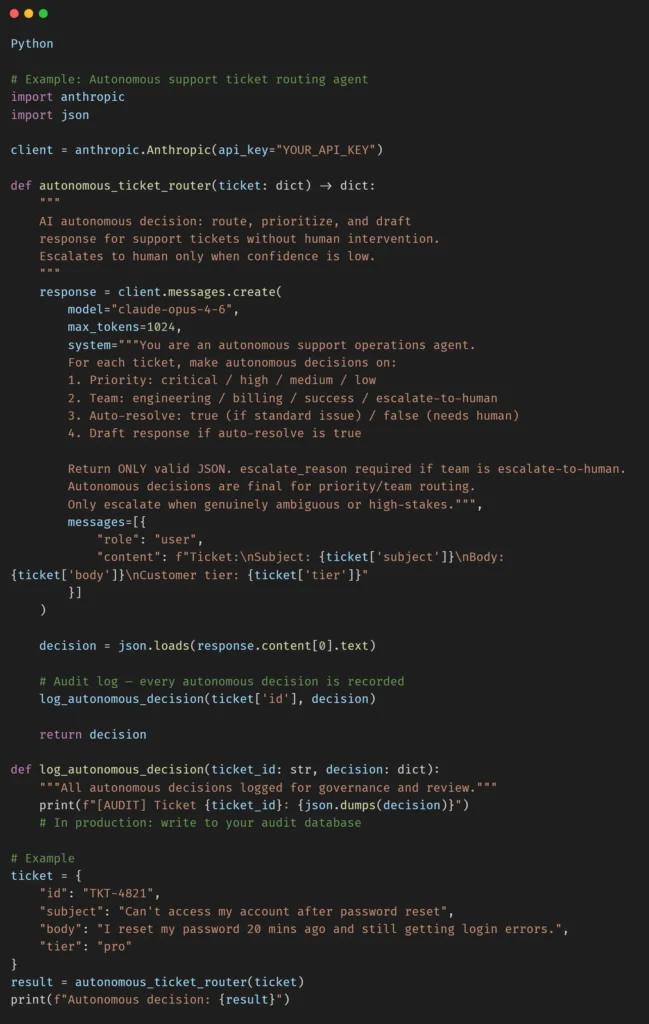
Step 2: Pick One Workflow and Build It Right
Step 3: Define Human Escalation Paths Before Launch
Every autonomous agent needs a clear escalation path. Define exactly which conditions trigger human review — confidence score below threshold, high-value customer, irreversible action, compliance-sensitive data. Build this into the agent architecture before deployment, not after the first incident.
Step 4: Measure, Iterate, Expand
Measure three things for each completely automated workflow: how close the decisions are to the human ones, how much time is saved with each decision, and the rate of escalation (a very high escalation means the agents have too wide a scope). Whenever the accuracy is above 85% most of the time and the escalation rate is below 10%, move on to the next workflow.
The Governance Question Nobody Is Asking Enough
As Agentic AI systems are being granted more freedom, serious ethical issues are being highlighted. Algorithmic bias, a situation where AI outputs are influenced by prejudices present in the training data, is a major threat. The lack of transparency or ‘black box’ problem of AI implies that figuring out the rationale behind AI’s decisions may be quite difficult, thereby making it harder to hold them accountable, especially when AI has autonomous decisions with direct real-world impact.
The companies that can, in fact, achieve the 15% auto-decision rate successfully will be the ones that now invest in governance infrastructure prior to the scaling stage. In other words, that implies the setting up of audit trails for each auto-decision, conducting accuracy checks at regular intervals, keeping a track of bias, and establishing accountability lines when harm is caused by an auto-decision.
Presently, just 21% of business entities have well-established AI governance frameworks. This is the gap where the 40% failure rate is located.
Conclusion: The Shift Is Already Happening — Position Yourself on the Right Side
In brief: The shift is already happening; put yourself on the right side of it. The issue of AI making autonomous work decisions is not going to.
Put a deadline on a calendar in 2028. It’s gradually being introduced, workflow by workflow, organization by organization, at this very moment. The 15% is a target; the journey really began the first time a production AI agent was deployed. The companies and individuals that will flourish in this changeover are not necessarily the ones with the most AI tools. It’s those who know what autonomous AI can and cannot do, create governance around it right from the start, and concentrate on the decisions that truly need human judgment instead of just defending the decisions that AI actually does better.
Your position, your team, and your profession are not endangered by AI making AI Autonomous Work Decisions. What endangers them is not getting ready for such decisions. The transition from AI-supported to AI-autonomous has been in progress for a long time. Be the leader in this change, start right now.
About Orbilon Technologies
At Orbilon Technologies, we harness the power of AI to develop web applications, mobile apps, SaaS platforms, and agentic AI systems for startups and enterprises worldwide. We are a team based in Lahore, Pakistan, with a US presence, and that builds production-grade agentic workflows, not pilot projects that include governance, audit trails, and measurable ROI from the very first day. Our clients are located mainly in the US, the UK, and beyond. We have earned a 4.96 rating on Clutch and GoodFirms and have helped many organizations to quickly move from AI evaluation to AI execution.
Website: orbilontech.com
Email: support@orbilontech.com
Want to Create Your Very First Autonomous AI Workflow? Whether you’re defining your first agentic use case or ramping up an existing AI workflow to full autonomy, Orbilon Technologies can assist you in designing, building, and governing it with clear ROI targets from day one. Book a Free Consultation
Want to Hire Us?
Are you ready to turn your ideas into a reality? Hire Orbilon Technologies today and start working right away with qualified resources. We will take care of everything from design, development, security, quality assurance, and deployment. We are just a click away.