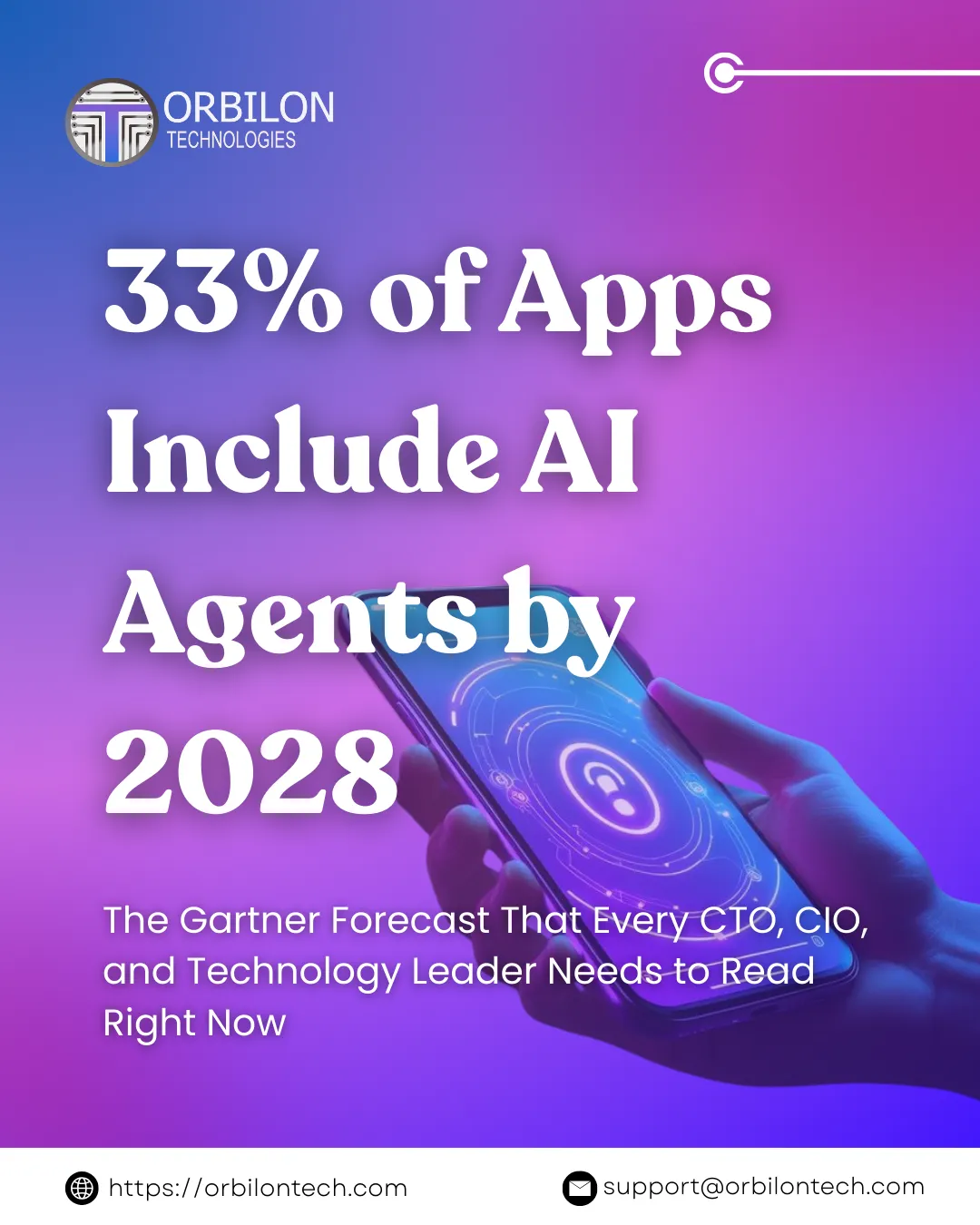
33% of Enterprise Apps Will Include AI Agents by 2028—Here's Your Roadmap to Get Ready
Introduction
Gartner Predicts 33% of Enterprise Software to Feature AI Agents by 2028, Here’s How to Prepare. Gartner’s most recent forecast reveals that by 2028, one-third of enterprise software applications will be equipped with agentic AI, a figure that was less than 1% in 2024. What is even more impressive is the prediction that 15% of the routine work, related decisions will be made without human intervention by agentic AI.
This is not a future that is far offjust three years from now. The question is not if AI agents will transform how businesses operate, but rather if your company will be prepared.
What Are AI Agents Really?
- Autonomous Decision-Making: At no point in time do they seek approval. Provide them with an objective, and they will determine the way to accomplish it.
- Multi-Step Execution: They decompose complex tasks into smaller tasks, perform them one after another, and modify their behavior result, oriented.
- Tool Integration: In doing so, they utilize various systems APIs, databases, and applications without any interruption to collect data and execute their plans. Learning and Adaptation: Over time, they become better through experience, and they also change their methods depending on the results.
- Conventional AI tools are reactive; they respond when instructed. AI agents, on the other hand, are proactive; they monitor, analyze, and execute their decisions on their own.
The Numbers Behind the AI Agent Revolution
- The market for AI agents will grow from $7.38 billion in 2025 to $47.1 billion by 2030 (44.8% CAGR).
- A full 23% of organizations are already scaling agentic AI systems in their enterprises, and 51% of companies are actively using agents in production today.
- McKinsey estimates that AI agents could create up to $450 billion in economic value by 2028.
Real, World Use Cases Delivering ROI
- Customer Service Transformation: Contact centers that implement autonomous agents achieve cost-per-contact reductions of 20, 40%.
- One global e-commerce company automated end-to-end resolution for order tracking, returns, and troubleshoot ingthus handling high volumes without any human intervention. Result: Resolution became faster, quality more consistent, and human agents were freed for complex cases.
- Healthcare Documentation: Healthcare providers who deploy clinical AI agents observe 80% adoption among providers and a 42% reduction in daily documentation time. That is providing healthcare professionals with the necessary time each day to focus more on patient care.
- Financial Services: Banks that utilize AI agents in loan origination are 40% faster in approving loans, while at the same time, they are able to reduce fraud by 35% through real-time verification. The agents perform real-time analysis of millions of data points to identify anomalies that traditional systems overlook.
- Legal Operations: Legal teams assisted by AI agents in contract review achieve up to 90% time reduction; thus, contracts that used to take days for review are now rapidly decided, and lawyers are free to focus on strategic negotiations.
- IT Self, Healing Systems: IT organizations that have implemented self-healing agents achieve a reduction in mean time to resolution by 30- 50%, as agents can detect, diagnose, fix, and verify solutions even before users realize there are problems.
What Industries Are Moving Fastest?
- Technology and SaaS (81% adoption): Automated onboarding, technical support, code review, bug triage, and documentation generation.
- Healthcare (68% high usage): Clinical documentation, patient scheduling, insurance verification, and medical research assistance.
- Financial Services (72% deployment): Fraud detection, risk assessment, compliance monitoring, algorithmic trading.
- Retail and e-commerce (74% planning expansion): Inventory management, personalized recommendations, order processing, supply chain optimization.
- Manufacturing: Procurement automation, quality control, predictive maintenance, supply chain optimization, with reported 25% faster delivery.
The common thread? Industries with high volumes of data, complex workflows, and operations that benefit from intelligent automation are the ones that see the fastest returns.
Your Step-by-Step Implementation Roadmap
To summarize the “Step-by-Step AI Agent Implementation Roadmap” in a more concise manner (but not losing the original meaning):
Phase 1 - Assess & Prioritize (Weeks 1-2)
Initially, start small with replicates of repetitive, high-impact, time-consuming, and error-prone processes. Examples include customer support ticketing, document processing, and approvals. Determine how much of an impact the AI solution could have to help prioritize projects
Phase 2 - Prepare Data & Infrastructure (Weeks 3-6)
- Cleanse, structure, and govern your data.
- Set up secure pipelines, integration points, monitoring processes, and authentication access.
- The solution needs to meet security, compliance, and auditability – no exceptions.
Phase 3 - Build vs Buy (Week 7)
Platform-based solutions typically represent 62% of the AI agent solutions evaluated, as they offer faster time to market with lower risk and pre-built integrations. Custom AI agent solutions, while representing 33% of solution evaluation, offer the opportunity for maximum control, differentiation, and competitive advantage due to their alignment with your unique business processes. The ideal combination is hybrid; utilize platform-based solutions for standard business processes and utilize your own custom AI agent solution for your unique competitive advantages.
Phase 4 - Develop & Test (Weeks 8-14)
Conduct testing of the AI agent in a sandbox environment with numerous ‘real-world’ edge cases. When defining success, consider the number of hours or time saved, the reduction of errors, the cost reduction, customer experience improvement, and productivity improvement. Testing should also include testing scenarios that are not “happy-path” only.
Phase 5 - Pilot (Weeks 15-20)
Conduct a controlled pilot with a selected group of early adopters. Measure the performance metrics of the AI agent with respect to technical performance, business metrics, and user adoption metrics, and refine your solution before moving to a broader release.
Phase 6 - Scale & Optimize (Weeks 21 and ongoing)
When you scale the AI agent solution, do so gradually with proper governance, establish feedback loops, and continue to audit the AI agent. Check for model drift and retrain the AI agent regularly, and continue to invest in change management.
Common Implementation Pitfalls
- Mistake 1: Underestimating Data Preparation Solution: Data cleaning should take 30- 40% of the project timeline and be done thoroughly at the start. Perform quality audits before the development phase.
- Mistake 2: Focusing Only on Cost-Cutting Solution: Efficiency should be balanced with quality, satisfaction, and strategic value. Avoid optimizing solely for headcount reduction.
- Mistake 3: Rushing Testing Solution: Prepare detailed test scenarios. Be ready for 4 to 6 weeks of thorough testing under realistic conditions.
- Mistake 4: Ignoring Change Management Solution: Put resources into training and communication. Make employees understand that agents help their work, not replace it.
- Mistake 5: Treating It as a One-Time Project Solution: From day one, establish feedback loops, regular reviews, and governance processes. Plan a budget for ongoing operations.
Building Trust in AI Agents
- 19% made significant investments in agentic AI.
- 42% made conservative investments.
- 31% were waiting or unsure.
- Transparency: Make agent decisions, making them explainable.
- Appropriate Guardrails: Implement human-in-the-loop checkpoints for high-stakes decisions.
- Demonstrated Reliability: Start with lower-risk use cases and build confidence.
- Clear Limitations: Be honest about what agents can and cannot do.
- Audit Trails: Maintain complete logs for accountability.
- Incremental Autonomy: Increase agent authority gradually as they prove themselves.
Practical Implementation Example: Customer Service AI Agent
The scenario below is an example of a practical approach to implementing a customer support AI agent. A mid-sized e-commerce company has an average of 5,000 customer inquiries each month, of which approximately 60% ask routine questions about their orders, returns, or account management.


Results after 6 months:
After six months, the following results have been achieved:
- 73% of the customer inquiry resolutions have been handled independently by the AI agent, exceeding expectations.
- The average customer inquiry response time has been cut to 30 seconds.
- Customer satisfaction scores have increased by 18%.
- The support team can focus on more complex customer inquiries.
- The cost of handling each customer inquiry has decreased by 42%.
Having a clear plan with dedicated goals allows organizations to successfully implement an AI customer support agent and scale this solution as needed.
The Bottom Line
AI agents are not a concept of the future that is far off; they are the new business infrastructure. As per the projections, by the year 2028, one in every three enterprise applications will be equipped with agentic capabilities, and 15% of the daily work decisions will be made autonomously. The technology is here, ready to be deployed. The market is booming at an exponential rate. Early adopters are already witnessing tangible results. The window of opportunity for competitive advantage is still open, but it won’t be there forever. Your actions this quarter should include:
- Evaluating your organization’s readiness.
- Pinpointing high, value use cases.
- Developing executive understanding and gaining their support.
- Initiating a focused pilot on a small scale.
- Quickly learning from both successes and failures.
Begin with a small scale. Test thoroughly. Keep improving continuously. Move carefully when you decide to scale. But, above all, start now.
The future work
The debate about whether humans or AI are to dominate the future of work is misguided. In fact, the future of work envisions humans collaborating with AI agents, which would carry out routine tasks and free human workers to focus on complex problem-solving, relationship building, strategic thinking, and creative innovation. That future is actually getting here much quicker than anyone had anticipated. Companies that decide to take action right awaycarefully, with a clear strategy, and proper governancewill be the ones to create that future instead of being at its mercy.
The question is quite straightforward: In the era of AI agents, will you be leading or following?
Conclusion
Are you looking at AI agent implementation for your enterprise? At Orbilon Technologies, we help organizations with their AI adoption through custom solutions that fit their needs. Our team is proficient in practical AI implementations that result in measurable business value.
Website: https://orbilontech.com
Email: support@orbilontech.com
We can talk about how AI agents can revolutionize your operations and make you a leader of the 2028 wave.
Want to Hire Us?
Are you ready to turn your ideas into a reality? Hire Orbilon Technologies today and start working right away with qualified resources. We will take care of everything from design, development, security, quality assurance and deployment. We are just a click away.