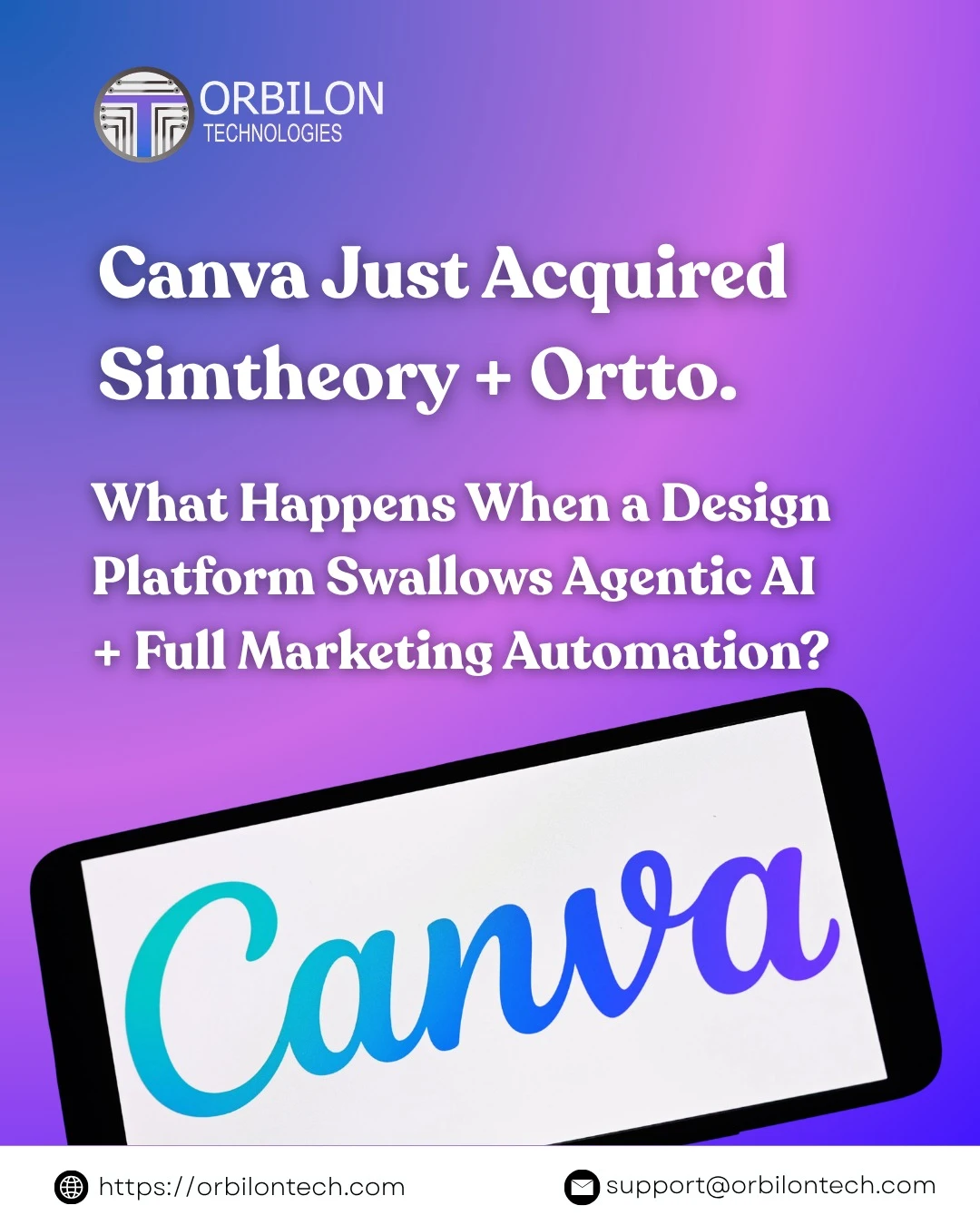
Canva Acquired Simtheory and Ortto: What Happens When a Design Platform Swallows Agentic AI + Full Marketing Automation?
Introduction
On April 8, 2026, Canva made its boldest move yet — and it wasn’t about design templates.
Canva acquired Simtheory and Ortto in a dual deal that brings agentic AI agent management and complete marketing automation into the platform used by 265 million people monthly. Financial terms weren’t disclosed, but the strategic signal is unmistakable: Canva is no longer a design tool. It’s becoming an AI-first work platform where teams ideate, create, publish, measure, and optimize — without ever leaving a single system.
Canva COO Cliff Obrecht put it directly: Simtheory accelerates the evolution “from a design platform with AI tools to an AI platform with design and productivity tools at its core.” That’s not a subtle pivot. That’s a complete identity shift for a company that closed 2025 with $4 billion in annual revenue and 31 million paying subscribers.
Here’s everything about the deal, what each company brings, and what this means for the marketing and AI landscape.
Who Are Simtheory and Ortto?
Both companies were founded by Australian brothers Chris and Mike Sharkey — serial entrepreneurs who previously co-founded Stayz, Australia’s largest holiday rental site, which was sold to Fairfax Digital and later acquired by HomeAway for $225 million. The brothers will join Canva in leadership roles across AI and marketing technology teams.
i. Simtheory: The Agentic AI Layer
Simtheory is an AI workspace and collaboration platform that lets teams build custom AI agents and assistants within their own cloud environments. It’s not a chatbot builder — it’s an agentic AI management platform where teams can deploy agents that execute multi-step tasks across tools autonomously.
Key capabilities include access to leading AI models from OpenAI, Anthropic, and Google, along with integrations that let agents create documents, read emails, adjust CRM records, and manage workflows. Since launching, Simtheory has gained rapid traction among enterprise and government teams exploring AI that goes beyond content generation into actual task execution.
For Canva, Simtheory represents the bridge from “AI helps you design” to “AI does the work for you.” The acquisition lays the groundwork for agentic workflows where a user describes what they need — a full marketing campaign, a localized ad set, a social media rollout — and AI agents plan, create, publish, and optimize the entire thing.
ii. Ortto: The Marketing Automation Engine
Ortto (originally founded as Autopilot in 2015, rebuilt after 2018, rebranded in 2022) is a customer data platform combined with end-to-end marketing automation. It’s trusted by 11,000+ customers across 190 countries.
The platform enables teams to design and orchestrate customer journeys across email, SMS, push notifications, in-app messaging, forms, and surveys. Its event-driven architecture and no-code integrations make it straightforward to connect and activate customer data in real-time — helping marketing teams deliver personalized campaigns at scale without jumping between disconnected tools.
For Canva, Ortto fills the massive gap between “we created the content” and “the content actually reached the right person at the right time, and we know if it worked.”
Why This Deal Changes the Game?
Before: Canva Was a Creation Tool
Canva’s workflow until now: design an asset → export it → upload to your email platform → set up a campaign in a separate automation tool → track performance in yet another analytics dashboard. Five tools, five logins, five data silos.After: Canva Becomes the Entire Marketing Stack
With Simtheory and Ortto integrated, the workflow becomes: describe your campaign → AI agents build the assets, copy, and variations → publish across email, SMS, social, and ads → Ortto’s automation engine handles targeting and timing → analytics measure performance → AI optimizes based on results. One platform. Start to finish. This is the vision Canva has been building toward through an aggressive acquisition spree:| Acquisition | Date | What It Adds |
|---|---|---|
| MagicBrief | January 2025 | Marketing intelligence & ad research |
| MangoAI | February 2026 | AI-driven video ad optimization |
| Cavalry | February 2026 | Animation capabilities |
| Doohly | March 2026 | Digital out-of-home advertising |
| Simtheory | April 2026 | Agentic AI agent management |
| Ortto | April 2026 | Customer data + marketing automation |
What Canva Acquired Simtheory and Ortto Really Means for Each Stakeholder?
- For Marketing Teams: This is potentially the biggest shift since HubSpot consolidated inbound marketing. Marketing teams currently use 8-12 tools on average to run campaigns. If Canva successfully integrates Ortto’s automation and Simtheory’s AI agents into its design interface, teams could consolidate their entire content-to-campaign workflow into a single platform.
- The practical impact: a marketer could create an email campaign visually in Canva, let AI agents handle audience segmentation and personalization using Ortto’s customer data, schedule delivery across email and SMS, and track opens, clicks, and conversions — all without leaving Canva.
- For Designers and Creatives: Canva’s core design product isn’t going away — it’s getting amplified. Simtheory’s AI agents could enable features like “generate 50 localized versions of this ad creative” or “create a complete social media kit from this brand guideline” autonomously. The design canvas becomes the starting point for AI-driven production at scale.
- For Competing Platforms: Adobe, HubSpot, Mailchimp, and Figma should be paying close attention. Canva now has 265 million monthly users, $4 billion in revenue, agentic AI capabilities, and a marketing automation engine — all in one platform with famously accessible UX. No competitor currently offers design + AI agents + marketing automation + customer data in a single tool at this scale.
- For the AI Industry: The acquisition of Simtheory signals that agentic AI is moving from developer-only tools to mainstream business platforms. When a design tool with 265 million users builds agentic workflows into its core product, that’s how AI agents go from “interesting demo” to “thing every marketer uses daily.”
Canva Create
Both Canva and the Sharkey brothers have hinted that the full integration vision will be unveiled at Canva Create on April 16, 2026 — which Canva is calling “the biggest evolution in Canva’s history.” Based on the acquisition timeline, expect to see:
- AI agents that build complete marketing campaigns from a brief.
- Integrated email/SMS automation powered by Ortto within the Canva interface.
- Real-time campaign analytics and optimization loops.
- Multi-channel publishing from a single Canva workspace.
- Agentic workflows that handle repetitive marketing tasks autonomously.
Mike Sharkey, CEO of both Ortto and Simtheory, captured the scale of the opportunity when he said the chance to bring their technology to a quarter of a billion people using Canva every month was what drew them to the deal.
What This Means for Businesses Evaluating Their Marketing Stack?
If you’re currently running separate tools for design (Canva/Figma), email automation (Mailchimp/ActiveCampaign), customer data (Segment/mParticle), and campaign analytics (Google Analytics/Mixpanel) — Canva just signaled that it wants to replace all of them.
That doesn’t mean you should rip and replace today. Ortto’s 40-person team will continue building the standalone product, and deep integrations take time. But for small-to-mid-market teams currently paying for 5+ marketing tools, Canva’s trajectory is clear: one platform, one price, AI-powered from end to end.
For enterprise teams, the question is whether Canva’s integration depth will match specialized tools like Salesforce Marketing Cloud or Adobe Experience Platform. That’s a harder sell — but with $4 billion in revenue and aggressive M&A velocity, Canva has the resources to try.
Conclusion: Design Was Just the Beginning
When Canva acquired Simtheory and Ortto, it didn’t just buy two companies — it bought the missing layers that turn a design canvas into a complete business execution platform. Agentic AI agents that plan and do work. Marketing automation that reaches customers across every channel. Customer data that closes the loop between creation and results.
Canva’s new tagline might as well be: “From idea to outcome.” And with 265 million users already inside the platform, the distribution advantage is enormous. The companies that consolidate fastest — design, AI agents, automation, analytics — into one cohesive workflow will define how the next generation of marketing teams operate.
About Orbilon Technologies
Orbilon Technologies is an AI development agency that builds intelligent marketing and automation systems — including AI agent workflows, marketing automation integrations, and custom AI-powered SaaS platforms. With years of engineering experience and a 4.96 average rating across Clutch, GoodFirms, and Google, we help businesses design and deploy AI systems that power the full marketing lifecycle.
Want to build AI-powered marketing automation for your business? Get a free consultation from our AI engineering team.
- Website: orbilontech.com
- Email: support@orbilontech.com
Want to Hire Us?
Are you ready to turn your ideas into a reality? Hire Orbilon Technologies today and start working right away with qualified resources. We will take care of everything from design, development, security, quality assurance, and deployment. We are just a click away.